

Overview
The company I’m about to highlight is one you’ve probably never heard of — a tiny, under-the-radar auto insurer quietly gaining traction. This nano-cap just posted an underwriting profit, recently earned a financial strength rating upgrade from A.M. Best, and owns three commercial buildings in Washington, D.C. that may be worth more than its entire market cap.
I uncovered this hidden gem the old-fashioned way — by combing through more than 2,500 over-the-counter stocks one by one. If you're the kind of investor who thrives on finding overlooked opportunities before the crowd, consider subscribing (it's free!). Now let’s jump in…
Forge Insurance Group (OTC: FIGP) is a specialty automobile insurer based in Maryland with operations in 17 states. Forge started as Amalgamated Casualty Insurance company in 1938 and originally operated as a taxi insurance specialist in Washington DC and Maryland. Forge Insurance specializes in insuring light vehicles like SUV’s and pickup trucks with local operations. Forge likes to insure vehicles that are used as tools in the business, rather than vehicles that are used as the primary source of revenue such as trucking and last mile delivery. Forge’s target business classes include auto repair shops, tradesmen (such as electricians, plumbers, and carpenters), property managers, and real estate agents to name a few. Forge stays away from insuring businesses where the vehicle is the main tool in the business. These businesses include for-hire trucking, towing, trash hauling, junk removal, moving companies and more. Forge insures cars, SUV’s, pickup trucks, work vans, and specialty trucks under 26,000 pounds.
In 2022, Forge emerged as a public company by completing a $20 million mutual-to-stock conversion stock offering. Forge Insurance stock is illiquid and currently trades over the counter on the pink sheets. Forge is led by Chairman and CEO Patrick Bracewell, who owned roughly 23% of the stock as of December 2024.
Most Recent Financial Results
Forge Group delivered strong results for second quarter and first half of 2025, which was reported on August 1st, 2025. The company is showing clear signs of operational efficiency and scale, with net premiums earned increasing nearly 50% year-over-year in both periods. More importantly, Forge turned the corner on profitability, reporting a second quarter underwriting profit of $518,000 and first half pre-tax operating income of $1 million—up from a $302,000 loss in the prior year period. This improvement reflects management's ability to scale premium revenue while reducing the expense ratio from 51.6% in the first half of 2024 to 41.6% in the first half of 2025. The company’s long-term goal is to be at or below a 35% expense ratio.
Forge’s combined ratio fell to 93.3% in the second quarter and 99.4% in the first half of 2025, both below the critical 100% mark, signaling underwriting profitability. The company’s adjusted book value per share increased to $20.98, up 6.2% year-over-year, while tangible book value per share rose 7.6% to $18.84.
Projected Earnings per Share
I don’t think it’s unrealistic to project that Forge’s normalized earning power per share could be something like $1.00 or more.
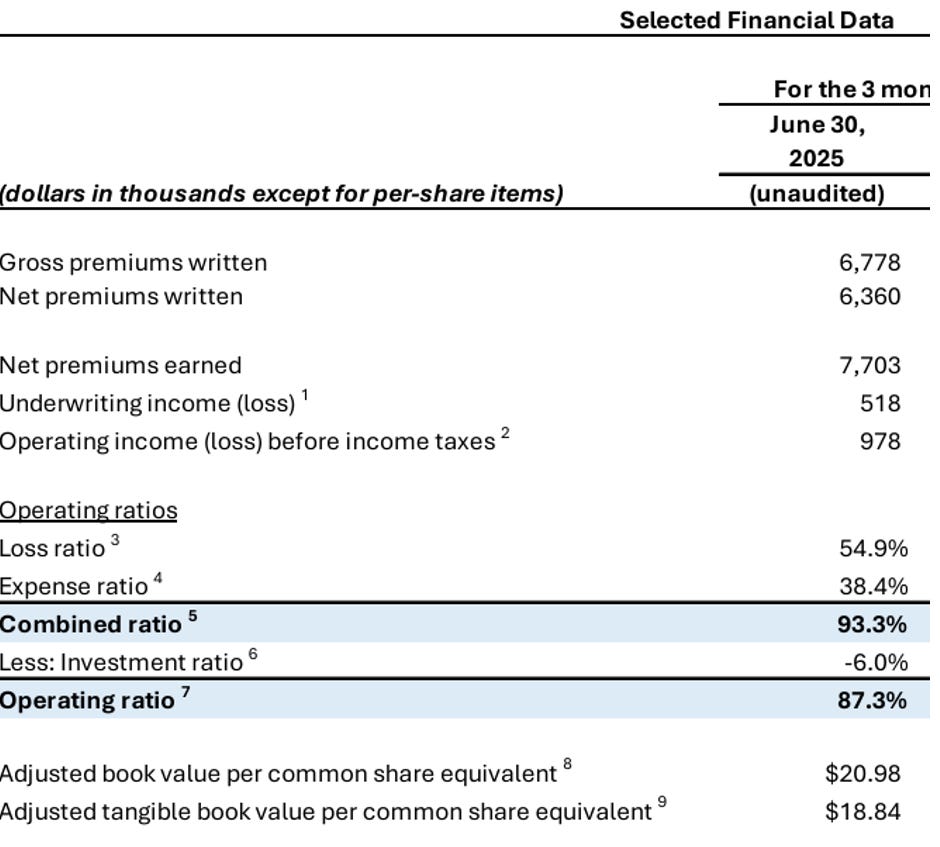
For instance, (as shown above) net premiums earned in the 2nd quarter of 2025 were $7,703,000. Annualizing this figure equates to $30.8 million in net premiums earned. That would be a nearly 40% increase from 2024’s net premiums earned of $22.064 million. A slight decrease in the 50% growth rates from the past few years but not an outlandish figure for a small growing insurance company like Forge. One minus the operating ratio of 87.3% would give us our projected operating income margin of 12.7%. Assuming a federal income tax rate of 21% would leave a net income margin of roughly 10%. 10% of $30.8 million in net premiums earned would equate to net income of about $3,080,000. Forge currently has 2,656,000 fully diluted shares outstanding so that would imply about $1.16 in EPS. At the current share price of $17.25, I am projecting Forge’s price to 2025 EPS of about 14.87. This is roughly in line with much larger insurance companies that are not growing as fast as Forge.
Premium Growth and Declining Expenses
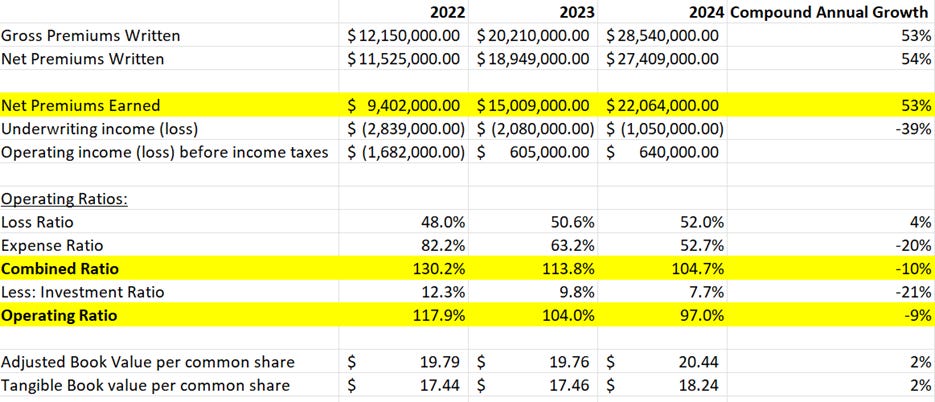
From 2022 – 2024, Forge’s net premiums earned grew by roughly 53% annually and the expense ratio has fallen from 82.2% in 2022 to 52.7% in 2024. A combined ratio of less than 100% indicates an underwriting profit and an operating ratio below 100% indicates profitability with investment income included. Clearly, Forge Group is gaining economies of scale as illustrated by the large decrease in expense ratio. Meanwhile, the loss ratio has only increased by about 4% annually, which is a testament to Forge’s underwriting discipline and only taking on good risks. I would expect Forge’s loss ratios to increase as they continue to add premium volume and expense ratios to continue to decline over the next few years.
For comparison purposes, below are the combined ratios for four other well-known auto insurers.

Recent Upgrade in Financial Strength Rating
A.M. Best recently upgraded Forge’s financial strength rating from B++ (good) to A-, which is excellent. This upgrade in financial strength could unlock new distribution channels previously inaccessible due to rating constraints.
Valuation and Share Repurchases
What’s interesting about Forge Insurance Group is its valuation. It is hard to find a well-run property and casualty insurer that trades for less than book value.
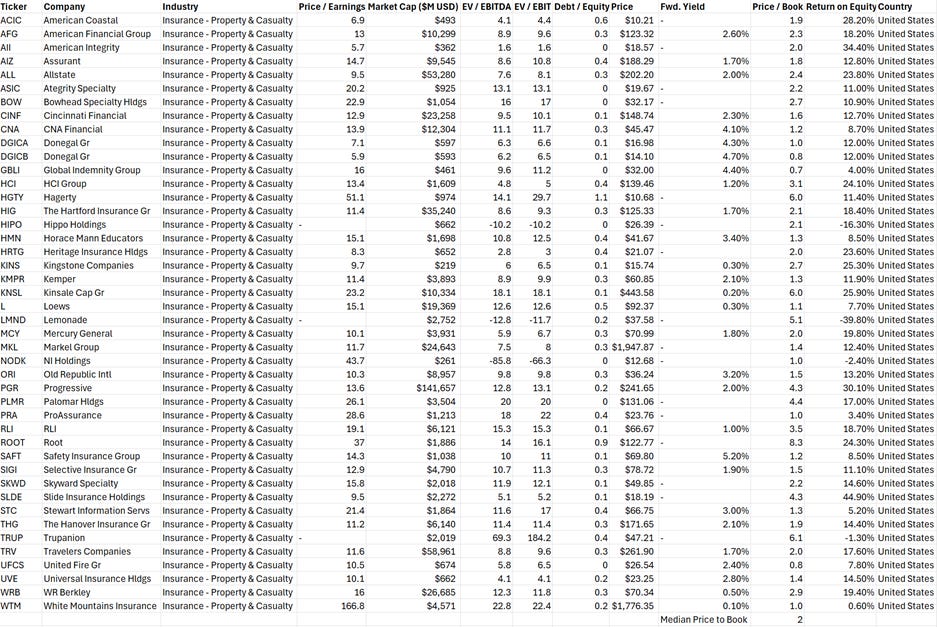
The table above analyzes 44 publicly traded P&C insurers in the United States. Of the 44, only 3 currently trade for less than book value and the median price to book value for the 44 insurers is 2. I think Forge could easily be worth 1.5 – 2x book value in a few years once they fully hit scale and are consistently profitable. That would imply a price range of roughly $31 - $42, or about 80 – 143% upside from the current price of $17.25.
In December 2024, Forge announced that it would repurchase up to $1,000,000 of its stock in 2025.
Real Estate Operations
Forge sold its main office building in 2015 and did a 1031 exchange to defer taxes and used the proceeds to purchase 3 commercial buildings in Washington DC for $40 million. Forge’s current market cap is only $35.4 million.
Forge teamed up with an operating partner to purchase the 3 buildings and currently owns a 92.3% stake in the real estate operations. The company bought the buildings with $10 million in equity and $30 million in non-recourse commercial mortgage debt. Per the 2022 shareholder letter, “The properties we acquired are well situated in the District of Columbia and are occupied by tenants on long-term leases that are largely “triple-net” (i.e., tenant is responsible for various property expenses as well as general property maintenance and upkeep).” This real estate is a hidden asset that could provide substantial value for Forge’s shareholders over the long term. As of December 31, 2024, the properties generated $2,320,000 in annual income.
Takeaways and Risks
Forge is a niche auto insurer that is under the radar due to its small size and lack of liquidity. Forge is a well-run insurer, and the CEO has skin in the game, owning nearly a quarter of the company. After reading through the shareholder letters, Patrick Bracewell has a sound long-term business plan for the company focused on disciplined underwriting, profitable premium growth, and cost discipline. Moreover, the company is executing on its long-term goals. For instance, in the mid-year report in 2022, the company’s expense ratio was at 88.7% and Mr. Bracewell talked about the company’s long-term goal being an expense ratio near 35%. Just three years later, Forge has nearly achieved its goal, having reported an expense ratio at 38.4% for the three months ended June 30th, 2025. Forge is now profitable from an underwriting perspective, having just reported a combined ratio of 93.3% for the second quarter of 2025. Remember that the combined ratio is equal to the loss ratio plus expense ratio. A ratio under 100% indicates an underwriting profit.
It should be noted that Forge is a tiny, illiquid stock and investors wanting to initiate a position should be patient. Forge’s current market cap is only $35.4 million based on the closing price of $17.25, as of August 4th, 2025. Investors should only use limit orders when buying Forge’s stock. The bid/ask spread is wide (currently at a $16 bid and $25 ask), and it may take some time for investors to build a position. Whenever I am trying to buy an illiquid stock, I will often place a limit order at the bid or just above it and buy in little blocks. For instance, if I am wanting to buy 500 shares, I will try to buy 100 shares at a time and slowly accumulate a position. Forge is still very small and does not yet have the scale and brand awareness of the larger insurers. Forge must continue to stay disciplined in underwriting to keep its loss ratios below the competition. As premium volume continues to grow, Forge should continue to see expense ratios decline as economies of scale kick in. For value-oriented investors, Forge represents a microcap with improving fundamentals, a credible management team focused on cost discipline, and growing brand presence in a fragmented market—potentially positioning it for continued profitable growth and multiple expansion.
Full Disclosure:
I own shares in the Forge Group and the stock currently makes up about 5% of my portfolio.