

Today, I wanted to touch on two key topics that don’t get talked about enough in investing - portfolio allocation and risk management.
If you’re an individual investor like me who is trying to outperform the stock market indexes over time, portfolio construction and risk management might actually be more important than the individual stocks you select.
Two books I read that really opened my eyes to the power of concentrated investing were The Warren Buffet Way by Robert Hagstrom and Concentrated Investing by Tobias Carlisle and Allen Benello.
There have been numerous case studies of successful investors that substantially outperformed the market indexes over time by using concentrated value strategies. When you combine value investing with the willingness to concentrate in fewer stocks, your chances of outperforming increase.
But what’s the ideal number of stocks? Is it 5, 10, 20, or 30?
How Many Stocks are “Enough”?
At some point, adding more stocks doesn’t meaningfully reduce risk — it just reduces your ability to be well versed about each stock in your portfolio.
The academic research on this comes from Evans & Archer (1968), who found that most of the benefits of diversification are achieved with roughly 10–15 stocks in a portfolio. Beyond that point, the reduction in unsystematic (company or industry-specific) risk is substantially reduced.
Later research by Meir Statman (1987) suggested that if your goal is to closely approximate the total market’s volatility, you might need closer to 20–30 stocks. But even in that framework, the marginal benefit of adding stock #25 versus stock #10 is very small.
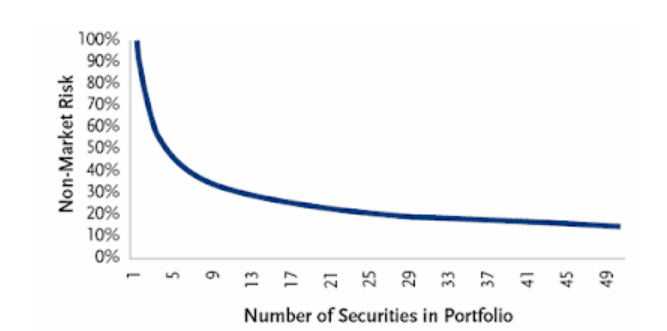
The key insight:
The first few stocks dramatically reduce risk.
The next 5–10 provide moderate additional benefit.
Beyond ~20–25 names, you’re mostly diluting your best ideas rather than lowering volatility in your portfolio. Moreover, you may actually be increasing risk by owning more stocks that you don’t know a lot about.
Warren Buffett is probably the most well-known concentrated value investor. He has said that diversification is protection against ignorance — and that if you truly understand a business, you don’t need 50 of them.
In other words, diversification has diminishing returns.
The deeper question isn’t volatility.
It’s how to intelligently construct a concentrated portfolio that maximizes geometric return. Geometric return is the compounded growth rate in a portfolio and ultimately determines how much wealth an investor accrues over time.
Diversification vs. Concentration
From a Kelly Criterion perspective, capital should be allocated based on expected edge divided by variance.
If you own too few stocks (say 5 or less):
Volatility is usually too high.
Large drawdowns will cause you to react emotionally
You risk permanent impairment because you’re more likely to make emotional decisions. i.e. selling due to short-term price declines
Your geometric (compounding) return can collapse even if arithmetic return is high.
You’re more likely to bail out of a highly concentrated strategy just because large volatility in a few names can rattle even the best investors
But if you own too many stocks:
Your best and highest return ideas get diluted.
Your portfolio will start to look more like the indexes.
You reduce upside more than you reduce downside.
There is an optimal middle ground.
For most investors running high-conviction value portfolios, that number tends to fall somewhere between:
8–20 stocks
Below 8, volatility dominates and you’re probably more likely to let emotion dictate your moves.
Above 20, it becomes harder to know each of your holdings well and returns are likely to be diluted. I’m not saying you can’t do well with a portfolio above 20 stocks, just know that it does become harder to outperform and you may well be diluting your best ideas.
In Margin of Safety, Seth Klarman wrote, “as few as ten to fifteen different holdings usually suffice.”
In the Intelligent Investor, Ben Graham suggested a portfolio size from 10 to 30 different stocks.
In the Warren Buffett Way, Robert Hagstrom did a study where he compared 3,000 portfolios containing 250, 100, 50, and 15 stocks each (over a 10-year period from 1987 - 1996) and found that “with a 250-stock portfolio, you have a one-in-50 (2%) chance of beating the market. With a 15-stock portfolio, your chances increase dramatically, to one in four (25%).”
The key with a highly concentrated portfolio is to set up a system and strategy for yourself that is sustainable and that you will be able to stick with when the inevitable drawdowns and volatility come.
Volatility Drag and Arithmetic vs. Geometric Returns
A helpful way to think about diversification and position count is through the lens of geometric compounding, not just arithmetic returns.
A high-volatility portfolio can post higher average annual returns, but the path matters: large drawdowns create volatility drag, and the recovery math is brutal (a 50% drawdown requires a 100% gain just to get back to even).
That’s why a “boring” lower-volatility portfolio can compound at nearly the same rate over a decade—even if its arithmetic average is lower—because it spends less time climbing out of holes.
Let me pose this scenario: Suppose you have two portfolios and you know what the future returns will be.
Portfolio “A” has an average annual return of 18% while portfolio “B” has an average annual return of 44%.
Portfolio “B” outperforms portfolio “A” in 6 out of 10 years and portfolio “B” has 4 years where the portfolio more than doubles (meaning the portfolio is up more than 100%).
Which one would you invest in?
Most people might logically conclude that portfolio “B” would be more likely to increase your long-term wealth. But what if I told you they both get you to the same place?
You’d actually end up with just as much money investing in portfolio “A” as you would in Portfolio “B”, even though Portfolio B has a much higher average annual rate of return.
Why? Volatility drag crushes geometric rates of return, which is the number that should ultimately matter to an investor.
Here’s how the annual returns look for both portfolios:
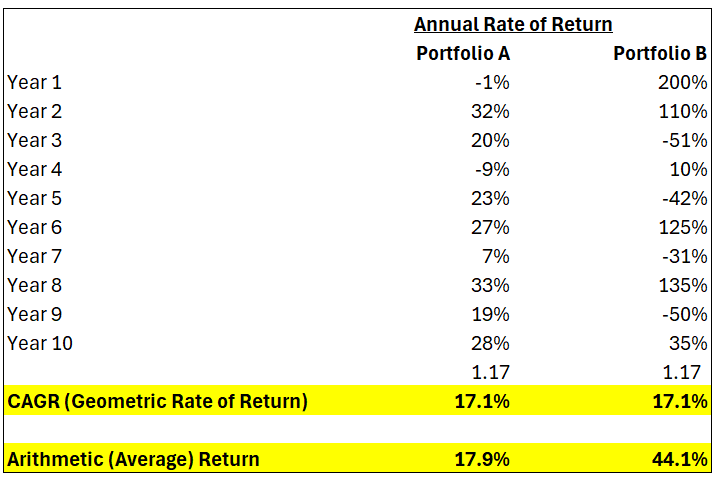
Portfolio “A” has much less volatility drag than portfolio “B”, and surprisingly you end up at the same place with both portfolios.
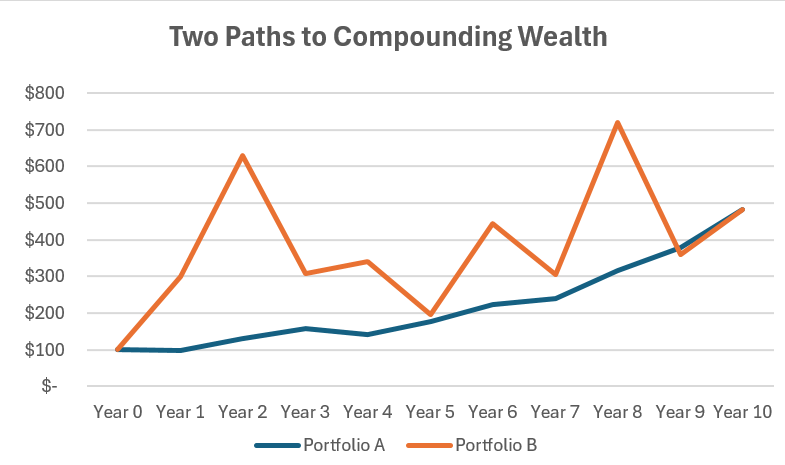
$100 invested in each portfolio grows to roughly $483 at the end of 10 years. It looks like Portfolio “B” is winning throughout most of the decade. But portfolio “A” steadily grows with less volatility, and you ultimately end up at the same place.
You have some big wins in portfolio “B”, and you feel like you are getting richer for a while - especially after the first two years. But inevitably, the markets and your positions move against you, and the ride is much more volatile in portfolio “B”.
Here’s the major key.
You’re much more likely to stay invested in Portfolio “A” for the long-term even though Portfolio “B” appears to offer much higher rates of returns.
If you ask me, I’d rather be invested in Portfolio “A” and that is how I am trying to construct my portfolio.
In case you were wondering, Portfolio “B” is likely a portfolio that is fully invested with 3 - 7 highly correlated stocks and probably includes a couple of micro/small cap stocks. And this track record for such a concentrated portfolio would actually be quite impressive. Many similarly constructed portfolios would probably do well just to keep up with the indexes over time.
Portfolio “A” probably has 10 - 15 stocks with less correlation to the overall market indexes and holds a high cash balance.
How to Effectively Run a Concentrated Portfolio
Here’s what most portfolio construction discussions miss:
If you lower portfolio beta (owning more stable, lower-correlation securities that aren’t as correlated to the broad market indexes), you can often hold fewer names safely.
Simply put, if your portfolio is concentrated in stocks tied to the same industry or macro trend, you should expect large drawdowns when that theme turns. Concentration plus correlation can amplify losses quickly. Imagine being heavily concentrated in software stocks for instance? Some of those portfolios have seen some brutal drawdowns recently.
I mentioned the power of a lower beta portfolio in my writeup: Why I’m Shifting a Portion of My Portfolio Toward Event-Driven Returns.
The Hidden Asset: Cash
Cash is often misunderstood in concentrated portfolios. It isn’t “dead money.” It’s strategic optionality.
In a highly concentrated portfolio, volatility is amplified. That makes dry powder incredibly valuable.
Cash has a beta of zero — it doesn’t decline when markets fall — and that stability becomes powerful when others are forced to sell. During large drawdowns, cash allows you to increase position sizes in your highest-conviction ideas precisely when forward returns are highest.
In that sense, cash isn’t a drag on returns. It’s a volatility buffer and a call option on future mispricing.
The key is discipline: holding cash not because you’re afraid, but because you’re waiting for asymmetric opportunities. In a concentrated strategy, that flexibility can materially improve long-term geometric compounding.
If you own highly cyclical or leveraged names, you may need more positions to avoid catastrophic drawdowns.
Diversification isn’t just about the number of stocks.
It’s about:
Correlation
Balance sheet risk
Business quality
Earnings/cash flow stability
Position sizing discipline
Specific Position Sizing
For specific position sizing, I usually start with a 3–7% position for most securities I buy. If I have high conviction in an idea, I may scale it up to 15% - 20%, but it has to be a very special opportunity with asymmetric upside, balance sheet strength, and a clear margin of safety. Those are rare.
I’ve found that the better approach is to start small and scale into the position gradually. This gives you time to build real conviction through ongoing research, listening to earnings calls, and enables you to be better able to handle short-term price volatility. It also prevents oversizing too early — which can trigger emotional decision-making if the stock declines shortly after purchase.
Position sizing is ultimately a risk-management decision, not just a conviction statement. A position should be large enough to matter if you’re right, but small enough that you can think clearly if you’re temporarily wrong. Gradual scaling allows the weight of the position to be earned through evidence, not enthusiasm and short-term emotions.
Over time, the portfolio naturally concentrates in your best-performing and highest-conviction ideas — but it does so deliberately, not impulsively.
What Actually Matters
Beyond 20–25 stocks, diversification mostly protects you from being wrong — but it also caps your returns when you’re right.
Warren Buffett once said diversification is protection against ignorance. That statement is often misunderstood. It doesn’t mean concentration is always superior — it means that diversification has diminishing marginal benefit once you understand what you own.
The goal isn’t to minimize volatility.
The goal is to maximize long-term geometric compounding while surviving inevitable drawdowns.
That usually requires:
Enough stocks to eliminate single-company risk
But few enough to let your best ideas matter
For most serious investors, that sweet spot is far smaller than Wall Street and most financial advisors would have you believe.
Agree with you and the literature. Nice post. There is a neat page on this in Chris Mayer’s 100-bagger book which I would love to see updated, in which he lists our the top 6/8 hedge fund managers by performance or size and highlights they all owned … 8-10 individual stocks.
Very good post! I really liked both the points about the number of stocks and the difference between arithmetic and geometric returns. The graph and examples are excellent, too! I think the points you make are very thought-provoking (saved and will re-read this post later).
Personally, I hold nine stocks, mostly deep value, and they all have net cash. Many of them are non-cyclical and most of them have non-cyclical elements. Reading your post has confirmed my view that it could be a good choice.
Regarding cash as a holding. I agree in principle. But in practice, I am quite bad at knowing when to use cash. It almost becomes a distraction (not being fully invested) and I think too much what to do with the cash holding. Beeing (almost) fully invested all the time works for me in terms of focus. Not optimal, but it's simple!