

As many readers know, I typically focus on small and microcap value stocks. In my experience, that’s where market inefficiencies tend to be greatest and where patient investors can occasionally find mispriced securities.
That said, I’m a value investor first and a small-cap investor second. I care far more about the price I’m paying relative to intrinsic value than I do about market capitalization. Whether a company is worth $10 million or $100 billion is secondary to whether it offers an attractive risk-adjusted return.
I simply tend to find more opportunities in smaller names.
But every so often, the market serves up an interesting situation in large caps.
Today, I’ll be sharing my thoughts on Adobe.
Over the past few years, Adobe’s stock has been significantly pressured by fears of AI-driven disruption. Adobe’s stock is down more than 60% from its high, which peaked near $700 per share in late 2021.
The market appears to be pricing in a future where Adobe’s revenue growth slows materially, and margins compress due to increasing competition from generative AI tools.
That’s the core of the bear case.
The market also appears to be assuming that AI will materially disrupt Adobe’s business model — perhaps even permanently impair it. To justify selling a wide-moat, 30%+ operating margin compounder at ~14x earnings, you essentially have to believe that revenue growth will stall or reverse over the long haul.
The bull case, however, is equally straightforward: Adobe remains the dominant leader in creative software, with an estimated ~70%+ share in many of its core categories and is now trading at a valuation that looks more like a cyclical value stock than a wide-moat software franchise.
After stripping away the noise, what investors are left with is a highly profitable, capital-light business with strong competitive advantages — available at a large discount to fair value.
To be clear, there is no shortage of analysis on Adobe. I’m not claiming to offer unique information. My goal here is simply to provide a clear, rational overview of the business, the valuation, and the key risks — and to explain what I believe the company is worth under reasonable assumptions.
In the sections that follow, I’ll walk through Adobe’s core products, valuation framework, and why I think the market is overreacting.
Overview of Adobe’s Business
Adobe generates most of its revenue from its Digital Media segment, which accounts for roughly 75% of total revenue.
Digital Experience represents the remaining ~25%. Digital Media houses Adobe’s core creative and document franchises — the foundation of the business.
Digital Media (75% of revenue)
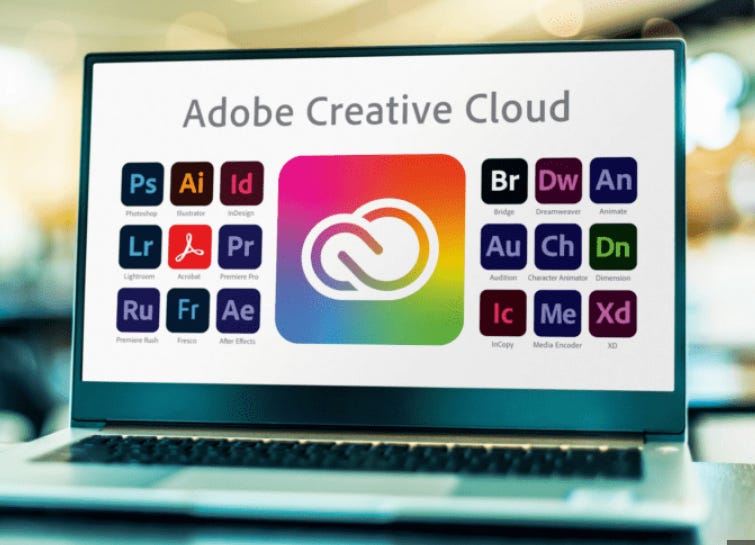
At the center of Adobe’s product offering is Creative Cloud, a subscription-based ecosystem of professional creative tools used across photography, design, video, and 3D. Key applications include:
Photoshop – industry-standard digital imaging and photo editor
Illustrator – vector graphics and logo/brand design
Premiere Pro – professional video editing
After Effects – motion graphics and visual effects
Lightroom – cloud-based photography workflow
These apps are integrated throughout Adobe’s cloud platform, enabling seamless asset sharing, collaboration, and cross-application workflows.
These apps are also used with Adobe Firefly, Adobe’s commercially safe generative AI models, powering features like generative fill, text-to-image, vector generation, and AI-assisted editing.
Adobe is also the creator of the PDF, monetized through its Acrobat family of products:
Acrobat Pro / Standard – full-featured PDF creation, editing, security, and e-signature tools
Acrobat Reader – free PDF viewing platform with massive global distribution
Acrobat has evolved into a full document productivity platform, now enhanced with AI-powered document summarization, Q&A, and workflow automation. Given the widespread use and necessity of PDFs in legal, corporate, and government workflows, this franchise is deeply embedded and mission critical.
Digital Experience (≈25% of revenue)
Digital Experience includes Adobe’s enterprise marketing and customer experience tools, such as Adobe Experience Platform, Experience Manager, Analytics, Commerce, Marketo, and GenStudio. These products help enterprises manage content, data, and personalized digital marketing at scale. In short, Adobe combines a dominant creative software ecosystem and a mission-critical global document standard — both built on recurring subscription revenue — with a growing enterprise marketing platform layered on top.
Recent Fiscal Year 2025 Results
Adobe is cheap, currently trading at only ~11x price to free cash flow and roughly 15x price to earnings.
You’d think a company priced at those kinds of value multiples would be seeing a slowdown in growth, but Adobe just delivered another record year.
For fiscal 2025 (ending November 28, 2025), the company generated $23.77 billion in revenue, representing 11% year-over-year growth. For a company already approaching a $25 billion revenue base, double-digit growth is notable.
Here’s a snapshot of the full-year results:
FY2025 Financial Highlights
Revenue: $23.77 billion (+11% YoY)
GAAP EPS: $16.70 (+35% YoY)
Non-GAAP EPS: $20.94 (+13.7% YoY)
GAAP Operating Income: $8.71 billion (+29% YoY)
Non-GAAP Operating Income: $10.99 billion (+10% YoY)
Operating Cash Flow: $10.03 billion (record)
Free Cash Flow: $9.85 billion
Ending Annual Recurring Revenue (ARR): $25.20 billion (+11.5% YoY)
Share Repurchases: ~30.8 million shares during the year, which was over 6% of total shares outstanding
From a segment perspective:
Digital Media revenue: $17.65 billion (+11%)
Digital Experience revenue: $5.86 billion (+9%)
A few things stand out.
First, Adobe remains a highly profitable, cash-generative business. Nearly $10 billion in free cash flow on $23.8 billion in revenue implies exceptional margins for a company investing heavily in AI and product development.
Second, ARR growth of 11.5% suggests the subscription engine remains healthy despite persistent AI disruption fears.
Third, management continues to return capital meaningfully via buybacks, reducing the share count by repurchasing nearly 31 million shares during the year.
In short, FY2025 shows a company still compounding at double-digit rates, generating enormous cash flow, and maintaining strong operating leverage — even as the market debates whether AI will erode its moat or strengthen it.
Valuation
I’ll keep this section brief since valuation is subjective and there are a number of possible valuation outcomes. I think Adobe is probably worth somewhere in the range of $450 - $600 per share.
Below is the math:
In 2025, Adobe generated roughly $7.91 billion in free cash flow after backing out stock-based comp. For tech companies like Adobe with stock-based compensation, it’s prudent to remove the stock-based compensation since it is a real transfer of cash from shareholders to employees.
That is roughly $18.52 per share in free cash flow less stock-based comp. Capitalizing $18.52 per share by 4% would put the fair value around $463. I think this is conservative since the 10-year treasury yield is around 4% today. This analysis assumes a 9% cost of equity and 5% growth rate. If a 3% discount rate is assumed, then fair value is roughly $617 per share.
Also consider that Adobe has compounded EPS growth by roughly 30% annually for last 10 years. I am not assuming that growth rate moving forward but let’s be conservative and just say they could do just 10%. If they can grow EPS by 10% annually over the next 5 years and the market puts a modest 20x multiple on earnings, then that would imply a price of roughly $538 per share. For some historical context, Adobe’s average P/E has been in the 40 - 50x range over the last 10 years.
What Kills the Bear Thesis?
The market appears to be assuming that AI will materially disrupt Adobe’s business model — perhaps even permanently impair it. To justify selling a wide-moat, 30%+ operating margin compounder at ~14x earnings, you essentially have to believe that revenue growth will stall or reverse over the long haul.
That’s a very strong claim.
Here’s what I believe undermines that thesis.
1. Commercially Safe, IP-Protected AI
One of Adobe’s most underappreciated competitive advantages is that its AI models are trained on licensed and public-domain data. That matters a lot.
Large corporations cannot risk copyright litigation. They cannot build global advertising campaigns on content that might later be challenged in court. Adobe’s positioning as a commercially safe AI platform — with IP indemnification for enterprise customers — is a structural advantage.
In other words, Adobe isn’t just selling AI tools. It’s selling enterprise-grade, legally defensible AI. That’s a very different product than a generic text-to-image generator.
For corporations that need to protect brand assets and proprietary content, that trust layer is mission critical.
2. The Platform, Not Just the Model
The bear case assumes that generative AI commoditizes creation.
But Adobe isn’t just a model provider. It’s an integrated workflow platform.
Photoshop, Illustrator, Premiere Pro, After Effects — these aren’t standalone tools. They are deeply embedded into corporate creative pipelines. Assets are stored in Creative Cloud libraries. Teams collaborate inside the ecosystem. Files move seamlessly across apps. Billing, permissions, version control, and enterprise compliance are built in.
AI becomes another feature inside that workflow — not a substitute for it.
Even if OpenAI, Google, or another player builds a powerful model, replicating the full production environment — including Adobe’s unique, feature rich software that professionals are trained on — would likely take years.
Creative professionals aren’t just prompting images. They’re color grading, compositing, editing timelines, managing layers, exporting to specific formats, and integrating into marketing automation systems.
That stack is incredibly sticky.
3. Switching Costs Are Real
Most Adobe users are professionals inside corporations or agencies. They’ve spent years mastering these tools. Companies have standardized workflows on Adobe across teams and geographies. Training, certifications, templates, brand assets, and workflow documentation are all built around the software suite and application stack.
Switching isn’t just about downloading a new app. It means retraining employees, migrating assets, reworking processes, and accepting productivity loss.
The pain of switching would have to be worth it.
So far, it isn’t.
4. Big Tech Is Partnering — Not Attacking
It’s also worth noting that firms like Google and OpenAI are partnering with Adobe — integrating models into its ecosystem — rather than launching a full-frontal assault on Creative Cloud.
If the goal were to replace Adobe, building distribution through Adobe’s platform wouldn’t make much strategic sense.
The more likely interpretation is that Adobe is becoming a distribution layer for AI — a control panel where enterprise users can access multiple models safely within a familiar workflow.
That strengthens the moat rather than weakens it.
5. Financial Reality vs. Narrative
Perhaps the most important point: the numbers do not reflect collapse.
Revenue is still growing double digits. ARR is growing double digits. Operating margins remain world-class. Free cash flow is nearing $10 billion annually.
The bear thesis requires deterioration.
So far, the business is compounding.
Risks and Takeaway
When you step back, the debate around Adobe comes down to one question: does AI undermine the company’s business model — or does it strengthen and extend an already fortress-like moat?
Adobe’s current valuation suggests the market is leaning toward disruption. Yet the underlying business continues to grow double digits, generate over $10 billion in annual operating cash flow, and maintains exceptional margins.
Adobe owns the creative workflow inside enterprises. It controls the PDF standard. It offers commercially safe AI in a world where IP risk matters. And it is integrating third-party models rather than being displaced by them.
That said, risks are real. AI could compress pricing if creation tools become commoditized. Lower-end creators may shift to free or lightweight alternatives.
Two competitors worth mentioning are Figma and Canva. Both have built impressive, cloud-native design platforms that are intuitive, collaborative, and easier to learn than traditional Adobe tools.
Canva, in particular, has gained enormous traction among individuals, small businesses, educators, and social media marketers who don’t need the full power of Photoshop or Illustrator. Figma has become popular for UI/UX design teams because of its real-time browser-based collaboration.
The risk is that as these tools improve — especially with AI layered in — they could continue moving upmarket and capture lighter-use cases that historically defaulted to Adobe. If enough users decide that “good enough” is sufficient, Adobe could see slower seat expansion at the low end.
That said, today both Figma and Canva tend to skew toward individuals, startups, and smaller teams. Large enterprises with complex brand standards, advanced production workflows, and cross-application needs still tend to rely on Adobe’s deeper functionality and integrated ecosystem. The competitive pressure is real — but at this stage, it appears more incremental than existential.
If Adobe fails to innovate fast enough, the moat could narrow over time. That’s the bear case. At current prices, the bear case seems to be fully priced in.
As of today, Adobe’s strong financials paint a different picture than the AI driven disruption the market is assuming.
If AI expands content creation rather than replaces professional workflows, Adobe may look less like a disrupted incumbent and more like the operating system of the AI-powered creative economy.
The market is pricing in fear.
The numbers, so far, are pricing in strength.
Do you think the market’s refusal to reward Adobe’s record guidance—trading it at a "cyclical value" multiple despite 45% operating margins is a sign that investors have permanently decoupled Adobe from the "Big Tech" cohort, or is this just a classic case of price action lagging behind the actual arrival of AI-driven earnings?
I’ve subscribed and would be happy to support each other. :)
Jorrit