

I last wrote about Adobe back in February and wanted to circle back to the company since I believe it could offer one of the better risk/reward setups among large cap value stocks.
Adobe has been one of the most polarizing stocks over the last year and seems to be the poster child for the AI disruption fears.
All the while, the company has been reporting strong financial numbers, and I believe the company has been taking the right steps to defend its market position in the age of AI.
There’s a lot of noise and market narratives surrounding Adobe, so my goal is to analyze the facts and let you decide if the market is right or wrong pricing a historically dominant software franchise at a historically low earnings multiple.

Contents
The Investment Thesis in Brief
Valuation: Adobe trades at approximately 11.7 times my estimate of normalized owner’s earnings, a substantial discount to its historical valuation.
Competitive moat: Adobe benefits from deeply entrenched professional workflows, industry-standard file formats, and high enterprise switching costs.
AI disruption: Generative AI threatens traditional creative software, but could also expand Adobe’s addressable market and create new monetization opportunities.
Financial performance: Despite concerns about AI, Adobe continues to deliver double-digit revenue growth, strong free cash flow, and aggressive share repurchases.
Expected returns: My base case suggests approximately 13–14% annualized returns over the next five years, with higher returns possible if Adobe successfully adapts to AI and AI ultimately strengthens their moat.
Biggest risk: AI-native competitors gradually erode Adobe’s pricing power and permanently impair its earning capacity.
Introduction: A Great Business at a Historically Low Valuation
Adobe has been one of the most dominant software franchises in the market over the last few decades. The company has historically been priced at a 30 - 50x earnings multiple.
For years, Adobe generated sticky, high recurring revenue growth, high margins and strong free cash flows.
While the ARR growth rates have decelerated slightly, Adobe still generates strong recurring revenues, high margins, and free cash flows. Over time, Adobe’s operating margins have expanded due to operating leverage and Adobe’s ROIC has been in the 30 - 40% range for much of the last 10 years.
Obviously, the market is forward looking and is pricing Adobe as if its historically strong earning power will be diminished in the future. While growth may slow and the market may never assign Adobe another 30x+ multiple, Adobe still possesses very high switching costs for its large enterprise customers and is the de facto gold standard for creative software.
Adobe now trades at ~11.7x my estimate of owner’s earnings (free cash flow less stock-based comp), which seems much too low for a business of this caliber. Other than a slight deceleration in ARR growth, the market is pricing in a level of deterioration that has not yet appeared in Adobe’s reported financial results.
The investment thesis does not require Adobe to dominate AI development; it requires the company to preserve and monetize its professional creative workflows. In fact, I would argue that even if Adobe long-term competitive moat is slowly weakened by AI disruption, investors have a margin of safety in the stock at current prices.
Understanding Adobe’s Business
Adobe generates most of its revenue from its Digital Media segment, which accounts for roughly 75% of total revenue. This segment includes well-known Adobe products such as Photoshop, Premier Pro, After Effects, Illustrator, and Lightroom.
Digital Experience represents the remaining ~25%. Digital Media consists of Adobe’s core creative and document franchises. Digital Experience includes Adobe’s enterprise marketing and customer experience tools, such as Adobe Experience Platform, Experience Manager, Analytics, Commerce, Marketo, and GenStudio.
These apps are also used with Adobe Firefly, Adobe’s commercially safe generative AI models, powering features like generative fill, text-to-image, vector generation, and AI-assisted editing.
Adobe is also the creator of the PDF, monetized through its Acrobat family of products:
Acrobat Pro / Standard – full-featured PDF creation, editing, security, and e-signature tools
Acrobat Reader – free PDF viewing platform with massive global distribution
Acrobat has evolved into a full document productivity platform, now enhanced with AI-powered document summarization, Q&A, and workflow automation. Given the widespread use and necessity of PDFs in legal, corporate, and government workflows, this franchise is deeply embedded and mission critical.
Adobe’s Competitive Moat
Switching Costs
I think it’s easy for some investors to underestimate how strong Adobe’s competitive moat still is. Most creative professionals and designers have spent years using Adobe’s products like Photoshop.
Most people can learn the very basics in a few weeks or months. However, true professional mastery of these products can often take several years of using the product full-time.
A graphic designer who has used Photoshop, Illustrator and Premier Pro for 15 years isn’t likely to switch merely to save a few hundred dollars on an annual subscription.
Now consider a marketing team of hundreds of creators in a large enterprise.
When considering large enterprise accounts, these switching costs become even stronger because instead of a few users, these accounts may have hundreds of creative professionals.
Switching involves retraining, productivity losses, converting project files, replacing plugins, and adapting workflows. Replacing Creative Cloud is more than just cancelling subscriptions. It would affect employees, clients, contractors, templates and production processes.
Industry-Standard Formats and Workflows
Adobe’s proprietary file formats, including PSD, AI, and INDD, have become industry standards, creating another layer of switching costs. Professional designers often spend years developing familiarity with keyboard shortcuts, tools, and workflows that make them highly efficient.
Moving to competing software would require not only learning a new platform but also potentially sacrificing compatibility with existing projects.
Exporting files to more universal formats can result in the loss of editable layers, vector elements, and other functionality, while accessing legacy projects may become more difficult without Adobe’s software.
Perhaps more importantly, clients, agencies, and collaborators frequently expect files in Adobe-compatible formats. For professionals whose livelihoods depend on seamless collaboration and meeting client requirements, switching to alternative software introduces unnecessary friction and potentially jeopardizes business relationships.
The AI Disruption Thesis: Let’s First Address the Bear Case
The bear thesis with Adobe is that AI native applications will slowly erode Adobe’s competitive moat and growth rates over time. To value a stock like Adobe near a 10x earnings multiple, you have to assume that the future earnings power and growth is structurally impaired.
I think the market is overreacting to the AI disruption fears but let’s examine the bear case.
Commoditization of Creative Work
The prevailing market narrative surrounding Adobe is that artificial intelligence will disrupt its business model by changing how creators interact with its software.
Investors are concerned that AI applications such as ChatGPT, Claude, and Google Gemini will eventually replicate much of the functionality offered by Adobe’s products, calling into question the company’s long-term competitive position and earning power.
Tools developed by OpenAI, Google, and Anthropic can already generate sophisticated images and videos, while increasingly performing editing tasks that historically required skilled designers using applications like Photoshop, Illustrator, and Premiere Pro.
As these AI tools become more capable, the technical expertise required to produce professional-quality creative content could decline substantially.
This threatens one of Adobe’s most important competitive advantages: the steep learning curve and high switching costs associated with its software ecosystem.
Furthermore, if businesses can accomplish the same amount of creative work with fewer employees, demand for traditional Creative Cloud subscriptions could come under pressure. Combined with the emergence of increasingly capable, low-cost alternatives, this raises legitimate questions about Adobe’s ability to maintain its historical pricing power and profit margins.
Seat Compression
AI will undoubtedly make marketing departments more efficient, potentially reducing the number of employees required to produce the same amount of work.
For example, tasks that once required a team of ten people might eventually be accomplished by five or fewer. For Adobe, this creates the risk of seat compression, as businesses may need fewer Creative Cloud subscriptions to accomplish the same objectives.
The counterargument is that while AI could reduce the number of paid seats, it could also dramatically increase the volume of digital content being produced.
As the cost and time required to create marketing materials decline, businesses may produce significantly more advertisements, videos, images, and other digital assets.
Adobe could potentially capture this increased activity by shifting more of its monetization toward consumption-based pricing, generative AI credits, and automated workflows rather than relying primarily on traditional per-seat subscriptions.
In other words, AI could reduce the number of people creating content while substantially increasing the amount of content being created.
AI-Native Competitors
There is also the risk that a marketing team could use AI tools like Claude or ChatGPT to vibe-code a simplified version of Photoshop, potentially replicating many of the functions currently performed using Adobe’s products.
However, I think this risk is somewhat overblown, particularly when it comes to professional users and large enterprises. Even if a company could develop a competing application that was just good enough for many everyday tasks, replacing Adobe’s software is considerably more difficult than just building an application.
Businesses rely on Adobe’s proprietary file formats, plugins, integrations, and collaborative workflows. A competing application would need to offer reliable compatibility with existing Adobe files and production processes, particularly when working with outside agencies, clients, and other creative professionals. Even relatively minor compatibility issues could create significant friction.
Replicating Adobe’s software is one thing. Replacing Adobe’s entire ecosystem is another matter - and would be extraordinarily difficult to do.
While AI may make it increasingly easy to build a capable image or video editor, convincing millions of professionals and businesses to abandon deeply entrenched workflows is a much more difficult proposition.
Pricing Pressure
If AI dramatically reduces the skill required to create professional content, customers may become less willing to pay premium subscription prices.
The market seems to be pricing Adobe stock based on some fears of future pricing pressure. Jason Lemkin at SaaStr has some interesting viewpoints on this risk.
Among casual creators, freelancers, and smaller businesses, increasingly capable and inexpensive alternatives such as Canva, Affinity, and AI-native tools are beginning to constrain Adobe’s ability to raise prices.
While the decision to emphasize freemium adoption could ultimately expand Adobe’s customer base, Lemkin believes it also reflects a defensive response to growing competition. I think his argument has merit. Adobe’s competitive advantages remain formidable among professional users, but investors should not assume that its historical pricing power extends equally across every customer segment.
Why AI Could Actually Strengthen Adobe’s Moat
Firefly and AI Integration
Adobe Firefly is Adobe’s generative AI platform, allowing users to generate and edit images, videos, and audio using natural-language prompts. Adobe has integrated these capabilities into applications such as Photoshop, Illustrator, and Premiere Pro, enabling professionals to incorporate AI directly into their existing workflows.
One of the more interesting aspects of AI is its ability to dramatically reduce the learning curve associated with Adobe’s software. Historically, mastering applications like Photoshop or Illustrator required considerable time and effort. AI increasingly allows users to accomplish complicated tasks simply by describing what they want to achieve.
At first glance, this could be viewed as a threat to Adobe’s competitive moat, as it may also make competing software easier to use.
However, I believe lowering the learning curve could ultimately be a net benefit for Adobe. Making its applications more accessible could attract millions of new users, while allowing existing customers to become significantly more productive.
Commercially Safe AI
Another compelling argument in Adobe’s favor is its emphasis on commercially safe generative AI. While marketing departments can use alternatives like ChatGPT and Claude to generate creative assets, doing so can introduce uncertainty surrounding intellectual property rights and potential copyright infringement.
Adobe seeks to address these concerns by training its Firefly models on licensed content, including assets from its extensive Adobe Stock library, as well as public-domain material. Furthermore, Adobe offers intellectual property indemnification for eligible enterprise customers using qualifying Firefly-generated content, providing an additional layer of protection against certain copyright claims.
For large enterprises producing thousands of marketing assets across multiple brands and markets, this legal certainty could represent a meaningful competitive advantage. As AI-generated content becomes increasingly prevalent in commercial applications, Adobe’s focus on intellectual property protection and enterprise trust could help differentiate its offerings from competing platforms.
Distribution Through ChatGPT, Claude, and Gemini
One of the more encouraging developments in Adobe’s AI strategy is its expanding integration with leading AI platforms, including ChatGPT and Google’s Gemini ecosystem.
Adobe has also expanded its relationship with Google, bringing its creative capabilities into Gemini and other Google products. Meanwhile, Adobe’s support for third-party AI agents and open standards such as Model Context Protocol (MCP) creates opportunities for assistants like Anthropic’s Claude to interact with Adobe’s applications.
I believe these developments are strategically important for several reasons:
Massive distribution opportunity: ChatGPT, Claude, and Gemini collectively reach hundreds of millions of users, many of whom have little experience with Adobe’s professional software. Making Adobe’s capabilities accessible through AI assistants could introduce its products to an entirely new audience.
Lower barriers to entry: Users can increasingly accomplish creative tasks through simple text prompts rather than learning complicated software interfaces. Someone might initially use Adobe’s tools to edit a photograph or create an advertisement, eventually becoming a paying Creative Cloud customer as their needs become more sophisticated.
Adapting to changing workflows: If conversational AI becomes the primary way people interact with software, Adobe risks losing its direct relationship with customers. By integrating with AI assistants, Adobe can remain relevant even if users spend less time inside its traditional applications.
A model-agnostic strategy: Adobe doesn’t need to develop the world’s best AI models. Instead, it can integrate third-party models while retaining the professional editing tools, file compatibility, and workflows required to turn AI-generated content into finished products.
There are legitimate risks. By distributing its capabilities through third-party platforms, Adobe potentially gives up some control over the customer relationship.
Nevertheless, I view this strategy positively. Rather than attempting to compete directly with OpenAI, Google, and Anthropic, Adobe is positioning itself to benefit from their growing ecosystems.
The bull case is that Adobe remains an essential creative production platform even as AI assistants fundamentally change how people interact with software.
Financial Performance and Owner’s Earnings
With all the AI disruption fears and negative sentiment surrounding Adobe, it’s easy to forget that this was and still is one of the most dominant software companies in the world with top tier profit margins, cash flows, and revenue growth.
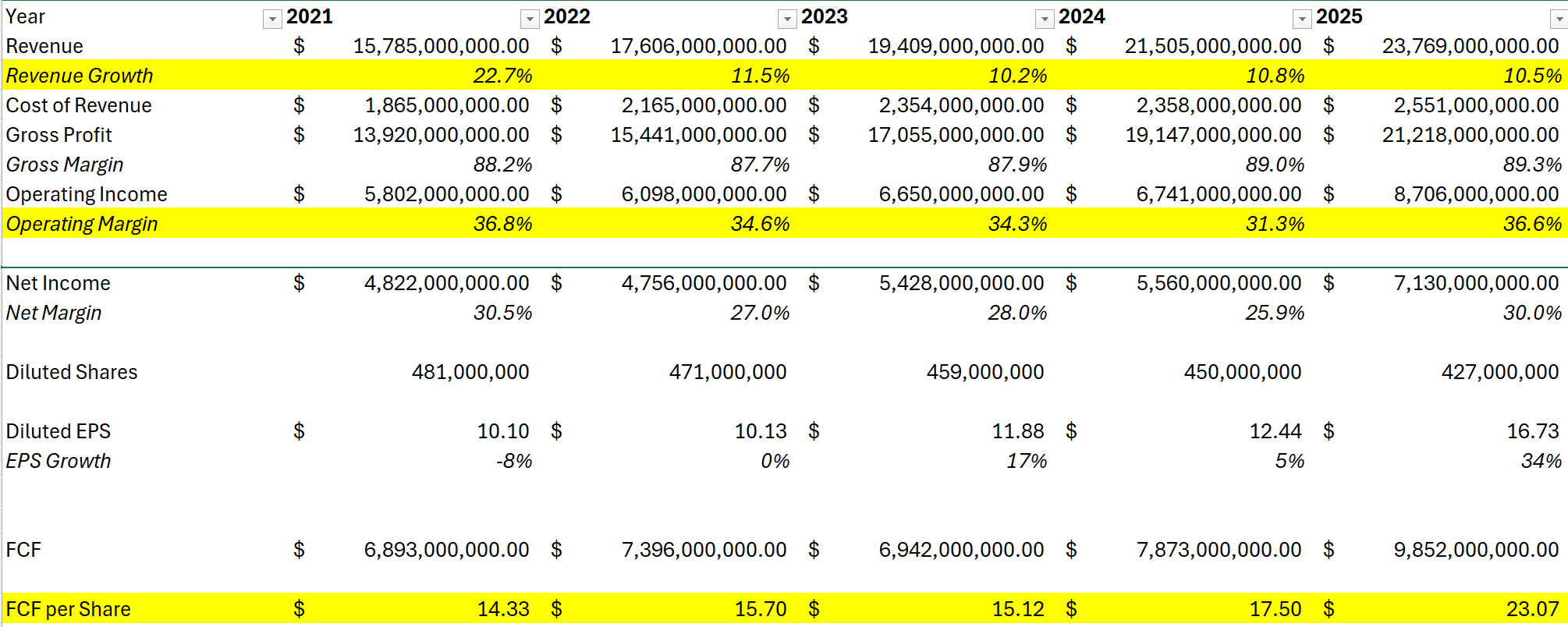
5-year Revenue CAGR: 13%
5-year Free Cash Flow per Share CAGR: 16%
Annual share count reduction: -2.5%
Average EBIT Margin: 34.7%
5-year Median ROE: ~34%
Recent Results
Adobe reported 3rd quarter results in early September and the numbers were strong.
Despite concerns about AI disruption, Adobe’s underlying business continues to perform well. Highlights from its third-quarter fiscal 2026 earnings report include:
Revenue: Record quarterly revenue of $6.76 billion, up 13% year over year.
Creative & Marketing Professionals: Subscription revenue increased 13% to $4.65 billion.
Business Professionals & Consumers: Subscription revenue grew 16% to $1.91 billion.
Annualized Recurring Revenue (ARR): Reached $27.5 billion, with management projecting 10.2% year-over-year growth for FY2026.
Free Cash Flow: Generated approximately $2.44 billion during the quarter, representing an impressive 36% FCF margin.
Earnings: Non-GAAP EPS increased 15% to $6.13. Management raised its full-year EPS guidance to $24.45–$24.50.
Share Repurchases: Repurchased approximately 9.5 million shares for $2.23 billion. Diluted weighted-average shares outstanding declined nearly 7% year over year.
AI Adoption: AI-first ARR increased more than 150% year over year, although Adobe did not disclose its absolute dollar contribution.
User Growth: Surpassed one billion monthly active users across its creative and productivity products.
My takeaway: Despite widespread concerns about AI disrupting its business, Adobe continues to deliver double-digit revenue growth, substantial free cash flow, and aggressive share repurchases.
At approximately 11.7 times my estimate of normalized owner’s earnings, the market appears to be pricing in a significant deterioration in Adobe’s competitive position that has yet to materialize in its financial results.
Importantly, Adobe is beginning to demonstrate traction with its AI offerings. AI-first annualized recurring revenue increased more than 150% year over year, while the company surpassed one billion monthly active users across its creative and productivity products. Although Adobe has not disclosed the absolute dollar contribution of AI-first ARR in this earnings release, these figures suggest growing adoption of its AI-enabled products.
The disconnect between Adobe’s operating performance and the market’s perception of its long-term prospects is striking. The company continues to grow revenue at double-digit rates, generate substantial free cash flow, and retire shares aggressively.
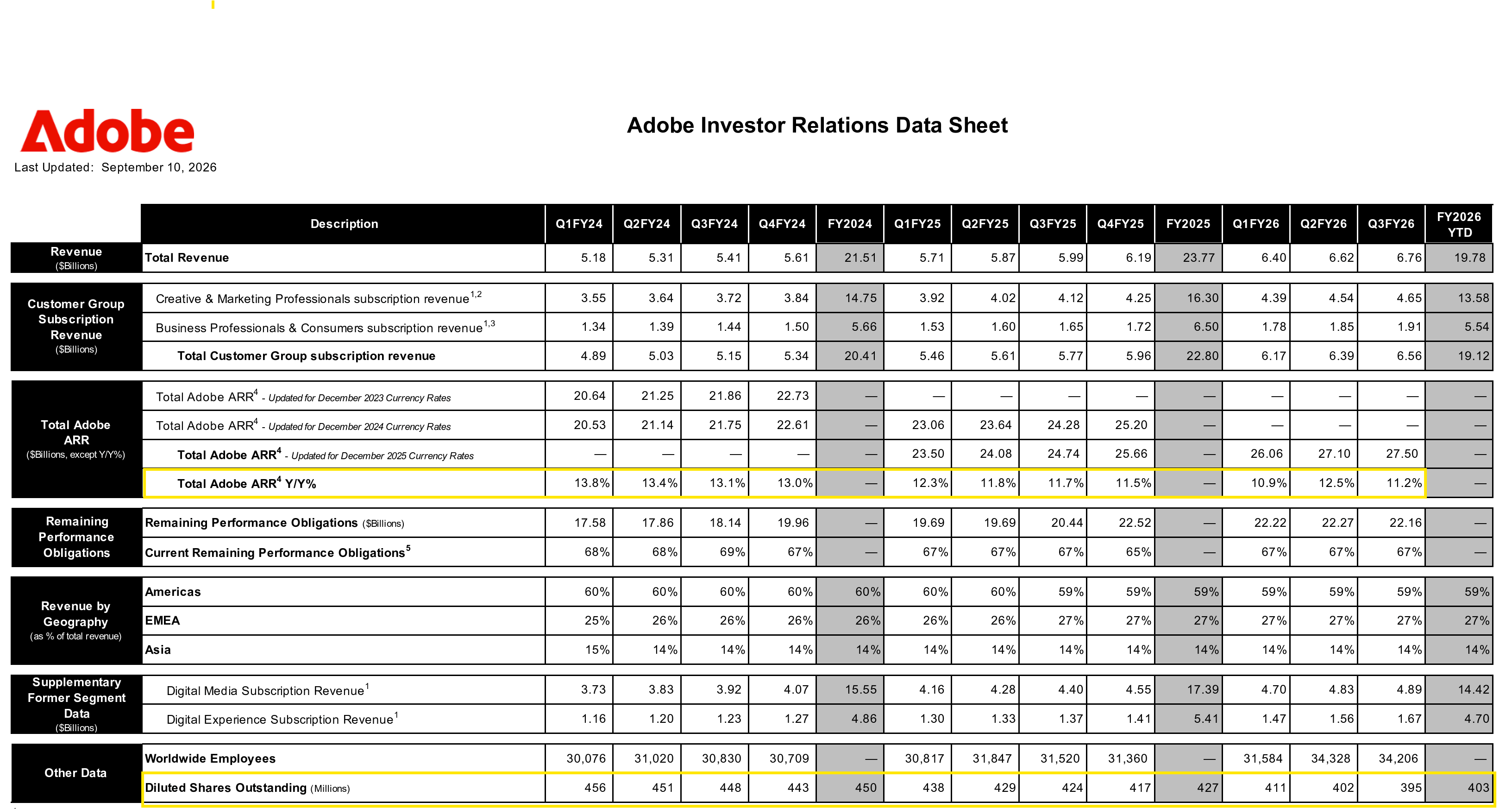
As you can see from the chart above, Adobe has been aggressively reducing its share count. One main area of concern for some investors is the deceleration in ARR growth. This is something I will be keeping an eye on.
Management and Capital Allocation
Another factor that has contributed to Adobe’s stock price decline this year is uncertainty surrounding its leadership transition. Shantanu Narayen, who has served as CEO since 2007 and helped transform Adobe into one of the world’s leading software companies, announced earlier this year that he would be stepping down. Adobe subsequently announced that Anil Chakravarthy would become CEO, effective December 1, 2026.
Leadership transitions create uncertainty for investors, particularly when a company is navigating a fundamental technological shift. Adobe is facing one of the most significant changes to the creative software industry in decades, and investors are understandably concerned about how its new leadership will respond.
While Chakravarthy brings considerable experience within Adobe, the market will likely want to see evidence that he can successfully execute the company’s AI strategy while preserving its competitive advantages and profitability.
The leadership transition has added another layer of uncertainty to an already pessimistic market narrative. However, a change in management does not necessarily imply a deterioration in the underlying business, and successful execution under new leadership could eventually help restore investor confidence.
$25 Billion Buyback
Back in April, Adobe announced a $25 billion share repurchase program extending through 2030. To put that into perspective, the authorization represents approximately 27% of Adobe’s current market capitalization.
At today’s depressed valuation, these repurchases could create substantial value for long-term shareholders. If Adobe’s stock price remains flat or declines further, the company will be able to retire an even larger percentage of its outstanding shares, providing a meaningful boost to earnings and free cash flow on a per-share basis.
I believe Adobe could realistically reduce its outstanding share count by approximately 3–5% annually over the next four years, even after accounting for dilution from stock-based compensation, which totaled $1.94 billion in fiscal 2025.
This is particularly attractive because Adobe doesn’t need to generate significant revenue growth to deliver respectable per-share returns. Even modest growth in total owner’s earnings, combined with a shrinking share count, could translate into meaningful growth in owner’s earnings per share.
For example, if Adobe grows total owner’s earnings by just 5% annually while reducing its share count by 4%, owner’s earnings per share would compound at approximately 9.4% annually, even without any improvement in its valuation multiple.
Of course, this assumes Adobe can sustain its cash generation and execute repurchases at attractive prices. Nevertheless, I believe the combination of strong free cash flow and aggressive buybacks represents an important component of the investment thesis that may be underappreciated by the market.
Valuation: What Is Adobe Worth?
I estimate that Adobe will generate approximately $7.9–$8.0 billion in normalized owner’s earnings in fiscal 2026, or roughly $20.50 per share. My estimate of owner’s earnings is equal to free cash flow less stock-based compensation, which I treat as a real economic expense to shareholders.
At a share price of approximately $240, Adobe trades at just 11.7 times normalized owner’s earnings, representing an owner’s earnings yield of approximately 8.5%.
A Simple Way to Think About Expected Returns
One way to estimate Adobe’s potential long-term returns is to add its current owner’s earnings yield to the expected growth rate in owner’s earnings per share.
Current owner’s earnings yield: 8.5%
Expected annual growth: 5–10%
Implied annual return: Approximately 13.5–18.5%
This is admittedly a simplified approach, but it provides a useful starting point. Importantly, these returns wouldn’t necessarily require Adobe to trade at a significantly higher valuation multiple.
Bear, Base, and Bull Cases
Given the potential disruption from AI and the potential impact on its future earning power, I think it’s important to consider a range of possible outcomes rather than relying on a single valuation estimate.
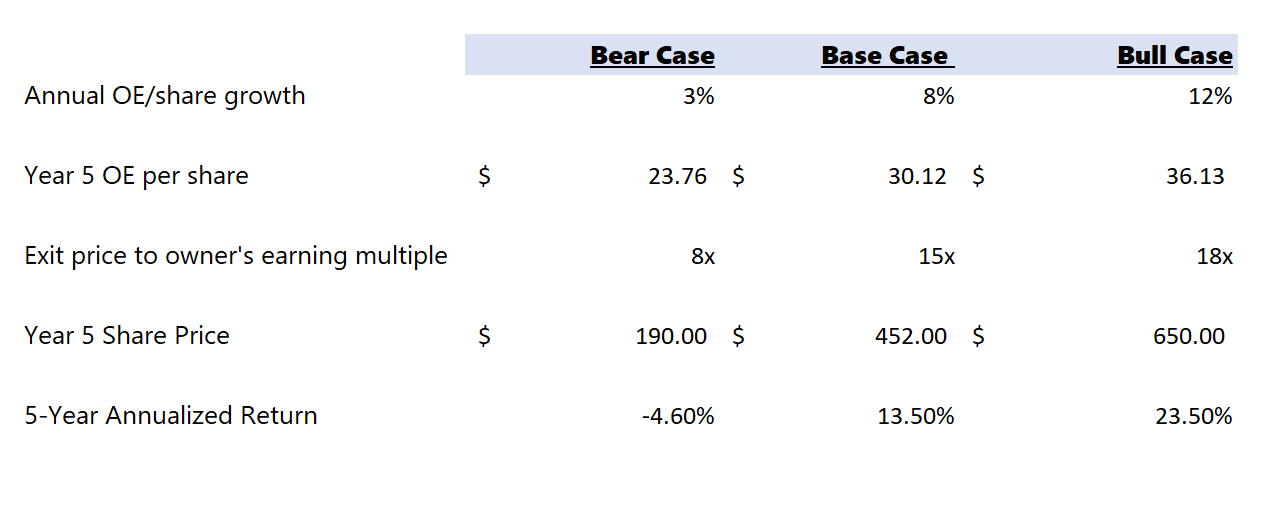
The following scenarios assume a five-year investment horizon, with returns driven by growth in owner’s earnings per share and the valuation multiple investors are willing to pay at the end of that period.
Bear Case — AI Erodes Adobe’s Competitive Advantages
In this scenario, AI-native competitors gradually pressure Adobe’s pricing power, while increased productivity reduces demand for traditional Creative Cloud subscriptions.
Adobe remains profitable, but owner’s earnings per share grow only 3% annually. Investors become less willing to pay a premium for the business, and the stock trades at approximately 8x owner’s earnings.
The result would be a share price of roughly $190 in five years, producing about a -5% annual CAGR.
Base Case — Adobe Successfully Adapts to AI
My base case assumes Adobe maintains its position as a leading professional creative software platform while successfully integrating AI into its existing products.
Revenue continues growing at a moderate pace, AI-related monetization helps offset potential subscription-seat compression, and aggressive share repurchases contribute to per-share growth.
I assume owner’s earnings per share compound at approximately 8% annually and the stock eventually trades at 15x owner’s earnings.
This produces a five-year price target of approximately $452, representing an annualized return of roughly 13.5%.
Bull Case — AI Becomes a Meaningful Growth Driver
In the bull case, Adobe benefits from a substantial expansion in demand for digital content. AI lowers the learning curve for its software, attracts new customers, and creates additional monetization opportunities through generative credits and enterprise services.
Meanwhile, Adobe maintains its competitive advantages in professional editing and production workflows.
Under this scenario, owner’s earnings per share grow 12% annually, and investors become willing to pay 18x earnings for the business.
This would imply a share price of approximately $650 in five years, producing an annualized return of roughly 23.50%.
My Takeaway
At approximately 11.7 times normalized owner’s earnings, I believe Adobe offers an attractive combination of current cash generation, modest growth expectations, and potential upside from a recovery in investor sentiment.
What makes the opportunity interesting is that Adobe doesn’t need to dominate the AI industry or return to its historical valuation multiples to generate respectable returns.
If the company can maintain its competitive position, grow owner’s earnings per share at a mid-to-high-single-digit rate, and continue repurchasing shares, I believe investors could earn attractive long-term returns.
The biggest risk is that AI causes a permanent deterioration in Adobe’s earning power rather than merely slowing its growth.
Ultimately, I believe the market may be pricing in a more pessimistic outcome than the company’s current financial performance warrants.
What Would Break the Thesis?
Adobe’s moat is strong today, but I am going to be keeping a close eye on whether AI is gradually eroding those advantages.
There are several developments that would cause me to reconsider the investment:
Sustained and rapid deterioration in ARR growth: A temporary slowdown wouldn’t necessarily concern me, but several quarters of weakening ARR growth could indicate that AI competition is beginning to affect the business.
Evidence of meaningful customer migration: If professional designers, marketing agencies, or large enterprises begin abandoning Adobe in favor of AI-native alternatives, it would suggest that the company’s switching costs are less durable than I currently believe.
Deteriorating pricing power: If Adobe is forced to offer substantial discounts, reduce subscription prices, or bundle increasingly expensive AI features without generating additional revenue, it could signal that its competitive position is weakening.
Declining owner’s earnings: Ultimately, I care more about sustainable cash generation than reported revenue growth. If Adobe’s normalized owner’s earnings begin declining because of weaker pricing, higher operating costs, or increased capital requirements, my estimate of intrinsic value would need to come down.
Failure to monetize AI adoption: Adobe doesn’t necessarily need to develop the best AI models, but it does need to capture economic value from the growing use of AI in creative workflows. If AI adoption increases while Adobe’s revenue and profitability stagnate, that would raise questions about whether the company is actually benefiting from the technology.
Conclusion: A Calculated Bet on Durability
Adobe is facing one of the most significant technological disruptions in its history, and I believe the market’s concerns about artificial intelligence are legitimate. AI-native applications are becoming increasingly capable, potentially threatening Adobe’s pricing power, subscription model, and long-term competitive advantages.
However, I believe the market may be underestimating the durability of Adobe’s ecosystem and its ability to adapt to this changing environment.
Adobe’s competitive advantages extend well beyond the functionality of its individual applications. Millions of creative professionals and businesses have spent years building their workflows around Adobe’s software, file formats, and integrations. While AI may make it easier to replicate certain features, replacing an entire professional creative ecosystem is a much more difficult proposition.
Furthermore, AI could ultimately expand Adobe’s addressable market by making sophisticated creative tools accessible to millions of new users. Adobe doesn’t necessarily need to develop the world’s best AI models to benefit from this trend. It simply needs to remain an essential platform for creating, editing, and producing professional content.
Meanwhile, Adobe’s financial performance remains strong. The company continues to generate double-digit revenue growth, substantial free cash flow, and aggressively repurchase shares.
At approximately 11.7 times my estimate of normalized owner’s earnings, I believe the valuation provides a reasonable margin of safety against some of the uncertainty surrounding AI. My base case suggests annualized returns in the low-to-mid teens over the next five years, with considerably more upside if Adobe successfully capitalizes on AI.
Ultimately, I believe investors are being offered an opportunity to purchase a highly profitable, deeply entrenched software franchise at a valuation that reflects substantial pessimism about its future.
*I own shares in Adobe (ADBE). This article should not be construed as investment advice or a recommendation to buy or sell Adobe stock. Investors should conduct their own due diligence and consider their risk tolerance and financial situation before making an investment decision. Portions of this article were developed with the assistance of AI, which I used primarily for editing, organization, and refining the presentation of my analysis. The investment research, conclusions, valuation assumptions, and opinions are my own.