

CarMax (NYSE: KMX) stock has been crushed in the last two months and is currently trading near its 13-year low. The stock fell substantially after reporting weak 2nd quarter earnings and then last week got hammered again after announcing they were firing the CEO. CarMax also provided lower preliminary earnings guidance for its 3rd quarter and said it expects same store sales to decline 8 – 12% in the quarter. The car industry as a whole is going through a downturn but I think the recent price drop in CarMax stock has created a golden buying opportunity. This report takes a closer look at CarMax’s fundamentals — its evolution, cost and data advantages, balance sheet strength, and valuation — to discuss why the stock offers an attractive margin of safety and significant upside potential.
It’s worth noting that my conviction in CarMax stock may be higher than most. I’ve spent much of my career in the auto industry, including roles as a dealership sales rep and as a lender for a major automotive manufacturer. That background gives me a firsthand perspective on the economics and dynamics of the retail auto industry. Full disclosure: I own shares in KMX.
History of CarMax
🚗 A Brief History of CarMax
CarMax is the nation’s largest used car retailer, generating over $26 billion in annual revenue. But the company’s story started in an unexpected place — inside Circuit City, the now-defunct electronics retailer.
Here’s a quick rundown of how CarMax became the dominant force it is today:
Founded in 1993 in Richmond, Virginia
CarMax began as a “stealth venture” within Circuit City and was co-founded by Richard Sharp (then CEO of Circuit City) and Austin Ligon. These entrepreneurs set out to reinvent how people bought used cars.
The Big Idea: Apply the “Big-Box” Retail Model to Cars
The founders borrowed the playbook that made Circuit City successful: large-scale operations, standardized pricing, and data-driven inventory management.
Their goal was to bring structure, transparency, and efficiency to the fragmented used car market.
A Radical Concept: The “No-Haggle” Model
CarMax pioneered the one-price, no-negotiation approach — a huge shift from the traditional back-and-forth car buying experience.
The first location in Richmond, VA featured about 500 late model used vehicles, all sold at fixed prices to create a transparent, stress-free shopping experience.
Spun Off and Scaled Up
In October 2002, Circuit City spun off CarMax as an independent, publicly traded company
At that time, CarMax operated 37 used car superstores, 17 new car franchises, and its own financing arm (CarMax Auto Finance).
The separation allowed CarMax to focus entirely on automotive retail, setting the stage for its rise to become America’s largest used car retailer.
🔹 The Big Picture
CarMax’s success was built on customer trust, fixed pricing, and operational efficiency — principles that still define the brand today. What started as an experiment inside an electronics store became a blueprint for modern automotive retailing.
What Has Created this Opportunity
The auto industry has been on a rollercoaster since the Covid-19 pandemic. After the pandemic hit, the pace of new car manufacturing declined substantially due to supply chain disruptions, along with staffing and chip shortages.
Due to this lack of supply in new cars, used car prices increased dramatically. Car dealers were also not discounting most of their new cars due to the lack of supply. What transpired because of this “supply shock” in the auto market was a period of highly inflated vehicle prices for both new and used cars — especially used. These high prices coupled with low interest rates and stimulus checks resulted in increased demand despite the high prices in both new and used vehicles. The federal reserve was forced to rapidly increase interest rates in 2022 because of a spike in inflation and this rapid increase in borrowing rates slowly decreased demand and made many vehicles less affordable for potential buyers. The result of all this was that many buyers who bought in the “Covid boom” of 2020 – 2021 ended up “underwater” on their vehicles, meaning they owed more than their vehicles were worth.
Fast forward to 2025 and used car prices are still elevated despite higher interest rates. High interest rates combined with elevated vehicle prices have created a difficult environment for the auto industry, as demand has fallen sharply across the board.
Since there was a large decline in new car production over the last few years (as a result of the supply chain and chip shortage issues during Covid), supply levels in the 2 – 5-year-old used car market are now well below normal levels. Per Edmunds, “The root cause of today’s high used car prices is limited supply. Edmunds found that the average age of trade-in vehicles was 7.6 years during the first quarter of 2025. That’s the oldest average since 2019, meaning fewer “near-new” vehicles — like lease returns or late-model trade-ins — are entering the used market.”
CarMax’s revenues and margins are no doubt being pressured due to the difficult dynamics just described in the auto industry. CarMax stock got particularly decimated due to the poor 2nd quarter earnings print and the fact that they decided to fire their CEO. The market hates uncertainty and CarMax stock was crushed because of these two negative developments. Despite all the recent bad news, I believe CarMax is well-positioned to recover and become more profitable once conditions in the used car market stabilize. The market’s pessimism has gone too far, and CarMax now offers contrarian investors a compelling opportunity at current prices.
CarMax’s Business Model
In its most recent annual report, CarMax stated that there were approximately 38 million used cars sold in the U.S. in calendar 2024, of which approximately 20 million were estimated to be age 0- to 10-year-old vehicles. In calendar 2024, CarMax sold approximately 3.7% of the age 0- to 10-year-old vehicles sold on a nationwide basis, which was consistent with calendar 2023. CarMax specializes in selling slightly pre-owned vehicles that are less than 10 years old. Vehicles less than 6 years old represented approximately 75% of CarMax’s used vehicle sales for fiscal 2025. Due to the low supply of 0- to 5-year-old used cars, CarMax will see a larger percentage of sales for vehicles that are 5 years or older. There is often more gross profit per unit on older vehicles, so I don’t see a large decline in gross profit per unit. However, there will likely be an increase in reconditioning costs on the older inventory.
🚙 Why CarMax’s Business Model Works
CarMax stands out from traditional dealerships for one simple reason — it’s a one-price store with no back and forth haggling.
Most smaller dealers have tried the same model and failed, largely because of how sales commissions work in the industry. Traditional sales reps earn a percentage of the gross profit on each car sold, which pushes them to negotiate for higher margins rather than help the customer find the right vehicle.
CarMax brought a different model to the car market. Every sales associate earns a flat commission, no matter how much profit is made on the car. That means reps are incentivized to help buyers find the car they need or want, not what pays best. Plus, customers work with one associate from start to finish, rather than being passed off to a finance manager halfway through the process.
In an industry where most cars are commodities, the winners are those with cost and scale advantages — and CarMax has both.
A typical CarMax store carries 300–400 vehicles, compared to fewer than 100 at many independent dealers.
Across the network, the company manages 50,000–70,000 cars in inventory, giving it leverage to negotiate lower shipping rates and drive down unit costs.
Its scale efficiencies and recent cost-cutting (roughly $250 per unit across logistics and reconditioning) further strengthen that edge.
The result? A more transparent buying experience for customers — and a leaner, more efficient operation that smaller competitors simply can’t match.
💸 CarMax’s Cost Efficiency Push
CarMax has been quietly making real progress on the cost side of its business. In the latest annual report, management wrote:
“We are focused on driving down our cost of sales by pursuing incremental efficiency opportunities that we have identified across our logistics network and reconditioning operations. We achieved savings of approximately $125 per unit in fiscal 2025 and anticipate that we will achieve another $125 per unit in fiscal 2026. This exceeds the initial $200 per unit target that we set at the beginning of fiscal 2025.”
In plain English — CarMax has managed to cut roughly $250 per vehicle in costs over the past two years. That’s not trivial.
Based on the company’s total unit volume, I estimate that translates to $150–200 million in savings from reconditioning and logistics alone.
Even better, in the Q2 FY2026 earnings release, management announced plans for an additional $150 million in SG&A reductions over the next 18 months.
These efficiency gains won’t completely offset lower sales or margin pressure from a softer market, but they should help cushion the hit to earnings and protect profitability while demand remains subdued.
📊 CarMax’s Data Moat
CarMax’s second moat comes from something you won’t find on its balance sheet — data. Over more than 30 years of buying, selling, and appraising cars, CarMax has built a massive dataset that smaller dealers simply can’t match.
Since its founding, the company has:
Sold over 13 million vehicles
Purchased more than 15 million
Appraised roughly 45 million
That experience gives CarMax an extraordinary understanding of what cars are worth in different markets and how much it costs to recondition them. It’s a real-world pricing engine built from decades of transactions.
You can see this in action with their instant online appraisal tool. When I entered a 2015 Honda Accord LX, CarMax offered $14,000 — right in line with Kelley Blue Book’s range of $12,716 to $15,041. A nearly identical Accord was listed on a local CarMax lot for $18,998, showing just how precisely their system balances trade-in and retail values.
According to their latest annual report, CarMax now gives digital offers to about 99% of users who visit carmax.com for an appraisal — a powerful example of how their data moat translates into pricing accuracy and customer trust.
You really start to see CarMax’s edge when you dig into the gross profit per unit numbers across the auto industry. CarMax pulled in $2,311 per vehicle, the second-highest among its peers — behind only Carvana. Even though CarMax trailed Carvana on the retail side, it had a higher wholesale gross profit per unit than Carvana as shown below.
CarMax reported a 12.15% wholesale gross margin, which is over three times higher than AutoNation’s 3.7% in 2024. To put that in perspective, Lithia actually posted a small loss in its wholesale operations that same year. It’s likely that CarMax’s wholesale margins will see some near-term headwinds given the higher depreciation in its wholesale units that management has recently talked about. Over the past few years, many dealers paid inflated prices to secure inventory. As the used car market normalizes, those vehicles are now worth less than their purchase prices, forcing dealers to take unusually large depreciation charges. In short, dealers are holding cars that simply aren’t worth what they paid for them because valuations in the used market were artificially high for an extended period. Investors should keep an eye on this, but I believe margins will return to normal in the next 18 - 24 months.
CarMax’s higher margins are not the result of luck — it speaks to CarMax’s cost discipline, scale, and operational know-how. The company’s nationwide buying network, pricing algorithms, and efficient reconditioning process give it a durable edge that’s hard for smaller players to replicate. These are the kind of intangible advantages that don’t show up directly on the balance sheet but absolutely show up in the numbers.

CarMax Auto Finance
CarMax has a large loan portfolio of nearly $18 billion dollars and generates solid profits from its lending business. Per the latest annual report, CarMax financed 42.7% of its retail vehicle sales through its lending platform.
At first glance, CarMax’s balance sheet appears heavily leveraged, with over $18 billion in total debt. However, the majority of this debt is tied to its auto loan portfolio and structured as non-recourse notes payable.
This is a standard arrangement in auto financing, where companies sell loans to a bankruptcy-remote special purpose vehicle (SPV), which then issues notes to fund additional loans. These obligations do not expose CarMax’s core assets to creditor claims, as the liabilities are fully backed by the underlying loan portfolio—effectively offsetting the debt with corresponding assets. Per CarMax’s latest 10-K filing, “Similarly, the investors in the non-recourse notes payable have no recourse to our assets beyond the related receivables”.
Here’s a snapshot of CarMax’s loan portfolio as of the most recent quarter ending August 31st, 2025. As shown below, CarMax’s loan portfolio remains solid, with an average credit score of 724 and an average loan-to-value (LTV) ratio of 90%—both indicators of generally strong credit quality. For context, a high LTV for an auto loan might be 130% or more, depending on the lender, collateral, and borrower risk profile.
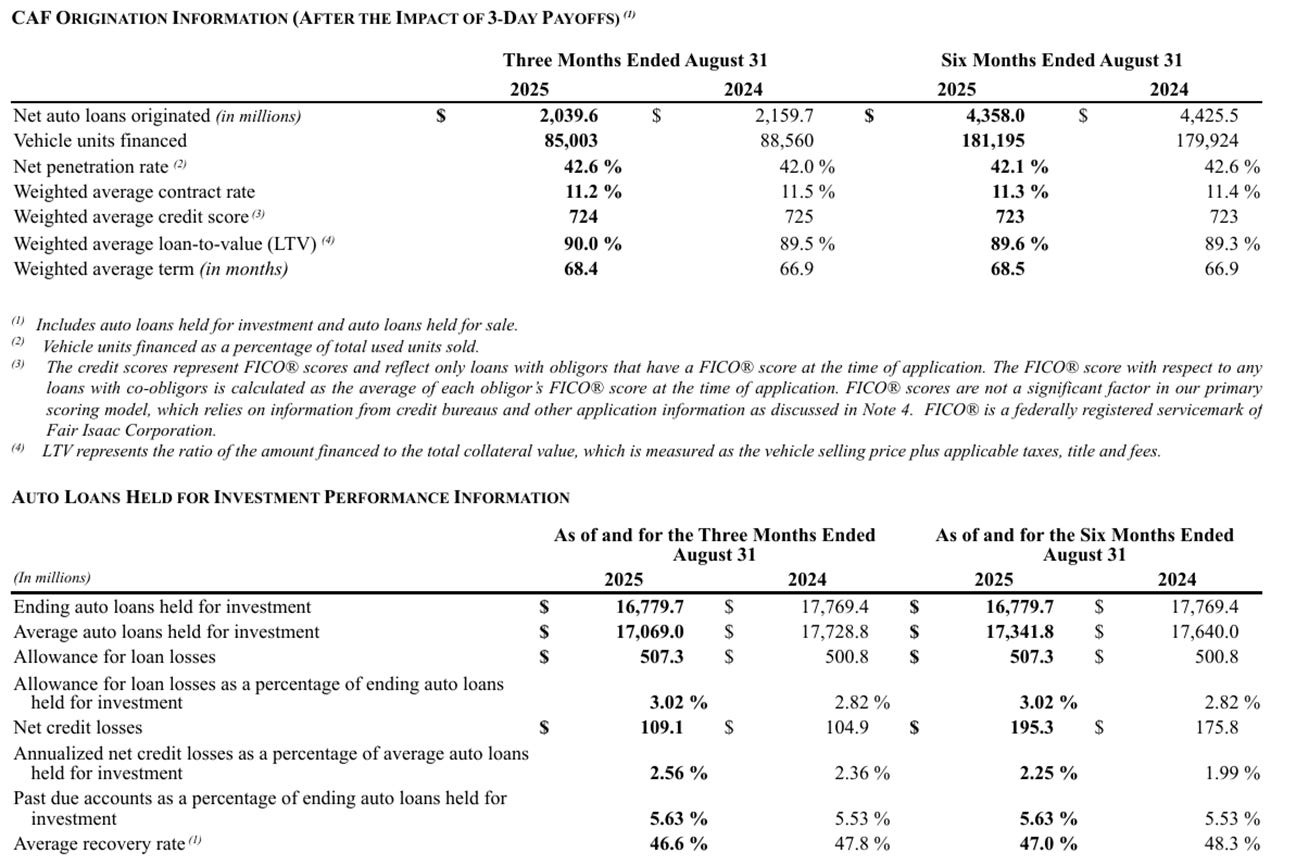
As of August 31, 2025, 5.63% of loans were past due. While this figure is slightly elevated, it does not currently pose a significant risk. However, if delinquencies were to rise above the 7% range, it would warrant a more cautious outlook.

Conservative Leverage and Ample Liquidity
Debt
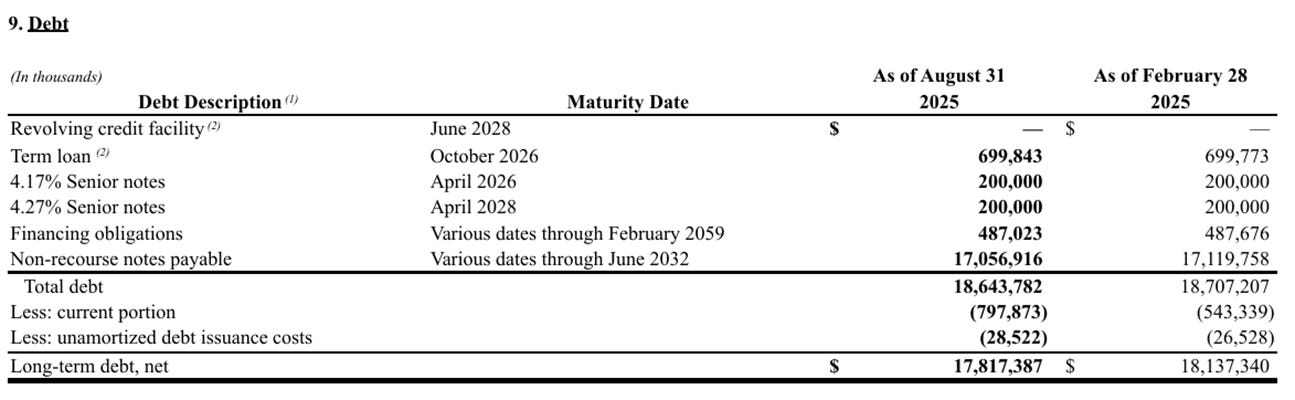
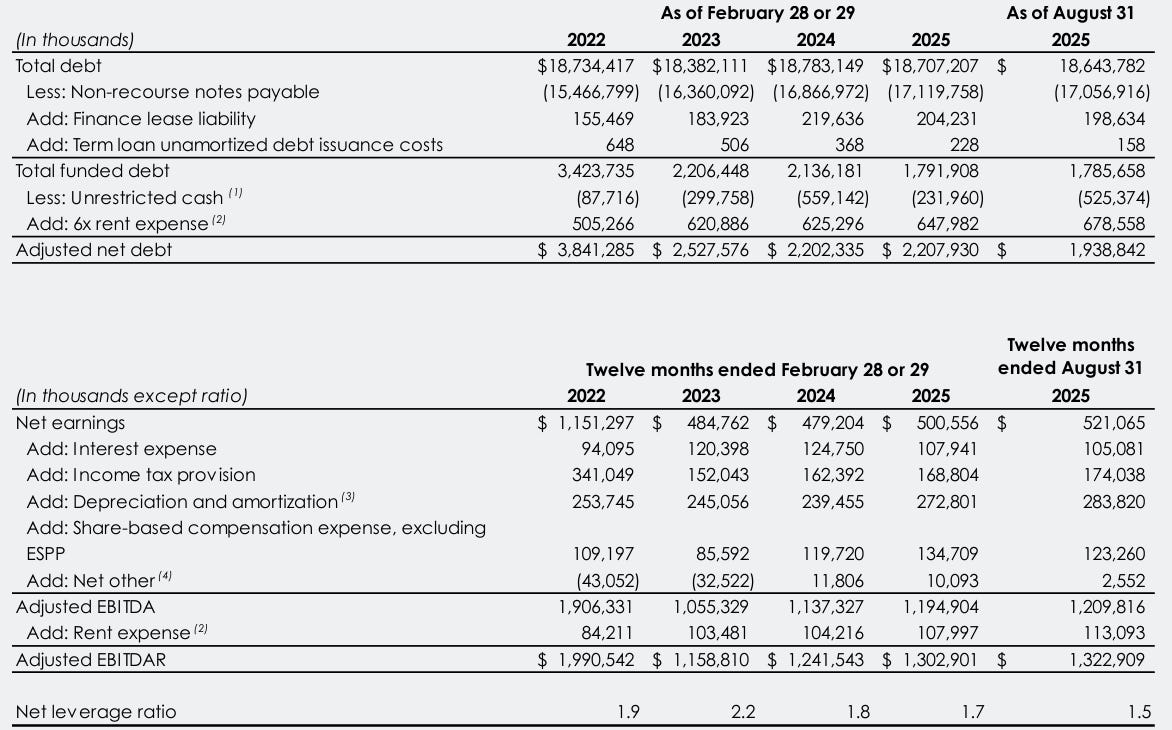
CarMax has a strong balance sheet considering the non-recourse notes are essentially cancelled out by the loan portfolio as previously mentioned. Not including the non-recourse notes, CarMax has roughly $1.8 billion of debt. CarMax has an undrawn $2 billion revolving credit facility and roughly $540.4 million in cash. Per its most recent quarterly earnings presentation, adjusted net debt was roughly $1.9 billion and net leverage ratios are currently at a reasonable 1.5x and at the lowest level over the past four years.
Interest Coverage Ratio
CarMax’s average interest coverage ratio over the last 5 years has been 9.7 and last year was 7.2. This means CarMax can cover their interest payments more than seven times over! Even if CarMax’s operating income fell by 50% (which is very unlikely), they would still be able to cover their interest payment more than 3 times over. Interest coverage ratio is calculated as operating income divided by interest expense. A higher ratio is better, and I usually like to see an interest coverage ratio of at least 3 - 4x.

The numbers tell an interesting story — in the next sections, I’ll explain what I think CarMax is worth, what the balance sheet says about downside risk, and how the fundamentals stack up.
