

Copart is the world’s largest provider of online auctions and vehicle remarketing services. In other words, Copart owns thousands of acres of junk yards in which they conduct salvage vehicle auctions.
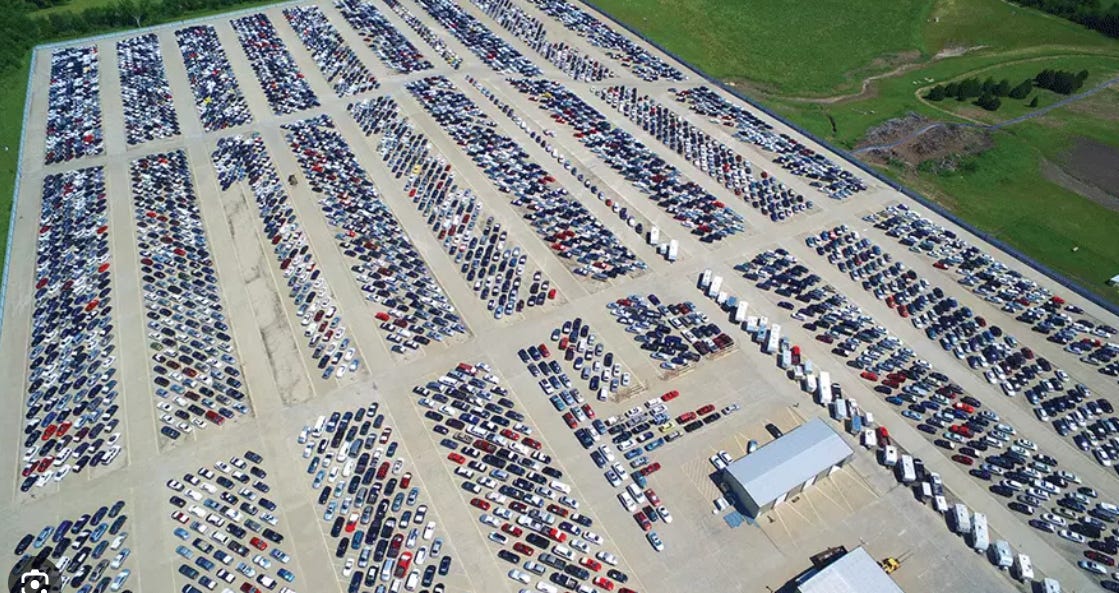
Copart receives most of its vehicles (about 80%) from insurance companies like State Farm, GEICO, Allstate and others - vehicles that are deemed to be a total loss. Sellers also include car dealers, individuals, car rental companies, banks, and fleet operators. Buyers include vehicle dismantlers, vehicle rebuilders, repair shops, used vehicle dealers, and individuals.
Copart operates in what is effectively a duopoly with Insurance Auto Auctions (IAA), which is owned by RB Global (RBA). It is estimated that Copart and IAA control 80 – 90% of the North American salvage auto auction market, with Copart controlling about 45 - 50% share and IAA 35 - 40%.
I have followed Copart for several years. The business has always impressed me, but the valuation always seemed a bit pricey. After the recent selloff, however, I believe investors have an opportunity to buy one of the highest-quality compounders in the public markets at a much more attractive price.
Copart’s Business Model
Most vehicles are sold on consignment, with Copart acting as an agent. Copart collects the auction proceeds from the buyer, deducts its fees, and then pays the remaining proceeds to the seller.
Roughly 85% of Copart’s revenues come from service fees where they collect fees on everything from memberships, financing, shipping, vehicle bidding, transaction, storage, titling, selling, and relisting. The other 15% of Copart’s business is vehicle sales, where they actually buy the cars and sell them for their own account.
On average, Copart might collect something like 5% - 15% of the sale price per vehicle sold. This can fee can be as low as 1% or as high as 20%+ depending on the vehicle and sale price.
What Has Caused the Selloff in Copart Stock?
I recently started buying Copart because it trades near a five-year low based on its stock price and near a 10 year low in terms of its price to earnings ratio.
Copart’s stock is trading down primarily because of a temporary slowdown in total-loss insurance claims along with a leadership transition, which is actually a positive as I’ll explain later.
Over the past several years, Copart has faced temporary headwinds as elevated inflation and sharply higher auto insurance premiums caused many consumers to reassess their insurance coverage.
Some policyholders increased deductibles, dropped comprehensive and collision coverage on older vehicles, or allowed policies to lapse altogether. As a result, fewer insured vehicles entered the total-loss claims process, reducing the number of salvage vehicles flowing through Copart’s auction platform. While this has pressured vehicle volumes in the near term, I view it as a cyclical rather than structural issue.
Insurance coverage is ultimately a necessity for most drivers, and as affordability improves and industry conditions normalize, I would expect salvage volumes to recover over time.
Incoming CEO Jay Adair had this to say on recent call with investors,
“On cyclical headwinds, we are experiencing the impact of cyclical and, in our view, unprecedented dislocation across the U.S. industry -- the U.S. insurance industry. The 2022 to 2024 inflationary cycle pushed carrier combined ratios out of balance, driving rate increases, which drove consumers to pull back their level of insurance coverage, which was observed through a shift toward higher deductibles and liability-only policies.
I believe that is now softening, and we are starting to see insurance companies become more aggressive again. And much of this is from 2020, COVID, the impact of that, the impact of insurers cutting dividends back and reducing insurance rates. And now we’ve seen kind of the flip side of that, as we have seen in the past year or two, and I think we’re now going to see things kind of normalize. We believe the consumer retrenchment is cyclical, not structural. So, I want to make that very clear.”
At roughly 18x earnings (near a 10-year low) and approximately 13x EV/EBIT after adjusting for its large net cash balance, I believe the market is overly pessimistic on the short-term cyclical headwinds and is underappreciating both the durability of the business and its long-term reinvestment opportunities. Nearly one-third of Copart’s market capitalization is represented by cash, investments and company-owned real estate carried at historical cost.
Cost Advantage Copart has Over IAA
Copart owns 90% of its salvage yards, while its primary competitor, IAA, leases the majority of its locations.
This difference in real estate strategy provides Copart with several long-term advantages. Because it owns most of its yards, Copart is less exposed to rising rents and lease-renewal risk. Ownership also gives management greater flexibility to expand existing locations, add storage capacity and respond quickly to catastrophe events. In addition, much of Copart’s land is carried on the balance sheet at historical cost, meaning its economic value is likely materially higher than its reported book value.
IAA’s leasing strategy may have appeared more capital-efficient in the short term, but it leaves the company more exposed to rent inflation and landlord negotiations. Copart, by contrast, has spent decades assembling a difficult-to-replicate network of strategically located industrial properties. As land values and replacement costs rise, this advantage becomes increasingly valuable.
The difference between the two companies is also evident in their financial performance. Although RB Global no longer separately discloses all of IAA’s historical profitability metrics, I estimate that IAA generated approximately a 15% return on invested capital in the years preceding its acquisition. Copart’s estimated median return on invested capital over the past five years has been closer to 30%.
The margin comparison is similarly striking. IAA’s pre-tax margins averaged approximately 19% during the three years before its acquisition by RB Global, while Copart has produced pre-tax margins of roughly 40% over its last three fiscal years, more than double that of IAA.
These differences cannot be attributed solely to real estate ownership. Copart also benefits from greater buyer liquidity, stronger recovery values, superior operating scale and earlier adoption of online auctions. However, its owned-yard strategy is an important contributor to its lower long-term occupancy costs, operating flexibility and durable competitive advantage.
What Reinforces the Long-Term Duopoly
Copart operates in an effective duopoly with IAA because very few companies possess the land, logistics infrastructure, buyer liquidity and operating capacity required to process salvage vehicles at national scale.
A smaller competitor may be able to serve a local market, but it would be difficult for that company to absorb a meaningful portion of a major insurer’s nationwide total-loss volume. Large insurers generally prefer maintaining relationships with both Copart and IAA, so they are not dependent on a single provider. That dynamic helps preserve two scaled competitors while making it extremely difficult for a third national player to emerge.
A new entrant would need to build substantial yard capacity and logistics infrastructure before insurers could safely award it meaningful volume. Yet without sufficient insurer volume, the entrant would struggle to attract enough buyers to generate competitive recovery values. This creates a classic chicken-and-egg problem that reinforces the existing duopoly.
Network Effects
Copart has built one of the largest and most liquid vehicle auction marketplaces in the world, connecting insurance companies, dealers, fleet operators and other sellers with millions of registered buyers across more than 170 countries.
As more buyers participate in Copart’s auctions, bidding becomes more competitive and recovery values improve. Better recovery values encourage more sellers to route vehicles through the platform, increasing inventory and attracting even more buyers.
This creates a self-reinforcing flywheel:
More buyers lead to better prices, better prices attract more sellers, and more inventory draws even more buyers.
Over time, this network effect strengthens Copart’s competitive position and makes the marketplace increasingly difficult to replicate.
Switching Costs
Copart also benefits from meaningful switching costs once it becomes embedded in an insurer’s operations.
Copart does far more than auction vehicles. It coordinates towing, storage, title processing, claims-system integration, payment collection, compliance and remarketing to a global buyer base.
Moving a large block of business to another provider could disrupt these workflows and, more importantly, risk producing lower salvage recoveries. For an insurer processing hundreds of thousands of total-loss vehicles, even a modest decline in recovery value could outweigh any potential savings from lower fees.
Efficient Scale, Real Estate and Intangible Assets
Replicating Copart’s network would require far more than building an auction website.
A potential competitor would first need to acquire thousands of acres of strategically located industrial land across the country. The challenge extends beyond capital. Salvage yards are difficult to permit because they often face environmental scrutiny, zoning restrictions and local opposition.
Even after assembling the physical network, a new entrant would still need to establish relationships with major insurers, build credibility as a reliable operating partner and attract enough buyers to create competitive auction liquidity.
The true barrier to entry is therefore not capital alone. It is time.
A well-funded competitor could spend years assembling land, obtaining permits, building logistics capabilities and developing customer relationships. During that period, Copart’s own network, buyer base and insurer relationships would likely continue to strengthen.
These advantages have resulted in excellent financial performance.
Over the past decade, Copart’s:
Gross margins have increased from 43% to 45%.
Operating margins have increased from 32% to 36.5%
Net margins have expanded from about 21% to 33%.
Copart’s revenue has grown about 15% over the last 10 years, and its EPS has grown by about 22% during the same time.
Growth along with increasing margins is a sign of a widening of the competitive moat. These are obviously the types of companies you want to own over the long term.
I estimate that Copart’s median return on invested capital (ROIC) and ROIIC has been about 30 - 35% over the last 10 years. Not only do they have high returns on capital, but I believe they still have a high reinvestment runway.
Stocks with high ROIC and large reinvestment runways can compound wealth for shareholders at a much greater clip than the market indexes.
Copart’s Management Team is Top Notch
Management is another reason I own the stock. Former CEO Jay Adair recently returned to lead the company after helping pioneer Copart’s online auction platform. Together with founder Willis Johnson, management maintains significant ownership and has consistently allocated capital with a long-term mindset.
Adair is chairman and founder Willis Johnson’s son in law. Together they own roughly 8% of Copart’s stock. Adair started working at Copart when he was 19 and learned the business from the ground up. He was instrumental in moving Copart’s auctions online and has track record of creating huge value for shareholders over time.
Opportunistic Share Repurchases
Copart’s management team is selective when repurchasing shares, only buying them back when they believe the stock is undervalued. This is in contrast to many companies that follow a uniform buyback cadence regardless of the stock value. From 2016 - 2025, Copart’s management team only bought back stock twice (once in 2016 and once in 2019) for a total of roughly $822.9 million. With the stock hovering near a decade low price to earnings multiples, Copart repurchased roughly $1.4 billion of stock just last quarter, which is more than 5% of the current market value.
Copart’s executive team operated and continues to operate with an “Outsider’s prospective.” See William Thorndike’s book: The Outsiders: Eight Unconventional CEOs and Their Radically Rational Blueprint for Success.
Copart has focused on long-term value creation for all its stakeholders and doesn’t necessarily care what Wall Street analysts think in the short-term. Here are some interesting comments that CEO Jay Adair made on a recent investor call,
“We’re just going to execute. We’re not going to talk about it. We’re not going to tell people what we’re about to do. And then when we do win, we’re not going to tell people that we won. We’re just going to do it. Let the results speak for themselves.
But at the end of the day, it’s because we’re going to focus on what it takes to win, and I don’t plan to put my playbook for winning out there publicly for my competitor to see. I believe -- I mean I know our customers personally, and I believe our customer relationships are stronger than ever.”
Copart clearly qualifies as an exceptional business. The more difficult question is whether the current valuation offers an adequate return. In the paid section below, I estimate five-year EPS, assign bear, base and bull terminal multiples, calculate probability-weighted intrinsic value, and determine the expected IRR from today’s price. I also cover Copart’s growth opportunities and why their future growth strategy is likely to look a little different than it has in the past.
