

Today, I wanted to let readers know about an idea that I recently added to my portfolio and that I believe is particularly attractive at its current, cyclically depressed price: Floor & Decor.
Floor & Decor is borrowing a page from Costco’s playbook, leveraging purchasing scale, a warehouse-style format, and everyday low prices to disrupt the traditional flooring industry. In fact, Charlie Munger once called Floor & Decor, “the modern imitator of Costco.” While Floor & Decor may not have the same expansive long-term growth opportunity as Costco, I believe the two companies share several important characteristics.
Both leverage a warehouse-style operating model, purchasing scale, and operational efficiencies to offer customers a compelling combination of low prices and broad product selection. As sales volumes increase, greater purchasing power and improved cost efficiencies can reinforce these advantages, creating a virtuous cycle that becomes increasingly difficult for smaller competitors to replicate. Although Floor & Decor operates in a much narrower/niche market versus Costco, I believe its specialized approach provides a similar opportunity to gain market share and strengthen its competitive position as it scales.
By counter-positioning itself against home improvement giants like Home Depot and Lowe’s, the company has created a differentiated business model with a long runway for market share gains and profitable growth.
The stock is trading near historical low valuations primarily due to the elevated interest rates and challenging housing market.
The downside to Floor and Decor is that it is obviously very cyclical and very tied to the housing market. Home improvement retailers like Home Depot and Lowe’s are a little bit more insulated because they have a more diversified product line.
Ironically, being in this specialized, (albeit cyclical) niche in flooring is what gives Floor and Decor its advantage over the competition.
Floor and Decor’s current P/E ratio doesn’t look super cheap at roughly 22x earnings, but I believe Floor and Decor’s normalized owner’s earnings are probably 50 - 100% higher than what the headline number suggests as I’ll explain later.
In this article, I’ll explore Floor & Decor’s competitive advantages, the economics behind its business model, and why I believe its long-term growth potential remains underappreciated.
Why Floor & Decor has an Edge
Floor & Decor is a home improvement retailer based in Atlanta, GA that sells vinyl, laminate, wood and tile flooring.
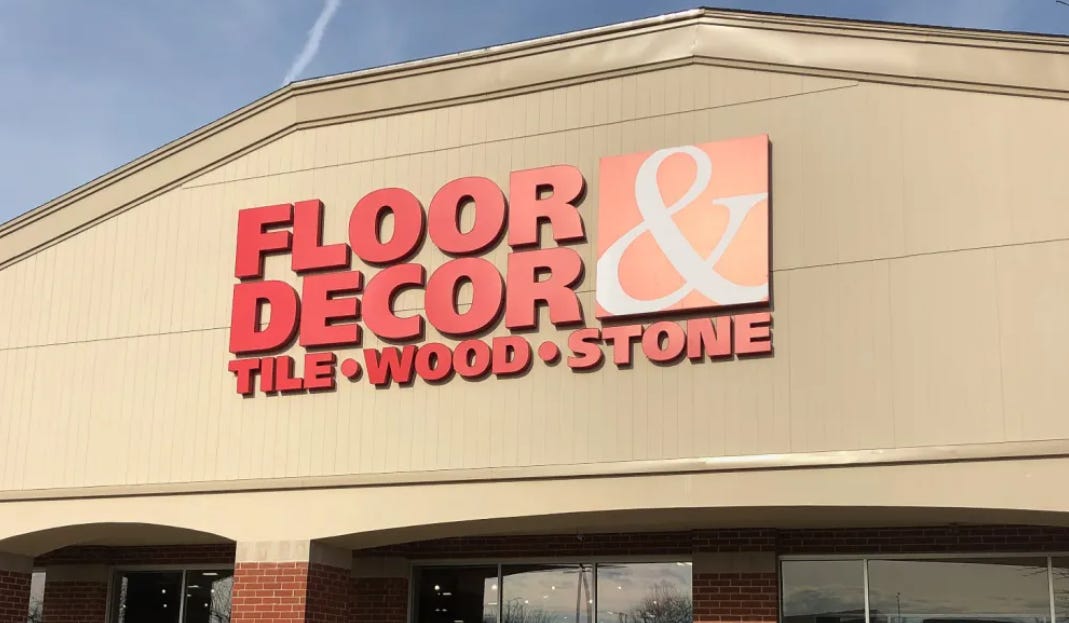
Floor & Decor sources its flooring products straight from its suppliers and is able to cut out the middleman. This enables them to offer the lowest prices on many of their products.
I believe they have a defensible moat against Home Depot and Lowe’s because they specialize in flooring and have 50 - 70K+ square foot warehouses entirely devoted to flooring products. Even the two home improvement giants Home Depot and Lowe’s typically only have 3,000 - 5,000 square feet (a few aisles) in their warehouse devoted to flooring.
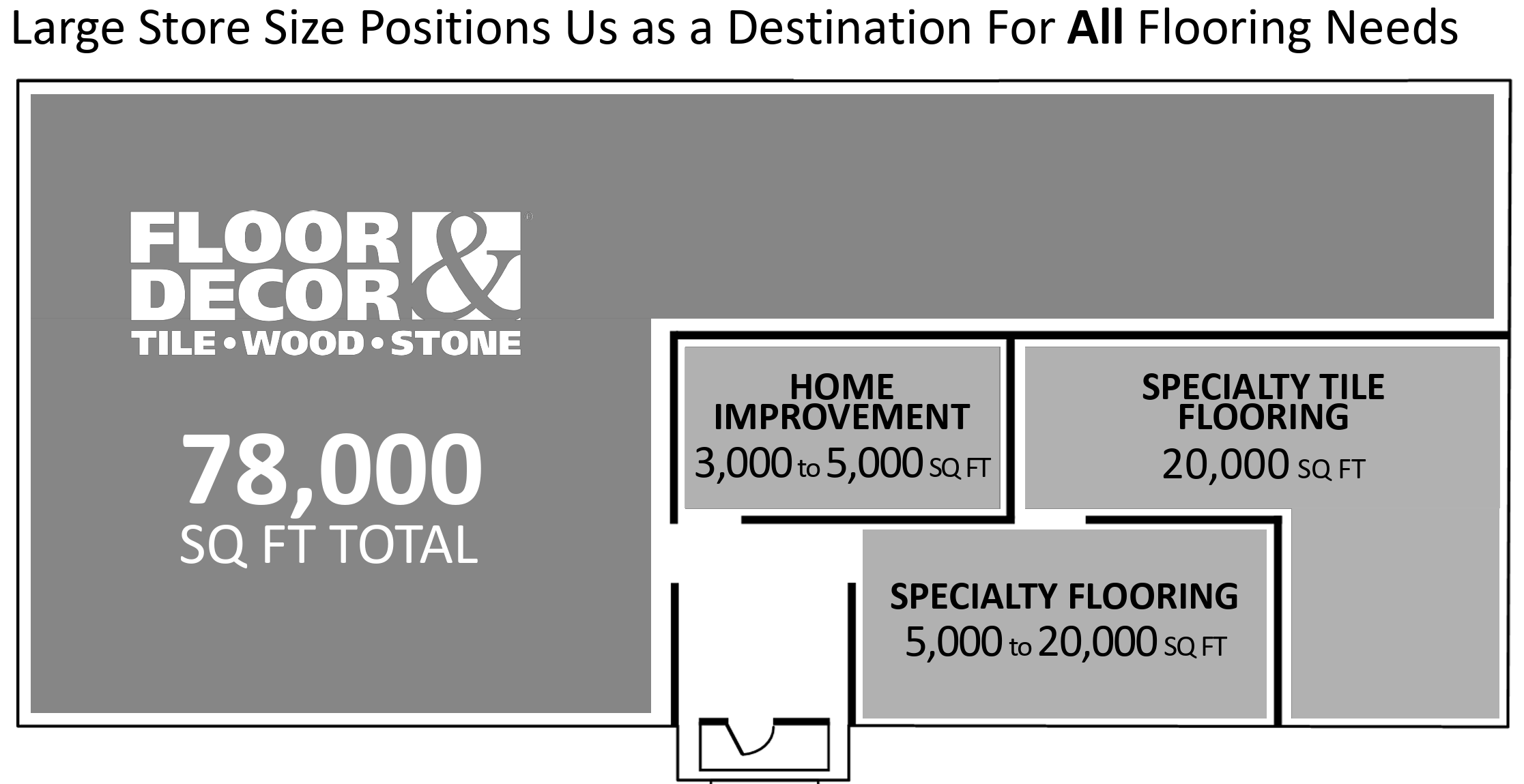
Floor & Decor can win over time because they can offer everyday low prices and offer the largest selection with the most in-stock inventory.
Not only does Floor & Decor typically win on price but they are also more likely to have in-stock inventory since their “flooring footprint” is usually 3 -15x+ larger than its competitors.
Time is money and when professional contractors need to get a job done, they may simply choose Floor & Decor over competitors because they are more likely to have the inventory in stock and the contractor can get the flooring same day versus having to wait a few days or weeks to get the product somewhere else.
Floor and Decor has a plan to open 500 stores and is currently a little over halfway to their goal. They are opening roughly 20 stores per year (will likely be 10 - 15 in 2027), and the unit economics are attractive. I believe normalized operating margins are probably double what they are currently at (10%+ vs. the current mid-single digits).
Fortress-Like Balance Sheet Will Enable Floor & Decor to Get Stronger During the Downturn
Floor & Decor has a rock-solid balance sheet with a net cash position, providing the company with the financial flexibility to continue investing and gaining market share throughout the current housing downturn. Importantly, the company can fund its store expansion plans through internally generated cash flow without relying on external financing or taking on significant additional debt. This financial strength is particularly valuable in a cyclical industry, allowing Floor & Decor to continue investing while weaker competitors may be unable to survive.
Floor & Decor operates a differentiated, flooring-focused warehouse model that few competitors have replicated at a comparable scale. Unlike generalist retailers such as Home Depot and Lowe’s, Floor & Decor can concentrate its purchasing power, inventory, and operational expertise on a single category. Combined with its strong financial position, this gives management the flexibility to remain selective and disciplined in pursuing new locations rather than expanding simply for the sake of growth.
Market Opportunity
The U.S. hard surface flooring addressable market is projected to be roughly $40 billion annually. Floor and Decor stated that their total TAM was roughly $49 - $54 billion with adjacent categories included.
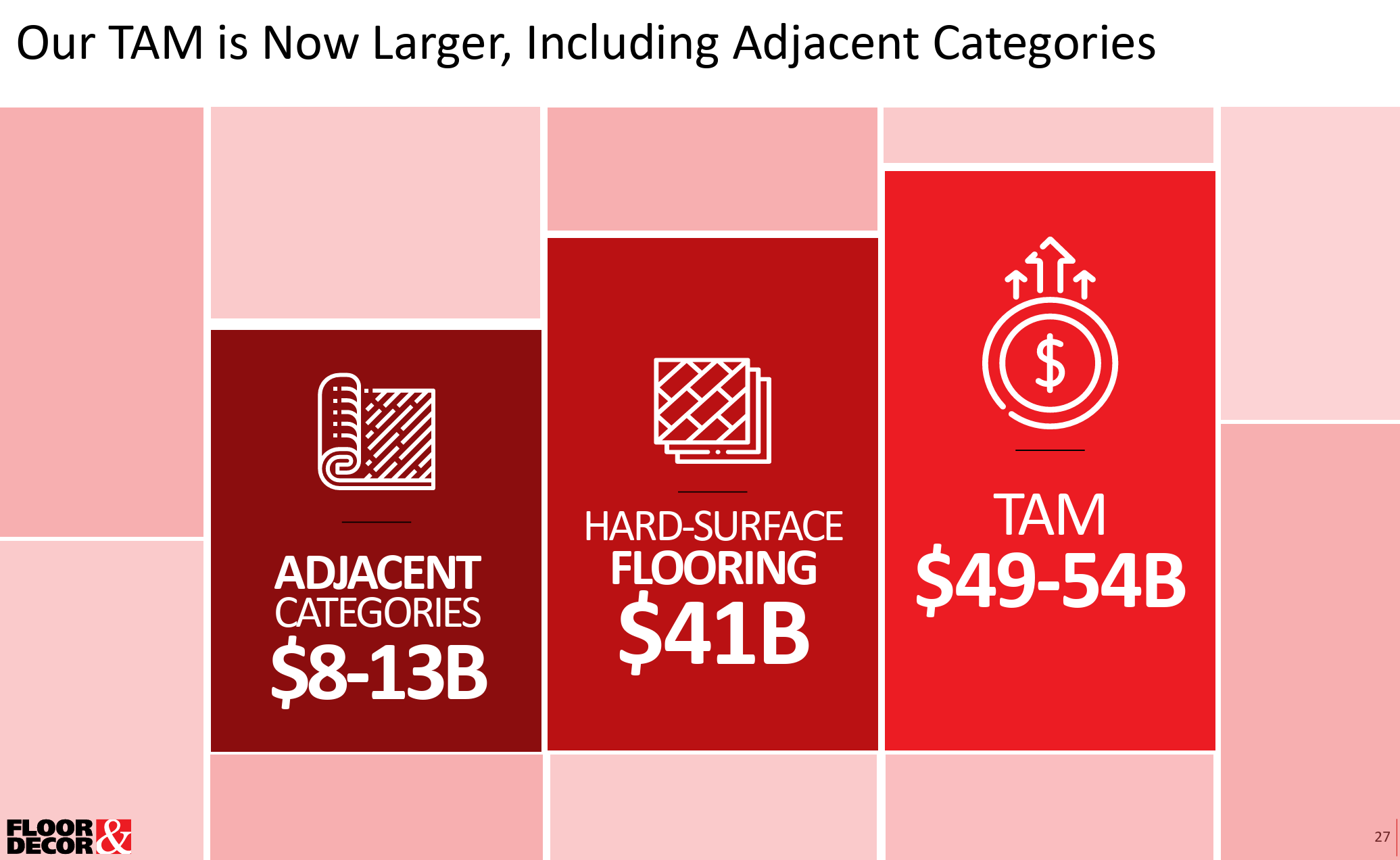
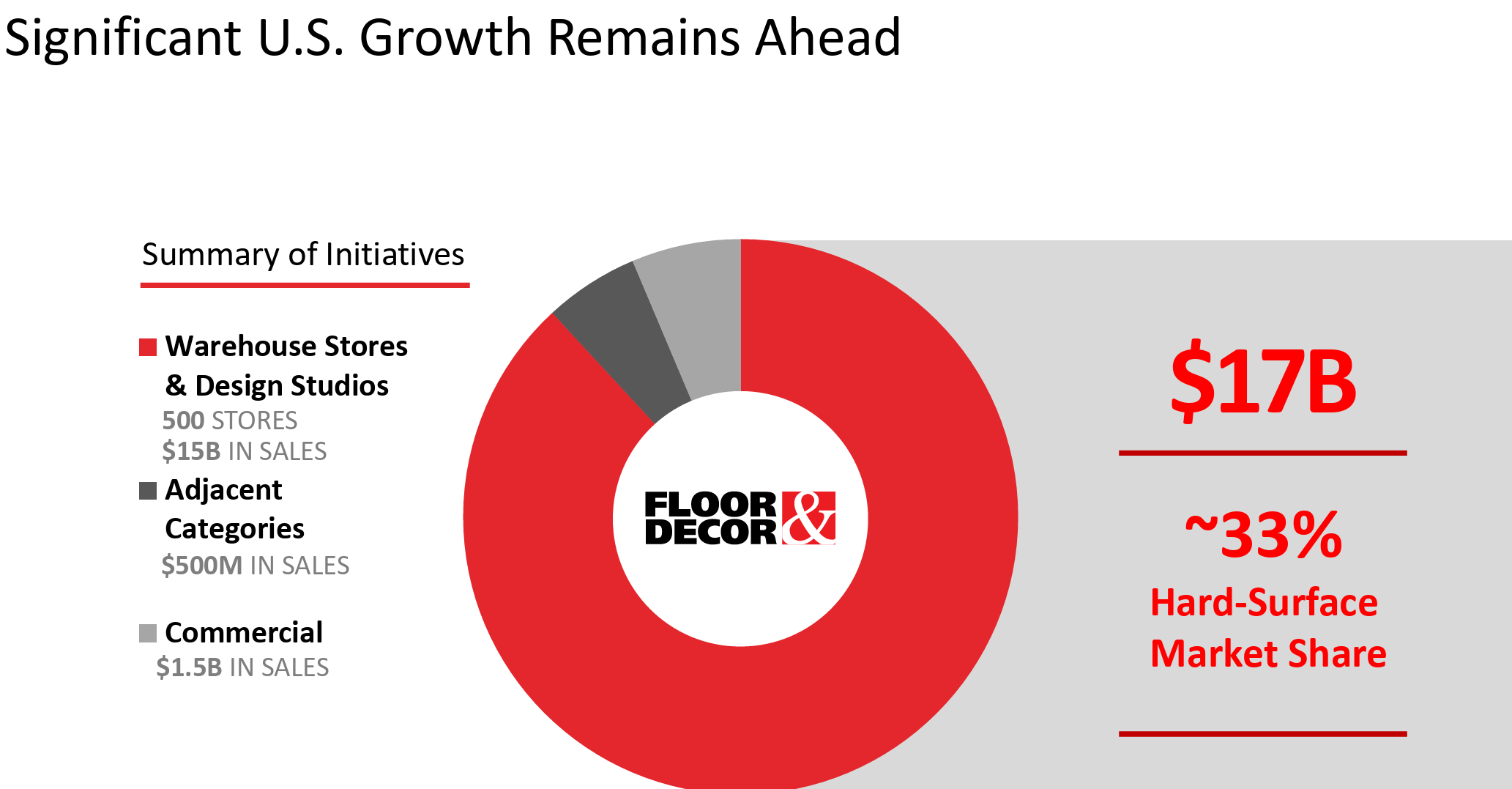
Floor & Decor’s long-term goal is to capture 33% of the hard surface flooring market in the U.S. and generate $15 - $17 billion in sales. Based on their current revenues approaching $5 billion, Floor and Decor already has more than 10% market share.
Here is their gameplan:
Floor & Decor has outlined a long-term goal to operate at least 500 warehouse stores across the United States. With 282 locations today, the company is already more than halfway toward that target. Assuming management maintains a pace of approximately 20 new store openings annually, Floor & Decor could reach 500 locations within the next 10–11 years. Management has tempered its expansion plans a bit given the current weakness in the housing market and plans to open 10 - 15 stores in 2027.
Store Economics
Management has also indicated that a mature warehouse store has the potential to generate approximately $25–30 million in annual revenue. At 500 locations, that would imply a long-term revenue opportunity of roughly $12.5–15 billion, compared with less than $5 billion today.
Importantly, this growth opportunity does not depend entirely on a recovery in the housing market or meaningful same-store sales increases. Much of it could come simply from expanding the store footprint and allowing newer locations to mature. If Floor & Decor can simultaneously improve store-level profitability and leverage its growing purchasing and distribution scale, earnings could compound considerably faster than revenue over time.
Back in March 2022, Floor & Decor outlined its target economics for new warehouse stores, projecting that a mature location could generate more than $5 million in annual four-wall EBITDA by its third year of operation. Based on projected first-year revenue of $14–16 million, this suggests the potential for attractive store-level profitability as locations mature.
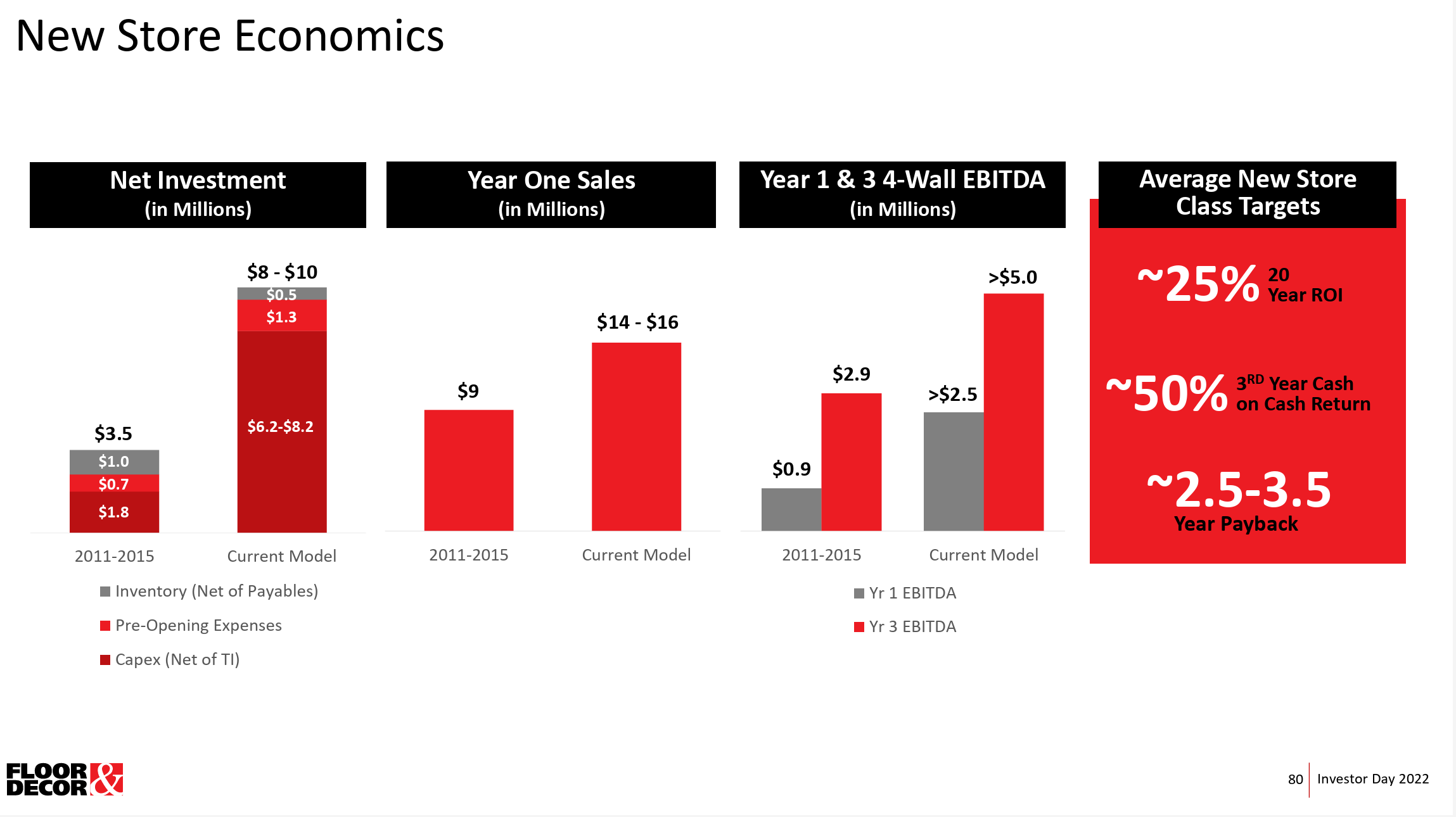
Management also targeted approximately 25% returns on invested capital over a 20-year period, 50% cash-on-cash returns by year three, and a payback period of just 2.5–3.5 years. These are compelling economics for a retailer with a substantial runway for new-store expansion.
However, it’s important to put these projections into context. They were presented in early 2022, before the Federal Reserve’s aggressive interest rate hikes and the subsequent slowdown in housing turnover and remodeling activity. Higher construction and occupancy costs have also pressured new-store economics in recent years.
Nevertheless, I believe these historical targets provide a useful indication of the earnings power Floor & Decor’s warehouse model could achieve under more normalized housing conditions, particularly as management shifts toward smaller, less capital-intensive store formats.
Valuation
At approximately $47 per share, Floor & Decor trades at roughly 24x management’s midpoint 2026 adjusted earnings guidance. While that may not appear particularly cheap for a retailer experiencing declining comparable-store sales, I believe current earnings substantially understate the company’s normalized earnings power.
Floor & Decor’s reported free cash flow understates the cash-generating potential of its existing store base. A meaningful portion of capital expenditures is devoted to opening new warehouses rather than maintaining existing operations.
If we exclude growth-related capital expenditures and assume approximately $100–120 million in annual maintenance capex, I estimate that Floor & Decor could generate roughly $350–400 million in normalized annual owner’s earnings, or approximately $3.30–$3.80 per share. At $47 per share, that implies a price-to-owner’s-earnings multiple of approximately 12–14x, considerably more attractive than its headline earnings multiple suggests. Importantly, this represents the cash-generating potential of the existing business before accounting for additional earnings from new-store expansion or a meaningful recovery in housing activity.
Some of the best long-term investments have rarely appeared cheap based on conventional valuation metrics. For businesses with substantial reinvestment opportunities, it’s important to distinguish between capital expenditures required to maintain existing operations and those directed toward future growth. By separating maintenance capex from growth capex, investors can develop a clearer picture of a company’s normalized owner’s earnings and the underlying cash-generating power of its existing business.
Takeaways
Floor & Decor continues to expand its store footprint and take market share despite one of the most challenging housing environments in recent history, and I expect a recovery in housing turnover, improving store-level economics, and greater purchasing and distribution efficiencies to drive meaningful earnings growth over the next several years.
What makes Floor & Decor particularly interesting is its long reinvestment runway. With approximately 282 warehouse locations and a potential domestic footprint of at least 500 stores, the company has an opportunity to nearly double its store count while strengthening its competitive advantages. Management’s transition toward smaller, less capital-intensive warehouses could further improve incremental returns on capital and accelerate long-term value creation.
I believe Floor and Decor has a strong management team that is aligned with shareholders. Both the CEO and CFO bought shares in the open market last May when the stock was trading around $50 per share. Moreover, for the first time management is starting to repurchase stock, which is a great sign when the stock is priced at cyclical lows. A $400 million share repurchase was announced during the Q1 earnings call and over the last two quarters the company has repurchased roughly $157 million in stock, which is roughly 3% of the market cap just in the last two quarters.
I recently initiated a position at approximately $47 per share. While the timing of a housing recovery remains uncertain, I believe the market is placing too much emphasis on near-term cyclical weakness and not enough on Floor & Decor’s long-term competitive position and earnings potential. I believe Floor & Decor could double or triple sales over the next 5 - 10 years and expand margins over time.
It’s worth emphasizing that weakness in the housing market is likely to persist into 2027, as management noted on its most recent earnings call. Given the uncertainty surrounding the timing of a recovery, I prefer to initiate a smaller starter position rather than commit my full intended allocation upfront. This approach allows me to establish exposure to a business I believe is attractively valued while preserving the flexibility to add to my position if continued market weakness creates an even more compelling buying opportunity.
For investors willing to look beyond the current housing downturn, I believe Floor & Decor offers an attractive opportunity to own a high-quality specialty retailer with the potential to compound earnings at double-digit rates for many years to come.
*I own shares in Floor & Decor (FND). This article should not be construed as investment advice and investors should conduct their own due diligence and consider their risk tolerance and financial situation before making an investment decision. Portions of this article were developed with the assistance of AI, which I used primarily for editing, organization, and refining the presentation of my analysis. The investment research, conclusions, valuation assumptions, and opinions are my own.
Great write up. Coincidentally, we’re heading to Floor and Decor momentarily.
Nice writeup, I do think it is interesting here. However, $392m cash + 124 A/R - 194m LT debt - 169 Current Lease Obl - 791 A/P - 290m accrued Exp doesn't look like 'net cash' to me.
Ignoring another $72m in non-current liability like taxes. Looks like $1.82 Bn in debt and leases owed in total.