

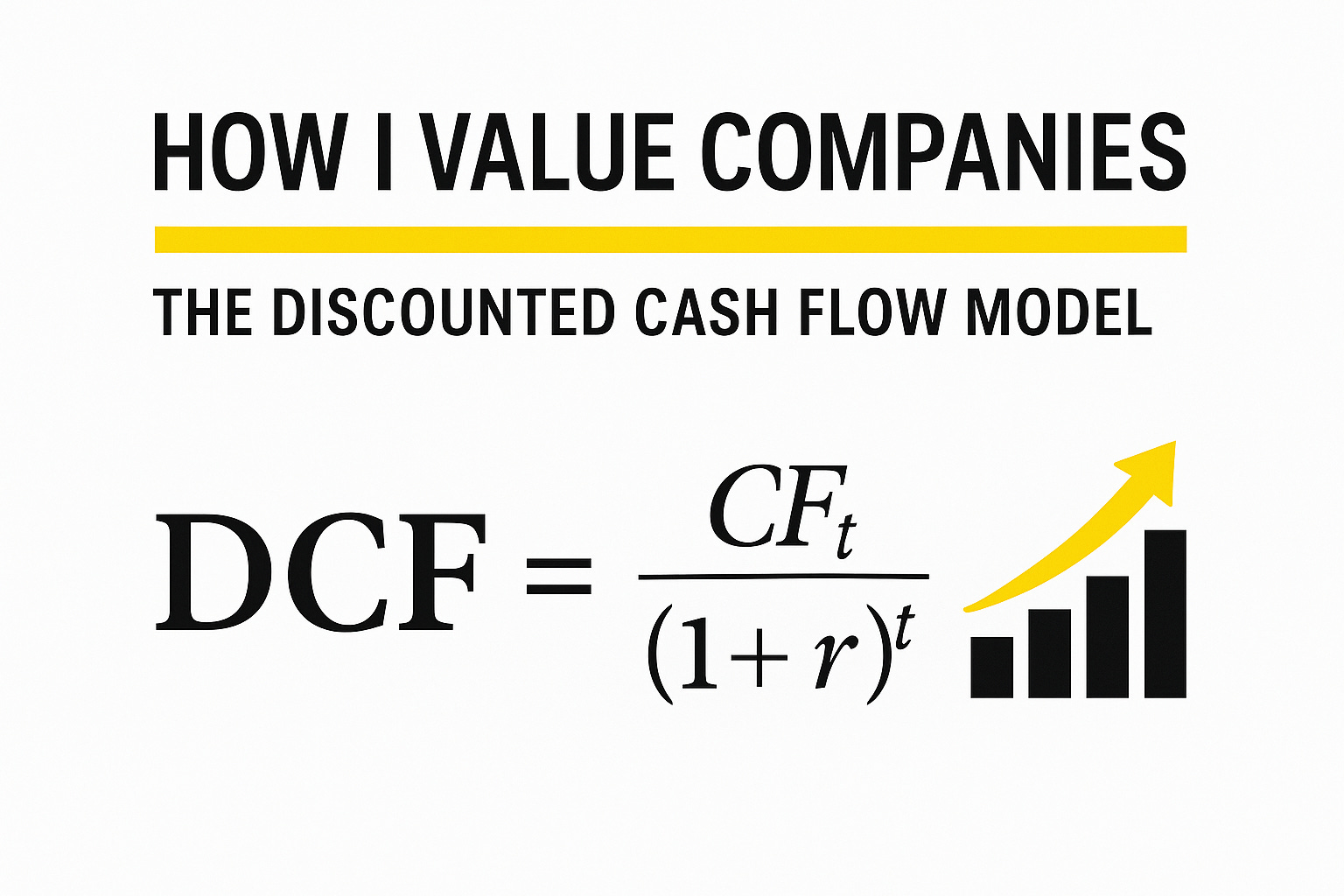
Today I wanted to walk readers through how I analyze a company and estimate what a stock is actually worth. Today we’ll start with a discounted cash flow model.
Why do I prefer discounting free cash flows and not earnings?
Earnings per share (EPS) is an accounting measure of profit that includes charges for non-cash items like depreciation, amortization, and stock-based compensation, which can make it very different from the actual cash a business generates.
Free cash flow (FCF), on the other hand, measures the actual cash left over after a company pays its operating expenses and the capital expenditures required to maintain and/or grow the business.
Because FCF reflects the true economic profitability of a company, it’s harder to manipulate and provides a clearer picture of a company’s ability to return money to shareholders through dividends, stock buybacks, or debt reduction.
EPS can look strong even when a company is burning cash, while solid free cash flow is often a much better indicator of financial health.
For valuation purposes, FCF is usually the superior metric because it represents the actual money an owner could pull out of the business.
Stocks represent ownership stakes in real businesses.
And in my view…
the only reliable way to beat the market over the long run is to buy businesses when they trade at a large discount to their intrinsic value.
But what exactly is intrinsic value?
There are several ways to think about it, but my favorite definition of intrinsic value is this:
Intrinsic value is the present value of all the future cash flows you could extract from a business.
Those future cash flows don’t all have the same value, though—because a dollar received in the future is worth less than a dollar received today.
Why Do We Discount Future Cash Flows?
Future cash flows must be discounted back to their present value because money in the future is worth less than money today. This happens for three main reasons:
Opportunity cost – if you had a dollar today, you could invest it in something and earn a return. If you receive that dollar one year from today, it loses money through inflation and the opportunity cost of not being able to invest it.
Inflation – future dollars buy less than today’s dollars. Inflation subtlety erodes purchasing power over time.
Risk – the future is uncertain, and cash flows many years out are far less certain than cash flows today.
The discount rate captures all three of these factors.
Understanding the Time Value of Money
To illustrate the idea, imagine I gave you a choice:
Take $100,000 today or $200,000 in 10 years—which would you choose?
It might seem obvious to take $200,000… but it depends.
If you could invest $100,000 today and earn 8% per year for 10 years, it would grow to:
$215,892.50
In that scenario, taking the $100,000 today and investing it at the 8% is the better deal.
But if you could only earn 6%, then the $100,000 would grow to:
$179,084.77
Here, taking $200,000 in 10 years is the smarter choice.
Now let’s consider inflation…
If you simply put the $100,000 under your mattress and inflation averages 2% per year, the purchasing power of that money in 10 years would decrease to:
$82,034.83
So, if you couldn’t invest the $100,000 you received today, you’d be better off taking the $200,000 in 10 years.
This example shows how the value of money depends on when you receive it, and what return (or “opportunity cost”) you could earn elsewhere.
What Is the Discount Rate?
In the example above, an 8% return means:
$215,892.50 in 10 years is equivalent to receiving $100,000 today.
That 8% return you require is called the discount rate.
And when valuing stocks, the discount rate is one of the most important assumptions you will make.
The discount rate is the return investors require to compensate for the time value of money and the risk or uncertainty of the future cash flows.
In other words, it represents the opportunity cost of putting your money into this business instead of another investment with a similar level of risk.
This is the foundation of the discounted cash flow (DCF) model.
A Real-World Example using Sirius XM
Let’s walk through a quick real-world example using one my current stock holdings - Sirius XM (SIRI).
*For further reading on SiriusXM, check out original writeup here: Deep Dive into Sirius XM’s Valuation
A discounted cash flow (DCF) model estimates what a company is worth today based on the cash it will generate in the future. For Sirius XM, the idea is simple:
If we know (or estimate) how much cash Sirius XM will produce each year, we can “discount” those future dollars back into today’s dollars and add them up to find the company’s fair market value.
Here’s how the model works, step-by-step:
1. Start with today’s free cash flow
Sirius XM’s management team increased free cash flow guidance for 2025 to $1.225 billion.
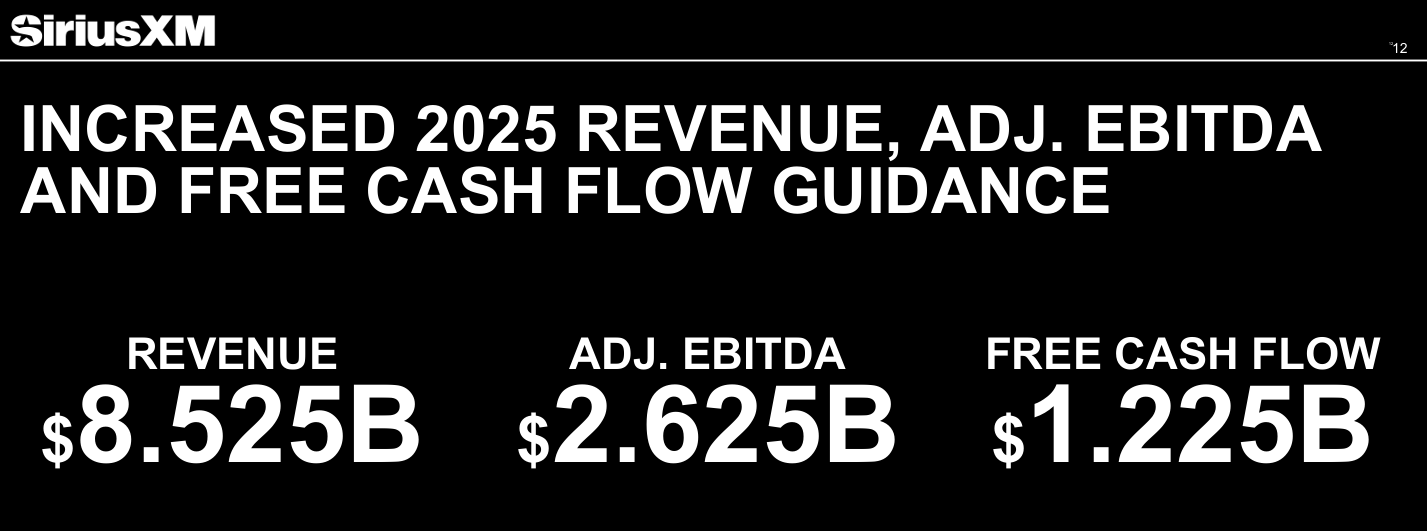
This is the cash left over after the business pays for everything it needs to operate.
You’re basically asking:
“If the company keeps generating cash like this, what is it worth?”
2. Estimate how fast that cash flow will grow
Let’s assume:
5% FCF growth per year for the next five years
So, free cash flow grows from $1.225B today to about $1.49B in year 5.

This isn’t a guess — it’s a conservative assumption based on:
flat or even slightly negative revenue growth
the fact that SiriusXM is implementing cost cuts
stable margins - free cash flow margins averaged 21% from 2015 - 2024
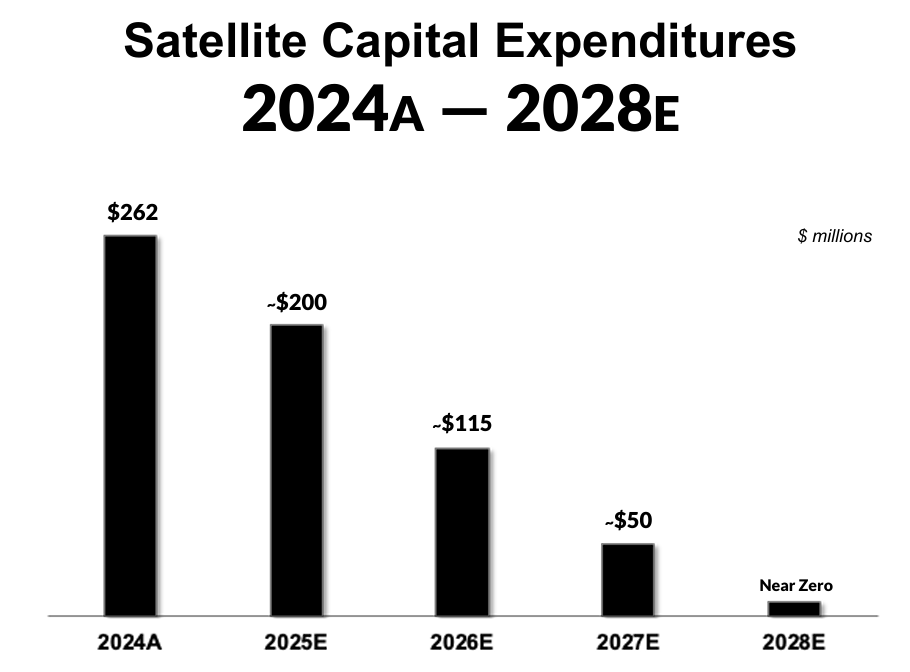
even with zero or slightly negative revenue growth, SiriusXM’s free cash flow is very likely to increase another $200 million by 2028 since satellite capex will be near zero by then.
strong previous track record of generating free cash flow - Sirius XM has averaged about $1.44 billion in free cash flow over the last 10 years. This 5-year projection only assumes free cash flow reverts to the mean and gets back to normal (SiriusXM is on the tail end of a large capital expenditure cycle in which they are investing in new satellites. This is why current free cash flow is below normal)
3. Discount those future cash flows back to today
Money in the future is worth less than money today.
This means:
Cash you get this year is worth full value
Cash you get 5 years from now is worth less because of the time value of money and risk
So, let’s apply a discount rate of 5.7%, which is Sirius XM’s estimated weighted average cost of capital (WACC) as shown below.

We then divide each year’s cash flow by a discount factor to get the present value of the future cash flows.

4. Calculate the value of cash flows after year 5 (the terminal value)
After year 5, we’ll assume the business grows slowly at 1% per year.
Using a “cap rate” of 4.7% (discount rate – terminal growth rate), we estimate all future cash flows past year 5.

This big number is called the terminal value, and it represents the majority of the company’s worth in a stable, mature business.
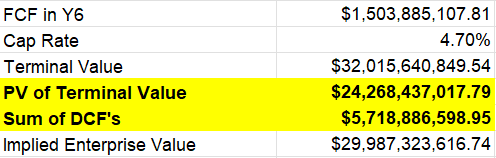
For Sirius XM, the terminal value comes out to:
$32.0 billion
We then discount it back to today to get its present value: $24.76 billion.

5. Add it all up to get the value of the business
When you add:
the discounted value of years 1–5 cash flows ($5.7 billion)
the discounted value of the terminal value ($24.26 billion)

We get:
Implied Enterprise Value: $29.99 billion
This is what the whole business is worth before subtracting the net debt.
6. Subtract net debt to get the equity value
Sirius XM carries about $9.998B of net debt (total debt - cash).
So:
$29.99B enterprise value
− $9.998B net debt
= $19.99B equity value

7. Divide by the share count to get the intrinsic value per share
Equity value ÷ 337M basic shares outstanding =
⭐ $59.32 per share (intrinsic value)
Even with fully diluted shares outstanding of about 356 million shares, intrinsic value for Sirius is still about $56 per share.
Compared to the current share price of $20.84, the model suggests Sirius XM is materially undervalued. Shares currently trade at a 65% discount to this estimated intrinsic value.

If we ended up with a value that was much higher than the highest price the stock had ever traded at, we should question our assumptions. Is our model too aggressive and should we be more conservative in our estimates?
To spot check our model, let’s check SiriusXM’s previous price levels. SiriusXM traded above $60 per share (split adjusted) many times from 2018 - 2022, so our estimate is likely not overly aggressive.
But as a value investor, I like to be overly cautious. Let’s suppose our DCF model overstated Sirius XM’s intrinsic value by as much as $20 per share. Now we say it’s only worth $40 per share. That is still nearly double the current stock price.
This is why I typically only purchase stocks when they are trading at 1/3 or less of my conservatively estimated intrinsic value. This gap between current price and estimated intrinsic value is an investor’s “margin of safety.”
The Power of Free Cash Flow Yield - Returning Money to Shareholders
Since Sirius XM’s estimated 2025 free cash flow is $1.225 billion, that means they will generate roughly $3.64 per share in free cash flow, which equals a 17.4% free cash flow yield on the current share price of $20.84 (as of December 2nd, 2025).
Despite a flat stock price, Sirius XM quietly generated $709 million in free cash flow over the first nine months of 2025. See the statement of cash flows below. $1.218 billion in operating cash flow less the capital expenditures of $509 million = $709 million.
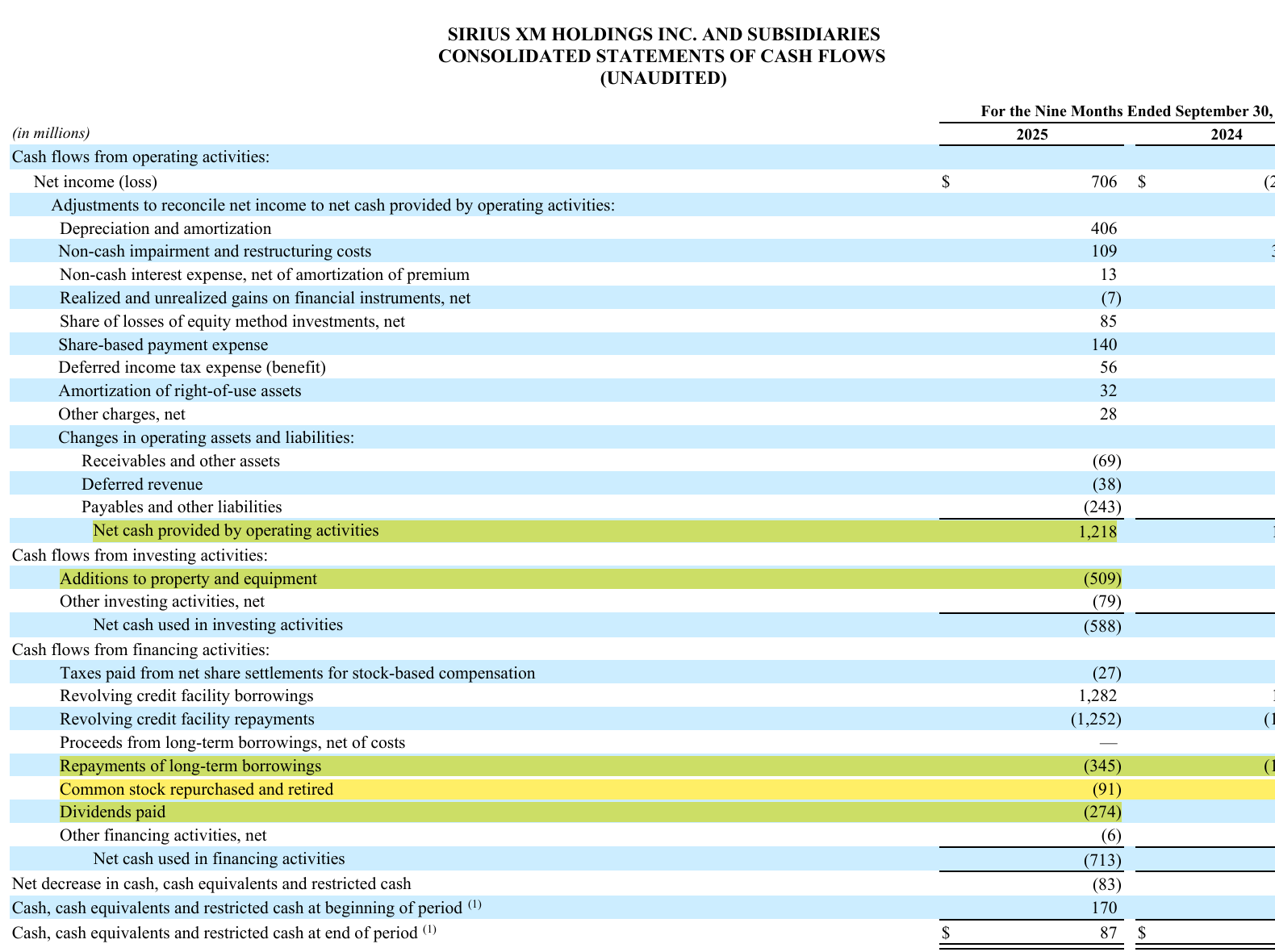
That cash is powerful: Sirius XM used roughly $710 million to pay dividends, buy back stock, and reduce debt—effectively returning the entire amount of free cash flow to shareholders and strengthening the balance sheet.

This is the key point many investors miss: even if the share price doesn’t move, owners still win when a company with a high free cash flow yield consistently sends cash back to them.
Over time, buybacks increase each shareholder’s ownership percentage, dividends provide direct cash returns, and debt reduction increases the equity value of the business. At the current free cash flow yield of 17.4%, Sirius XM will generate the entire market value of the company just in free cash flow in less than 6 years!
A stagnant stock price does not mean stagnant returns—high free cash flow yield plus disciplined capital returns can quietly compound shareholder value beneath the surface.
Eventually the stock price will reflect the underlying intrinsic value of the business.
Takeaway
The key tenants in obtaining the most reliable discounted cash flow valuations are conservatism and predictability. DCF models are subject to large changes in value based on different growth and discount rate assumptions.
The more stable and predictable a company’s financials are the more accurate the DCF model is likely to be. Sirius XM is a good example of a company that is stable and predictable.
SiriusXM is a stable, low growth, “cash cow” with a sticky customer base and revenues are primarily subscription based. Sirius XM’s average free cash flow for the last 10 years has been about $1.44 billion, and they have never had a year of negative cash flows.
Obviously, discounted cash flow models won’t work well for valuing speculative growth companies with negative free cash flows. The more conservative you can be in your estimates, the better.
DCF models are about reasonable estimates, not perfection. Conducting discounted cash flow models can be a great way to spot check valuation and make sure you are investing with a margin of safety.
*If you enjoy value investing research like this, consider subscribing. I publish independent, high-conviction value ideas and honest updates as the facts change. I used AI tools for editing, formatting, and grammar, but all research, analysis, and conclusions are my own. I own shares in SiriusXM (SIRI)
appreciate how you broke this down. Most people get lost in EPS talk and miss the whole point — cash is the accurate scoreboard. The DCF walk-through hit that perfectly. What stood out is how predictable FCF turns a “boring” business into a compounding machine, especially when buybacks and debt paydown quietly build value in the background.
What really clicks is your margin-of-safety filter. Buying at 1/3 intrinsic value feels almost old-school Graham, but it’s the only thing that consistently works when the numbers flatten out all the market noise. And the point about terminal value being most of the valuation? Most retail investors skip right past that part and totally misread the math.
The Sirius example makes it clear: if you’ve got stable FCF, low capex ahead, and a management team returning real cash, price stagnation is basically a disguise — the compounding is happening underneath.
Curious what you think about this:
When you’re running a DCF on a stable, low-growth “cash cow,” what’s the first assumption you stress-test to see if the whole valuation could break? Growth rate, discount rate, or capex normalization?