

Today I wanted to update readers on the performance of all of my 17 writeups since I started this newsletter.
The results have been satisfactory with 12 winners and 5 losers, good for a 70.6%-win rate. The average gain on my picks so far has been roughly 28% and the average loss has been 23%.
Here is a breakdown of all of the 17 stocks I have written about since I started this Substack and their performance.
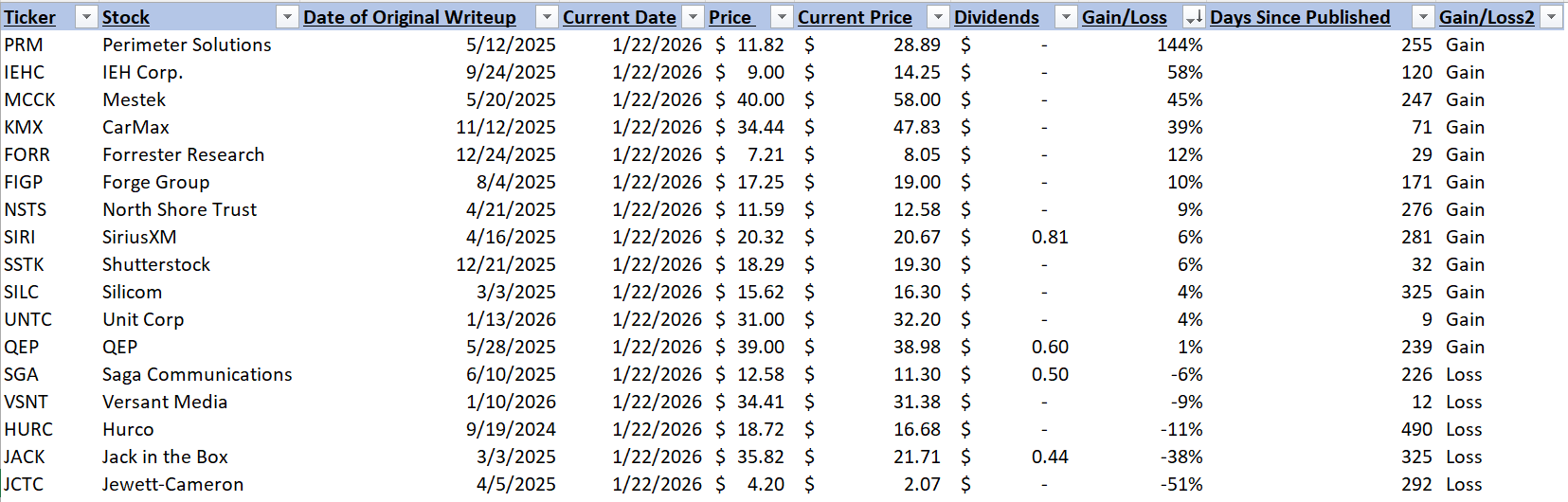
The best performers have been:
Perimeter Solutions (PRM) - up 144%. Perimeter Solutions has a monopoly in the niche fire retardant industry and is the sole supplier to the US Forest Service. They have a strong regulatory moat and are replicating the TransDigm (TDG) operating playbook. Here’s my original writeup on the stock: Perimeter Solutions: The Little-Known Monopoly Dominating a Critical Niche. I sold the position after it had reached my intrinsic value targets. I still like the stock; I just choose to redeploy the capital in other value investing opportunities.
IEH Corp (IEHC) - up 58% - IEH is the only U.S. company that supplies hyperboloid connectors for printed circuit boards and is an overlooked, niche supplier in the aerospace/defense industry. Two of IEH’s largest customers are Boeing and Airbus along with other large defense companies such as Lockheed Martin, Northup Grumman, and General Dynamics. The founder’s great grandson runs the company and owns more than 25% of the stock. I bought the stock when it was trading near net current asset value and at less than 3x EV/normalized EBIT. IEH just had some positive news, and they are likely to uplist to a larger exchange at some point. I trimmed the position slightly after the recent runup but plan on holding at least half of my original position for the long-term. IEH has seen some temporary headwinds on their operating margins since gold prices have run up. However, since IEH is often a “sole source” supplier, they should be able to raise prices to offset the cost increases.
Mestek (MCCK) - up 45% - Here’s the original writeup on Mestek: Mestek: A Profitable HVAC Company Selling at 3.5x EV/EBIT and Just Below Net Current Asset Value. Mestek is an HVAC company that has been consistently profitable for years and has a large balance of cash and investments with little debt. The founder took over the business from his dad and owns a majority stake in the company. I sold the position because most of their investments are in gold and other commodities and I believe the price is now fully reflecting the runup in gold prices.
CarMax (KMX) - up 39%. CarMax at 13-Year Lows: A Value Investor’s Perspective
I bought CarMax after the stock got obliterated and was trading near a 13-year low. CarMax probably has one of the strongest competitive moats among all the car dealers and when I bought the stock, it was trading for less than 80% of book value. The strong selloff came after the company had reported disappointing results and they had fired their CEO. CarMax has yet to find a permanent CEO, but I still like the stock long-term.
The stock has now run up a bit. I believe CarMax should earn something like $3 per share when they report their next fiscal year earnings. CarMax is likely fairly valued in the short-term trading around 15x earnings as of this writing. However, as I stated in the article, I think CarMax is probably worth at least $90 per share over the long-term once the auto industry recovers and they return to earning mid-cycle margins.
The 2 worst performers have been Jack in the Box (JACK) and Jewett-Cameron Trading Company (JCTC). Thankfully, I cut my losses on these and don’t own them anymore because my investment thesis changed and I became increasingly concerned about management and capital allocation at both of these companies.
A Word on “Net-Net” Stocks
Early on, I spent a lot of time researching net-net stocks, which can offer attractive upside when purchased at sufficiently deep discounts. A “net-net” is a stock trading at a discount to its net current asset value. Silicom, Hurco, and Jewett-Cameron were net-nets when I wrote about them. Many prominent value investors have done well investing in a widely diversified basket of “net-nets.” The problem today is that it’s harder to find legitimate companies selling at a discount to net current asset value. I’ve found maybe 8 -10 in the U.S. that I believe might be worth a small investment. There are many more in countries such as Japan and South Korea, but I haven’t really done much international investing.
Over time, I’ve come to believe that “net-net” investing generally works best when applied across a large basket of positions, where a few outsized winners can offset inevitable disappointments.
I think the only way concentrated “net-net” investing can work is finding the ones that have had a consistent track record of profitability, and companies where the insiders/founders own a large percentage of the stock. I believe these factors are why IEH and Mestek have performed well. The challenge is obviously in finding these higher-quality companies. I’ve found maybe 2 - 3 U.S. based companies that meet these criteria.
Unless an investor is a control investor with the ability to influence outcomes, concentrating heavily in individual net-net stocks introduces more risk than I’m comfortable taking. Jewett-Cameron was the worst performer and was a “net-net” stock. The company’s founders own very little stock, and the company could very well be insolvent in the near-term if they continue to burn money.
As a result, I’ve shifted away from most net-net investing and have moved towards concentrating in a fewer, higher-quality situations.
A Little Background About Me
I’ve been interested in value investing since college and have spent years studying it. I’ve read nearly every major work on the subject—Security Analysis, The Intelligent Investor, Buffett Partnership and the Berkshire Hathaway annual letters among my favorites—along with many others. I’ve also passed Level I of the CFA exam and completed the Level II coursework, which has further shaped my analytical approach.
My goal with this newsletter is to help readers identify attractive value investments by focusing on what matters most: buying assets with a margin of safety. I prioritize downside protection, balance sheet strength, and mispriced earning power over short-term narratives or market sentiment.
For readers who are new here, I run a concentrated value portfolio focused on a small number of deeply researched ideas. I typically hold 7–10 positions at any given time and keep a meaningful cash balance to deploy opportunistically when mispricing’s emerge.
Last year, my portfolio was up 41%. This was probably an unusually good year, and I will be happy if I can do 15 - 20% over the long-term.
I also occasionally invest in “event-driven” opportunities that are not as correlated to the market indexes. These include investments in spinoffs, short-term tender offers, merger arbitrage, and distressed debt. Here’s an article about why I like to have a portion of my portfolio in “event-driven” types of investments.
Thanks for reading and happy investing!