

I’ve been thinking a lot lately about how to maximize risk-adjusted returns within my portfolio.
Most investors spend the majority of their time searching for new ideas. That’s important—but what’s arguably more important is what you do after you’ve found one: how you size the position.
In my previous article, A Value Investor’s Portfolio Construction Playbook, I discussed the optimal number of stocks to own and why excessive diversification can dilute returns and hinder your chances of outperforming the market indexes.
This article takes the next step.
Once you’ve decided how many stocks to own, the real question becomes:
How do you construct your portfolio, so your best ideas actually matter?

The Position Sizing Dilemma
There’s a balance here that most investors struggle with.
If you underweight your best ideas, they won’t meaningfully impact returns—even if you’re right.
If you overweight them, a single mistake can materially impair your portfolio.
There’s also a behavioral component.
When a position becomes too large, you’re far more likely to react emotionally to price volatility. It’s easier to get too attached to one position, overthink it, and it can feel personal. That’s when mistakes happen.
On the other hand, if a position is too small, it’s easy to ignore and a good outcome may not contribute meaningfully to your overall portfolio results —even if it ends up being a multi-bagger.
So, the goal isn’t just to find great investments. It’s to size them in a way that balances conviction, downside protection and risk management. At the end of the day, one of the most important things is the ability to stick with an investment strategy over the long-term. My strategy is concentrated value investing but there are other strategies that can work as well.
A Simple Framework I Use
Over time, I’ve developed a simple framework to guide my position sizing decisions:
Expected Upside / Expected Downside
It’s not perfect, but it forces me to think probabilistically and stay grounded in both the bull and bear cases.
Let’s walk through an example using PayPal—a position I currently own and have written about previously.
PayPal: A Real-World Example
At my cost basis, PayPal was trading at roughly:
~8x earnings
~6.5x EV/EBIT
The market was clearly pricing in very little growth—and possibly long-term decline.
Now, I have no idea what the stock will do in the short term. But I do believe the current price reflects a material undervaluation.
That said, I could absolutely be wrong.
Bear Case
If PayPal turns into a “melting ice cube,” earnings could stagnate or decline. In that scenario, the market might assign a 5x earnings multiple, implying a share price of roughly $27.
Base-to-Bull Case
If PayPal stabilizes and grows modestly, a 15x earnings multiple is reasonable. On current earnings, that implies a price of roughly $81.
With a cost basis around $42, that gives me:
Upside: +93%
Downside: -36%
Translating This into Position Size
From there, I calculate:
Upside / Downside = 93% / 36% ≈ 2.6x
This ratio helps me anchor position sizing.
For a setup like this—roughly a 2.5x upside-to-downside profile—I’m comfortable sizing it at around 15% of the portfolio.
Not 5%. Not 30%. Right in the middle.
Perimeter Solutions: A Brief Case Study
To illustrate why proper position sizing is so important, I want to highlight an investment I made last year in Perimeter Solutions. You can read my original writeup here: Perimeter Solutions: The Little-Known Monopoly Dominating a Critical Niche.
At the time I began buying the stock about one year ago, I thought it was probably worth about $22 per share and the stock was trading around $9.50. So, I thought the upside was probably 132% and the worst-case downside was about 50%.
Thus, the expected return was 132% and the worst-case downside loss was 50% for an upside/downside ratio of about 2.64. I made Perimeter a 17% position in my portfolio at the time because it was one of my better ideas. The outcome turned out better than I expected and the stock nearly tripled. If I had only sized Perimeter at 3 - 5% of my portfolio, it wouldn’t have had a meaningful impact on my overall investment performance for 2025.
If I had been too aggressive and oversized it, I probably would have sold out too soon and gotten too emotionally attached to it because it had made up such a large percentage of my overall portfolio.
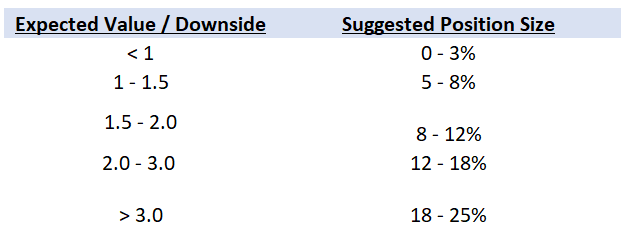
Below is a general framework I use to know how to size positions based on the expected value to downside ratios.
My Max Position Size Rule
I also impose a strict constraint:
I generally won’t invest more than 25% of my portfolio in any one stock—no matter how compelling it looks.
Even your best ideas can go wrong. Limiting position size protects against:
Thesis errors
Unknown risks
Bad luck
It’s less about limiting upside and more about ensuring survivability.
Where Kelly Criterion Fits In
If you want to take this a step further, the natural extension of this framework is the Kelly Criterion.
At a high level, Kelly tells you how much of your portfolio to allocate based on:
Your edge (expected return)
The probability of being right vs wrong
The magnitude of wins vs losses
The formula can be expressed as:
f* = (bp − q) / b
Where:
f* = optimal fraction of your portfolio
b = odds (upside relative to downside)
p = probability of success
q = probability of failure
Applying Kelly to PayPal (Simplified)
Let’s make a rough assumption:
Probability of success (base/bull case): 60%
Probability of failure (bear case): 40%
Upside: +93%
Downside: -36%
That gives us odds (b) of roughly:
0.93 / 0.36 ≈ 2.6
Plugging into Kelly:
f* ≈ (2.6 × 0.6 − 0.4) / 2.6 ≈ 0.45 or 45%
Now, this is where most people get into trouble.
Full Kelly is almost always too aggressive in practice.
Your probabilities are uncertain
Your inputs are imperfect
Markets are not static
So instead, I think about fractional Kelly.
Half Kelly → ~22%
Quarter Kelly → ~11%
This lines up pretty well with my intuitive position sizing of ~15%.
Knowing When to Sell
Proper position sizing also helps take the guesswork out of selling. I don’t know about you, but I definitely have a harder time knowing when to sell versus when to buy.
If a 15% position doubles and grows to 30% of your portfolio, trimming it back to 15% allows you to recoup your initial investment while still participating in future upside.
Instead of trying to time the market, you’re simply rebalancing back to your target weight—a far more disciplined and repeatable approach.
Conclusion
Position sizing is one of the most underappreciated drivers of long-term returns.
It’s not enough to be right—you have to be sized correctly when you’re right.
The best investors don’t just find great ideas. They:
Press their advantage when the odds are in their favor
Protect capital when they’re wrong
Stay disciplined regardless of short-term price fluctuations
For me, combining:
A simple upside/downside framework
A rules-based position cap
And a Kelly-based sanity check
…has been a powerful way to stay rational and consistent.
At the end of the day, investing is a game of survival and compounding.
And the investors who win aren’t necessarily the ones with the best ideas—
They’re the ones who size their positions correctly and prioritize risk management over how much they could make on any single idea.
Good post! I think I do something like this in practice. But I will calculate the upside/downside in a more structured way to see if I end up between half and a quarter Kelly criterion (I guess I will).