

Overview
IEH Corporation (OTC: IEHC) manufactures hyperboloid printed circuit board (PCB) connectors primarily for the commercial aerospace and defense industries.
IEH’s customers also include medical device manufacturers, oil and gas exploration firms, and commercial space launch companies. These hyperboloid connectors are known for exceptional reliability in harsh environments. IEHC’s products are mainly used in defense and military/commercial aerospace, where a long service life and vibration resistance are critical.
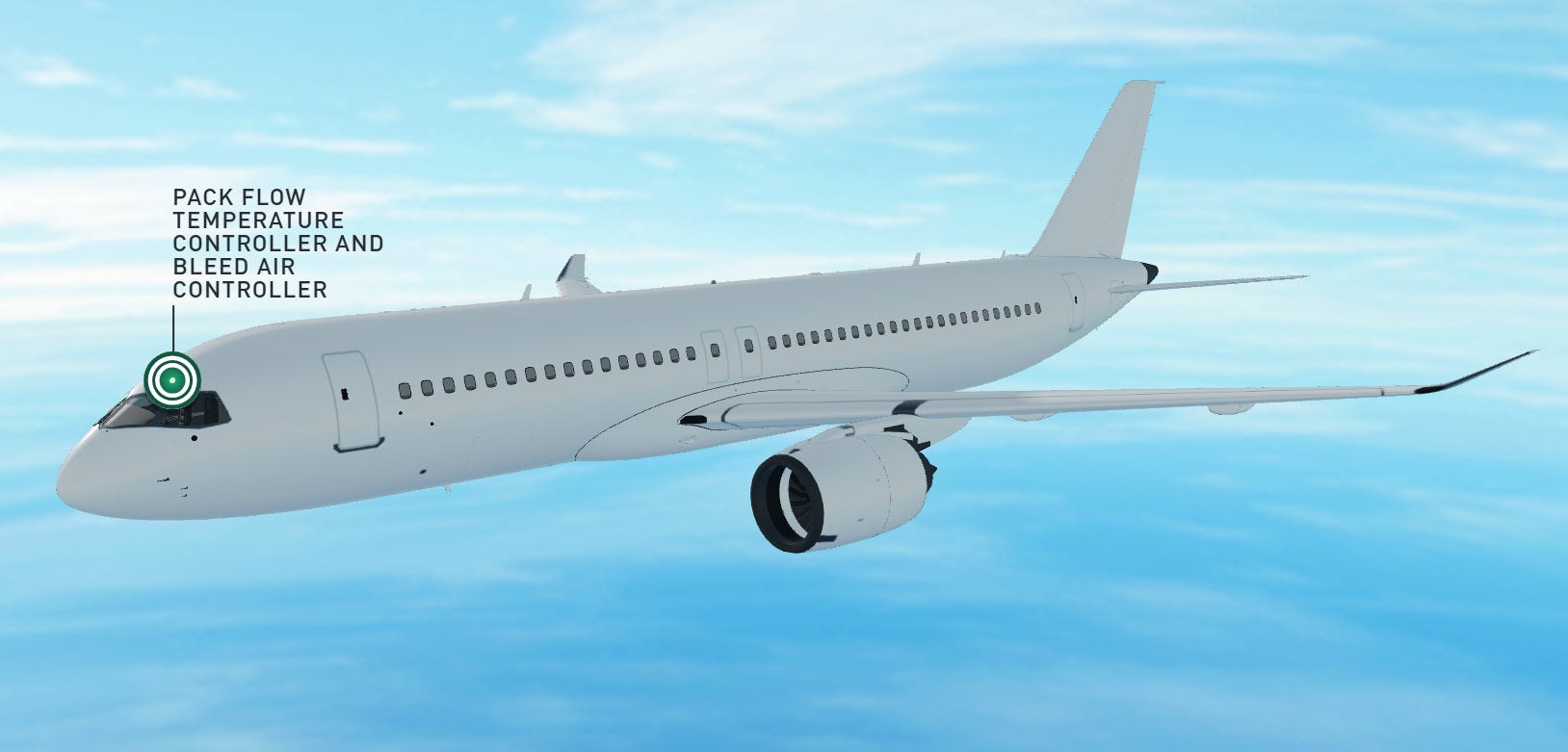
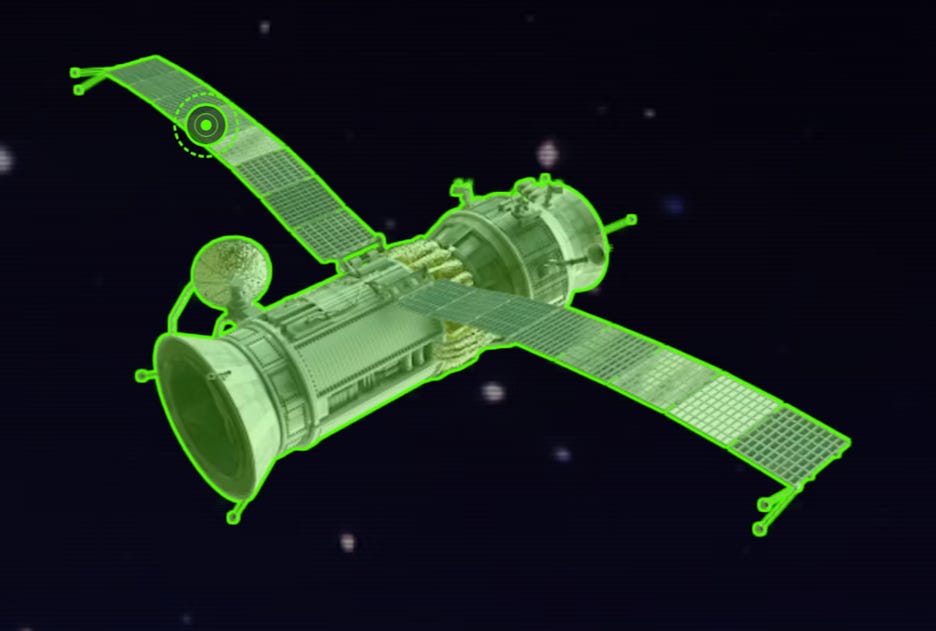
Once designed into a system (like a missile, radar, or aircraft engine controller), their connectors often become sole- or approved-source components, making IEH a long-cycle, high-reliability supplier to major defense primes, U.S. government agencies, and commercial aerospace OEMs like Boeing and Airbus. IEHC’s niche is small but defensible: highly engineered connectors that are “designed-in” and hard to displace once qualified. There is a cool graphic on their website that shows the products they make and where they are integrated into various applications such as jets, satellites, radars, and communication systems. IEH’s PCB connectors are used on both the Atlas and Vulcan rockets.
IEH Corporation is family owned and operated and was founded in the early 1940’s. IEH is based in Brooklyn, NY with an office in Allentown, PA and is run by Chairman and CEO Dave Offerman who is the great-grandson of the company’s founder.
IEH is the only company that designs and produces hyperboloid PCB connectors in the U.S. Per the company’s most recent 10K, “We believe we are the only independent producer of Hyperboloid printed circuit board connectors in the United States.” IEH’s only other meaningful competitor is Smiths Interconnect, which is a subsidiary of England-based Smiths Group and is currently in the process of being sold.
What has Created this Opportunity?
Boeing is one of IEH’s largest customers and the two 737 max crashes in 2018 and 2019 had a significant impact on IEH’s revenue. Then in 2020, the COVID pandemic brought most air travel to a halt. On top of that, IEH transitioned from a legacy “DOS based” accounting system to a more modern SAP system. As a result of this transition, IEH was late to file its financials with the SEC and had to rereport some figures that were misstated. IEH’s stock got hit with two “black swan” events at almost the same time - all while transitioning their inventory accounting software. These three events have caused a nearly 50% decline in IEH’s stock price over the last 5 years. IEH has fully transitioned to the new software system, and all their financials are now up to date. Moreover, demand for commercial air travel has roared back and the Covid pandemic is now well in the rearview mirror. IEH just reported a 33% increase in revenue from 2024 to 2025.
Valuation
IEHC is a tiny microcap stock, having a current market cap of just $21.5 million. IEH has $10.2 million in cash with no debt, meaning nearly half the company’s market cap is in cash! IEH’s current enterprise value is only $11.26 million as of September 16th, 2025. IEHC’s net current asset value is $7.52 (a rough approximation for liquidation value), which is just below the current share price of $9. To get a sense for IEH’s “normalized earnings,” I looked back from the period of 2009 – 2019 which was before the onset of the Covid-19 pandemic and the Boeing Max crashes. These two events were worst case “black swan” events for IEHC because of their large contracts with Boeing and the fact that most of their business comes from the commercial aerospace and defense industries. From 2009 through 2019, IEHC’s median operating income (aka EBIT) margin was about 16.3%.
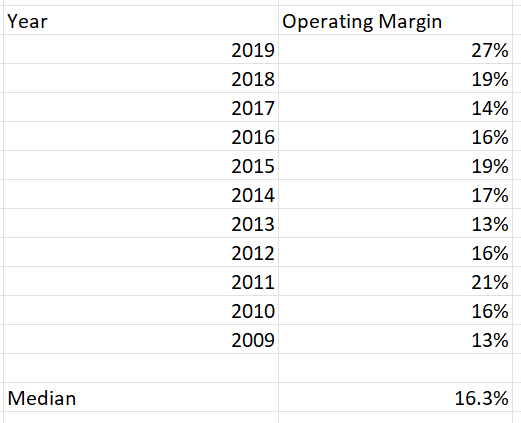
Applying the median operating income margin of 16.3% to the last fiscal year revenue of about $28.7 million equates to a “normalized EBIT” of $4.69 million. That means IEHC is currently trading at roughly 2x EV/“normalized EBIT”.
Strong Returns on Invested Capital
As mentioned in the introduction, IEHC’s niche is small but defensible. I estimate that IEH Corp should be able to earn something like 20 -25% returns on invested capital once revenues and margins return to pre-Covid levels. IEH is on the right track as it reported a 33.7% increase in revenue from fiscal 2024 to 2025. Per IEH’s most recent annual report, the increase in revenues was due to increase in orders from defense customers and an increase in revenue from commercial space exploration. IEH’s revenues are nearly back to where they were before the Covid pandemic.
In a whitepaper from Morgan Stanley, Columbia Business School professor Michael Mauboussin defines the operating and financing approaches to invested capital. I’ve calculated IEH Corporations invested capital in the table below.
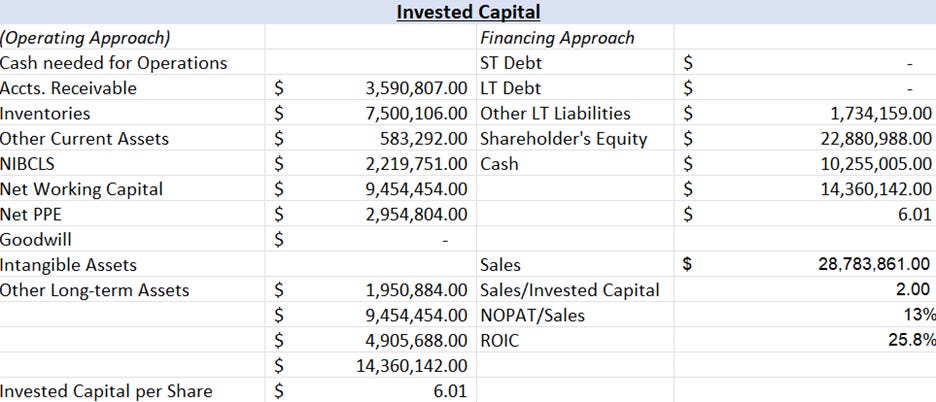
Using Mauboussin’s formula, I estimated IEH’s invested capital to be $14,360,142 as shown in the table above. Return on invested capital (ROIC) is defined as net operating profit after tax divided by invested capital. I am assuming IEH Corp’s “normalized net profit” to be roughly $3.7 million, which is the $4.69 million in normalized EBIT less taxes. I assumed a 21% tax rate. This equates to a roughly 25% return on invested capital. Over the long term, stock returns should roughly equate to the returns on invested capital, assuming all capital is reinvested into the business.
Insider Ownership
CEO and Chairman Dave Offerman has a track record of effectively allocating capital and creating value for shareholders. Since Mr. Offerman joined the company in September 2004, IEH’s stock price has increased more than 30x. A 30x return over a 21-year holding period equates to a 17.6% annualized return. And that 30x return includes a 50% decline in the share price over the last five years. From September 2004 – September 2019 (before COVID pandemic), IEHC’s stock price had increased over 70x, good for a 32.7% annualized return. Mr. Offerman took over the reigns of CEO in 2017 after his father passed away. Mr. Offerman owns 25% of the company, as of the latest 10-K filing.
Takeaway
IEH Corporation is a supplier of a highly specialized, “mission critical” PCB connectors. I believe the stock price is currently trading well below its intrinsic value. I think IEH has an economic moat, which is rare to find in a microcap stock. IEH is the only domestic player that makes a highly specialized niche component used in mission critical technologies. It probably doesn’t make sense for a would-be competitor to try to compete with IEH due to the highly specialized, niche nature of the hyperboloid PCB connectors. IEH has been manufacturing and designing PCB connectors for over 40 years. IEH can likely produce at least 20% returns on invested capital over the long-term given their unique position as the only company producing highly specialized hyperboloid printed circuit board connectors. I believe commercial aerospace demand will recover back to its pre-Covid levels. Per this Mckinsey report, “by December 2023, demand was back to 97 percent of prepandemic levels, and it’s expected to grow between 5 and 10 percent annually through 2026.” Moreover, IEH’s products will be used in space exploration and EVTOL’s, which should bolster already strong demand for IEH’s products. IEH gives investors a significant margin of safety given that the stock trades near its net current asset value and half of IEH’s market cap is in cash. IEH’s stock is illiquid and so investors should use limit orders and be patient when buying IEH’s stock.
Full Disclosure: I own shares in IEHC.