

PayPal (PYPL) reported its fourth quarter and full year results on Tuesday, February 3rd. The stock sold off sharply, declining nearly 20% after the earnings report.
PayPal now trades at a 5-year low and near its all-time low since being spun out from eBay back in 2015. At current prices, PayPal is no longer priced like a fintech growth stock — it’s priced like a cash cow at a value multiple.
PayPal’s market cap sits around $36 billion against roughly $5.6 billion in free cash flow, implying a current free cash flow yield north of 15%.

This is a business that processed nearly $1.8 trillion in payment volume last year, generated over $5.5 billion in free cash flow, and returned $6 billion to shareholders through buybacks — yet trades at roughly 7x earnings.
The question is no longer whether PayPal can grow at high rates. I think the real questions now become: is PayPal priced for permanent stagnation or decline, and can PayPal at least maintain its current earning power and competitive position?
The main risk in any value investment is misjudging whether weak performance is temporary or represents a permanent decline — the classic “melting ice cube” scenario.
The key question with PayPal is whether its earning power is durable. PayPal is estimated to have greater than a 40% market share in online payments. Given the company’s scale, global reach, and entrenched position in digital payments, I believe PayPal can at least maintain its current level of earnings, even if future growth is slower than it was in the past.
At today’s valuation, investors are effectively being compensated for the risk of long-term stagnation. You don’t need heroic growth assumptions — you only need confidence that PayPal can sustain its core earning power to achieve an attractive investment outcome from current prices.
3rd Quarter Earnings Snapshot
PayPal delivered modest growth in 2025, with improvements in revenue, transaction margin dollars, operating income, and EPS. The market likely did not react well to the earnings report primarily because PayPal guided for a decline in EPS for 2026. I think this decline in earnings is temporary and the market has overreacted.
Here are the highlights from PayPal’s most recent earnings report:
Full-year net revenue rose 4% to $33.2 billion, GAAP operating income increased 14% to $6.1 billion, and GAAP EPS grew 35% to $5.41.
Transaction margin dollars increased 6% to $15.5 billion, while total payment volume (TPV) grew 7% to $1.79 trillion, reflecting continued platform scale and resilience.
Operationally, growth was mixed:
Active accounts increased 1% to 439 million
TPV rose 9% in 4Q and 7% for the year
Payment transactions per active account declined 5% (though up 5% excluding unbranded PSP)
Transaction margin remained healthy at ~46–47%
Branded checkout performance remains an execution focus
Cash generation remained strong, though slightly lower year over year:
Fiscal year 2025 free cash flow: $5.6 billion
Adjusted free cash flow: $6.4 billion
Returned $6.0 billion to shareholders via buybacks (bought back 86 million shares)
Paid a quarterly dividend of $0.14/share
Ended the year with $14.8 billion cash/investments vs $11.6 billion in debt
For 2026, management guided to a mid-single-digit GAAP EPS decline and flat to slightly positive non-GAAP EPS, reflecting lower interest rates and near-term investment headwinds, but positioning for longer-term execution improvement.
PayPal’s Moat
PayPal’s moat is built primarily on scale and its position as a two-sided marketplace connecting hundreds of millions of consumers with millions of merchants worldwide.
Since both buyers and sellers are embedded within the same ecosystem, PayPal benefits from network effects: merchants want to offer a payment method that consumers already trust, and consumers prefer a checkout option that is widely accepted and familiar.
This scale also creates a data advantage. Unlike wallets that primarily sit on top of card networks, PayPal often has visibility into both sides of a transaction — the buyer’s history, funding source, behavior patterns, and the merchant’s risk profile — which improves fraud detection and underwriting decisions over time.
This dual-sided data can provide a practical edge in combating fraud, helping reduce chargebacks and false declines, and strengthening merchant conversion rates. Per Morningstar, PayPal transactions convert at a rate of almost 90%, compared with an industry average of about 50%.
While Apple Pay and Google Pay benefit from deep ecosystem integration and device-level security, they typically operate more as payment rails or wallet layers, whereas PayPal’s role as an intermediary platform gives it more data points of both sides of a transaction.
This combination of scale, network effects, and data-driven risk management helps reinforce PayPal’s competitive position even in an increasingly crowded payments landscape.
The Power of PayPal’s “Float”
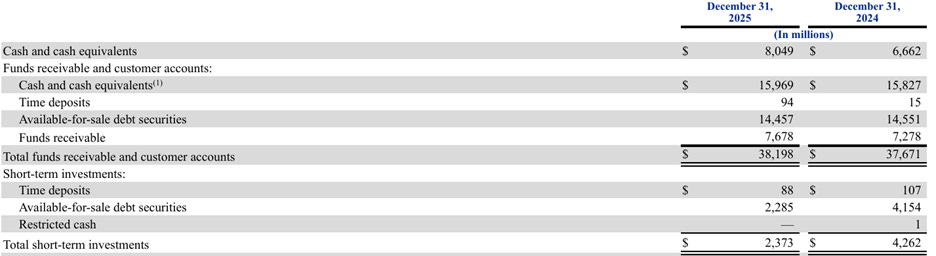
One often overlooked aspect of PayPal’s economics is the value of its “float.” As a global payments platform, PayPal temporarily holds billions of dollars belonging to customers and merchants before those funds are withdrawn or settled. At year-end, this “float” balance totaled more than $40 billion and is recorded as a liability on the balance sheet, but economically it functions as low-cost, short-duration funding.
While regulatory constraints limit how aggressively these funds can be invested, even modest yields on such a large base can generate meaningful interest income. If we assume that only 50% of the float is investable and earns a conservative 3% yield, that alone produces roughly $600 million annually. At a 4% yield, the figure approaches $800 million.
In 2025, PayPal likely earned roughly $648 million on its “float” since it recorded $227 million in other income and had roughly $421 million in interest expense.
As you can see from the chart below, most of PayPal’s funds receivable are invested in short-term debt securities and money markets.
In higher-rate environments, this float quietly enhances free cash flow and return on capital without requiring incremental investment. It is not the same as an insurance company’s permanent float, but it represents a structural advantage embedded within the business that is easy to overlook when focusing solely on headline revenue growth.
Valuation
PayPal reported an operating income margin of roughly 18.3% for 2025 - which equates to roughly $6.07 billion in operating income.
PayPal generated approximately $5.6 billion in free cash flow in 2025 on a GAAP basis, reflecting strong underlying cash generation from its global payments platform.
Based on my calculations, PayPal is currently priced at roughly 6.1x EV/EBIT and 6.6x EV/FCF.
PayPal reported depreciation and amortization of roughly $963 million in 2025, so current EV/EBITDA is ~5.2x.
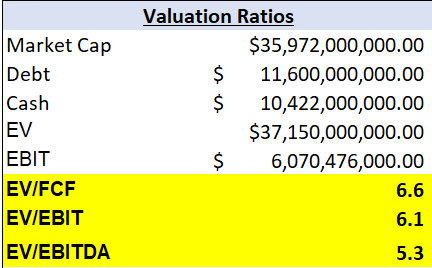
For the cash and investments, I only included short-term investments in order to be more conservative. The market cap is based on closing price of $39.10 on February 12th.
Management also reports adjusted free cash flow of roughly $6.4 billion, which excludes the net timing impact from originating and subsequently selling Buy Now, Pay Later (BNPL) receivables. The difference between the two figures is largely a working capital timing issue: under GAAP, cash used to originate BNPL loans reduces operating cash flow immediately, while the cash received from selling those loans may occur in a later period.
The adjusted figure attempts to normalize this timing mismatch to better reflect ongoing cash earnings power. For conservative valuation purposes, investors may prefer to anchor on the lower GAAP number, while recognizing that over time the BNPL timing effects should largely net out.
Owner’s Earnings
Free cash flow is useful, but it can sometimes overstate economic reality when large amounts of stock-based compensation are added back.
PayPal reported roughly $1 billion in stock-based comp. in 2025, which represents real dilution to shareholders. To stay conservative, I focus on owner’s earnings — net income plus depreciation and amortization, minus maintenance capex and working capital needs.
In my view, this provides a clearer picture of the cash the business generates for its owners over time. In 2025, PayPal generated roughly $6.4 billion in operating cash flow. Capital expenditures totaled $852 million, but given the company’s asset-light, software-driven model, a reasonable estimate of maintenance capex is roughly half of that, or about $400–450 million.
That puts pre-SBC owner’s earnings near $6.0 billion. After subtracting approximately $1.0 billion in stock-based compensation — which I treat as a real economic cost due to dilution — true owner’s earnings are closer to $5.0 billion, or roughly $5.40 per share. At current prices around $39, that implies an owner’s earnings yield of roughly 14%, meaning investors are being paid a meaningful cash return even before assuming any growth.
I assumed PayPal’s cost of capital to be roughly 7.66% (9% cost of equity and 3.52% after-tax cost of debt) and assumed long-term growth of only 2%, which is just below the long-term inflation rate. Thus, our capitalization rate is roughly 5.66%, which equals cost of capital less the growth rate.
Discounting owner’s earnings of $5 billion by 5.66% yields an implied enterprise value of roughly $88.2 billion. Subtracting net debt of $1.18 billion yields an equity value of $87.1 billion, or roughly $95 per share.

I believe this valuation is conservative given the 10-year treasury yield is currently about 4.1%. The lower the discount rate, the higher the implied valuation and vice versa.
Share Buybacks
PayPal’s management team has guided for $6 billion in share repurchases in 2026. At current prices, that level of share repurchases would retire close to 17% of the company’s outstanding shares.
When executed at valuations below intrinsic value, opportunistic share buybacks can meaningfully increase each remaining shareholder’s ownership stake and per-share earning power.
Historically, PayPal has maintained a consistent share repurchase program, even during periods when the stock was not obviously undervalued. Today, however, PayPal’s valuation sits near historical lows and share repurchases at these levels should create much more value for shareholders than previous buybacks did.
Risks and Takeaway
The primary risk with PayPal is the possibility of slow, structural erosion. Payments is a competitive industry, and pricing pressure in branded checkout has already weighed on take rates.
If PayPal’s core franchise were to gradually lose relevance or face sustained margin compression, today’s earnings power could prove less durable than it appears.
There is also execution risk around “buy now, pay later” (BNPL), enterprise growth, and maintaining relevance in an ecosystem increasingly influenced by Apple Pay, Shopify, and Stripe. That said, at current valuations the market appears to be pricing in little to no growth — and perhaps even some decline.
If PayPal can simply maintain its core earning power and continue returning capital through buybacks, the owner’s earnings yield offers a reasonable margin of safety.
At current prices, PayPal does not need to be a heroic growth story. It is a cash-generative business trading at a price that assumes long-term stagnation. For patient investors willing to accept short-term volatility, that setup can produce attractive long-term returns.
*This article is for informational purposes only and should not be viewed as investment advice. Investors should conduct their own due diligence and assess their personal risk tolerance when considering an investment. I do not currently own shares in PayPal but may initiate a position in the near-term.
It has been so far