

Every so often you come across a stock that is just too cheap to ignore.
LGL Group (NYSE: LGL) is one of those situations – trading at a discount to its net cash. What’s more, this isn’t some broken down cigar butt. LGL Group is currently profitable and has posted positive earnings every year except one over the last 10 years.
At today’s share price of roughly $6.82, LGL is a small, sleepy microcap with a market capitalization of about $37 million. But what makes the company interesting is this simple fact:
LGL holds more net cash (cash - all liabilities) than its entire market value.
In other words, the market is currently valuing the underlying operating business at a negative value. This literally means if you were a private buyer buying the whole company, you would get paid to buy the business.
That kind of setup doesn’t guarantee great returns, but it does create a potentially attractive risk/reward profile with a huge margin of safety. In addition, value investor Mario Gabelli and his son Marc own a combined 35% of the stock so there is a high level of insider ownership.
What Does LGL Actually Do?
LGL Group is based in Orlando, FL and is structured as a holding company with two components:
A small operating business
An investment arm that manages a large cash balance
The operating company that LGL owns is called Precise Time and Frequency (PTF). PTF designs and sells high-precision timing and frequency equipment. In simple terms, its products act as ultra-accurate electronic clocks that keep complex systems synchronized. These devices are used in applications like satellite communications, computer networks, broadcasting, and electric utilities—anywhere technology needs to agree on an exact time or frequency. It’s a small, niche business, but one that plays an essential behind-the-scenes role in modern infrastructure.
Precise time and frequency is not a high-growth tech business. Rather, it’s a small, specialized electronics manufacturer that generates a few million dollars in annual revenue with modest profits.
The more important part of the investment thesis in LGL Group is its large cash holding.
A Balance Sheet-Driven Opportunity
As of the most recent quarterly filing, LGL reported roughly $41.57 million in cash with only $1.38 million in total liabilities. So LGL Group has a little over $40 million in net cash and the company’s entire market cap sits at around $36.87 million.
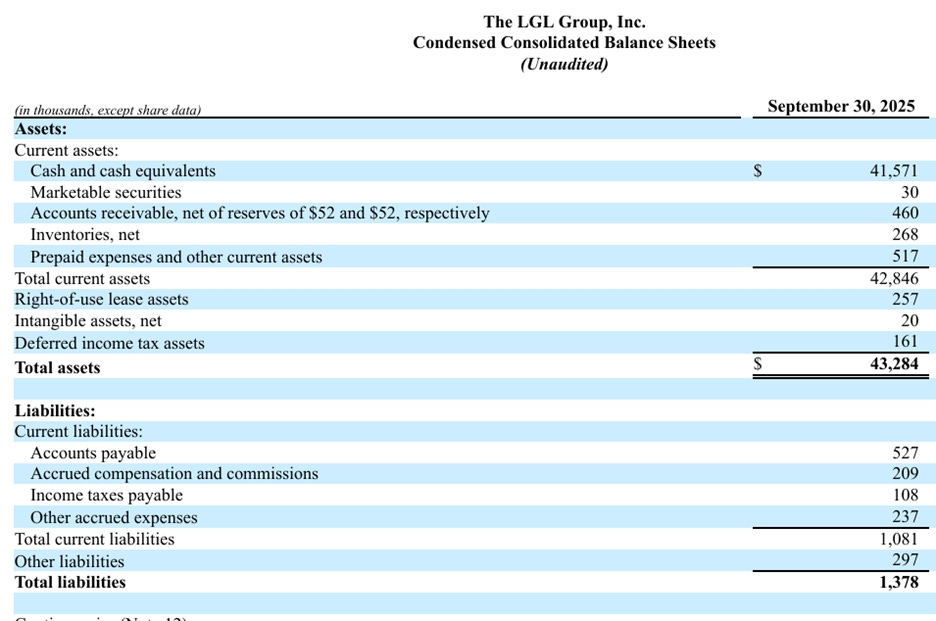
That means investors are currently paying less than one dollar for each dollar of cash on the balance sheet—and getting the operating business thrown in for free.
Against a share price of $6.82, that implies LGL is trading at roughly an 8% discount to its net cash value of $7.43 per share.
Not many stocks offer that kind of margin of safety.
What Happens Next?
The obvious question is: if the stock is this cheap relative to its cash, why hasn’t value already been realized?
The answer lies in LGL’s corporate strategy.
This is not a company planning to liquidate and return the proceeds to shareholders. LGL has a long history as a capital allocator—it has bought, sold, and spun off businesses over the years. Management explicitly describes the firm as a holding company seeking acquisitions and investment opportunities.
In practical terms, LGL today functions as a publicly traded acquisition vehicle with about $40 million of dry powder.
That leads to three possible paths forward:
An Acquisition
The most likely outcome is that management eventually deploys the cash to buy another operating business. A well-priced, accretive acquisition could create meaningful per-share value over time. LGL Group also has a track record of creating value for shareholders through spinoffs.Back in 2022, LGL Group spun off M-tron Industries, Inc. (MPTI). M-tron industries stock is up nearly 5x since it began trading as a public company back in late 2022.
Opportunistic Investments
Short of buying an entire company, LGL may invest in special situations, minority stakes, or structured opportunities through its merchant investment arm. LGL Group recently invested $2 million in Morgan Group Holding Company, which provides brokerage, underwriting, and institutional research services and has $5 billion in private client assets and 1,000 accounts.Buybacks or Capital Returns
With the stock trading below net asset value, share repurchases would be highly accretive. Back in September, LGL announced a share buyback of between $500,000 - $700,000.
Risks
The main risk with LGL is not balance sheet risk—the cash is real and the liabilities are minimal.
Instead, the risk is capital allocation risk.
Right now, shareholders effectively own a safe pile of cash at a discount. That’s attractive. But if management deploys that cash poorly—overpaying for an acquisition or making bad investments—the current margin of safety could quickly erode.
I think the capital allocation risk is mitigated given that LGL’s management team has a history of creating value through the spinoff of M-tron Industries and the fact that they are buying back stock at a discount to liquidation value.
Moreover, famed value investor Mario Gabelli and his son Marc own a combined 35% of the stock so they should be aligned with investors to create value through future acquisitions, buybacks or spinoffs.
Why It’s Interesting Today
I don’t view LGL as a long-term “compounder” or a classic growth story. It’s more of a value-plus-optionality situation.
On the downside, intrinsic value is largely protected by cash and liquid assets. On the upside, there is embedded optionality if management can deploy capital intelligently.
At current prices, you’re essentially buying:
A net cash position greater than the market cap
A small but viable operating business
A free call option on future acquisitions
That combination doesn’t guarantee exceptional returns, but it does offer a relatively rare setup: limited downside with asymmetric upside.
For patient investors willing to wait and watch what management does next, LGL Group is worth keeping on the radar.
*As always, this is not investment advice. Do your own research and consider your personal risk tolerance before making any investment decisions. I own shares in LGL Group.
Nice. LGL is a weird one.
> For patient investors willing to wait and watch what management does next, LGL Group is worth keeping on the radar
One thing to add here is the unusual incentive structure for new CEO Jason Lamb. His base pay is 60k a year! The bonuses come from making deals (surely targeting naval and defense tech). I wrote about it here:
https://onefoothedge.substack.com/p/lgl-group-a-sleepy-companys-incentive
https://companycharts.substack.com/p/the-monthly-net-net-scan-75-tickers?r=6kpr46 May this list find you well.