

Many know the story of Warren Buffett and GEICO.
Fewer know the story of Lou Simpson, the investor who ran GEICO’s investment portfolio for over 30 years, from 1979 to 2010.
Simpson joined GEICO in 1979, just a few years after Buffett made a $4 million investment in 1976, when the company was teetering on the verge of bankruptcy.
At the time, the economic environment was very difficult for insurers. High inflation and high interest rates in the 1970s led to significant losses in bond-heavy portfolios. Like most insurance companies, GEICO had traditionally invested the majority of its assets in fixed income securities.
Stocks were widely viewed as too risky.
Most insurers held 10% or less of their portfolios in stocks.
Simpson took a different approach.
A Different Way to Invest Insurance Float
While most property and casualty insurers limited equity exposure to 10–15%, GEICO under Simpson allocated 35–45% of its portfolio to stocks.
Not only that — the portfolio was highly concentrated.
In his 1982 letter, Buffett wrote:
“In Lou Simpson, GEICO has the best investment manager in the property-casualty business.”
At the time, GEICO’s equity portfolio was worth $280 million and held 33 stocks.
Simpson gradually reduced that number, concentrating capital into his best ideas.
Over time, the portfolio typically held 8–15 stocks.
By 1995, GEICO’s stock portfolio had grown to $1.1 billion — with just 10 holdings.
How Simpson Invested
Simpson’s approach was simple, but not easy to execute.
He focused on:
high-quality businesses
strong management teams
attractive valuations
and long-term holding periods
But what really stood out was his willingness to concentrate capital.
Some Investments that Simpson Made
The “Baby Bells”
Simpson invested in the regional telephone companies spun out of AT&T following the Department of Justice antitrust breakup.
These were often overlooked, misunderstood, and trading at attractive valuations — a recurring theme in his investing.
Freddie Mac
Simpson purchased shares of Federal Home Loan Mortgage Corporation when the stock was relatively illiquid and trading at just 3–4x earnings.
The investment ultimately generated 10–15x returns for GEICO.
Nike
One of Simpson’s more well-known positions was Nike.
At times, it became a very large holding — eventually reaching about 16% of the portfolio, largely due to appreciation.
Simpson initially purchased Nike at around an 8% free cash flow yield (~12.5x FCF).
His approach was disciplined:
add to the position around ~13x earnings
trim closer to ~20x
He also developed a relationship with founder Phil Knight and gained confidence in management.
Simpson viewed Nike as a conservatively run business and appreciated its restraint in avoiding value-destructive acquisitions.
Simpson’s Investment Performance
Simpson’s results speak for themselves.
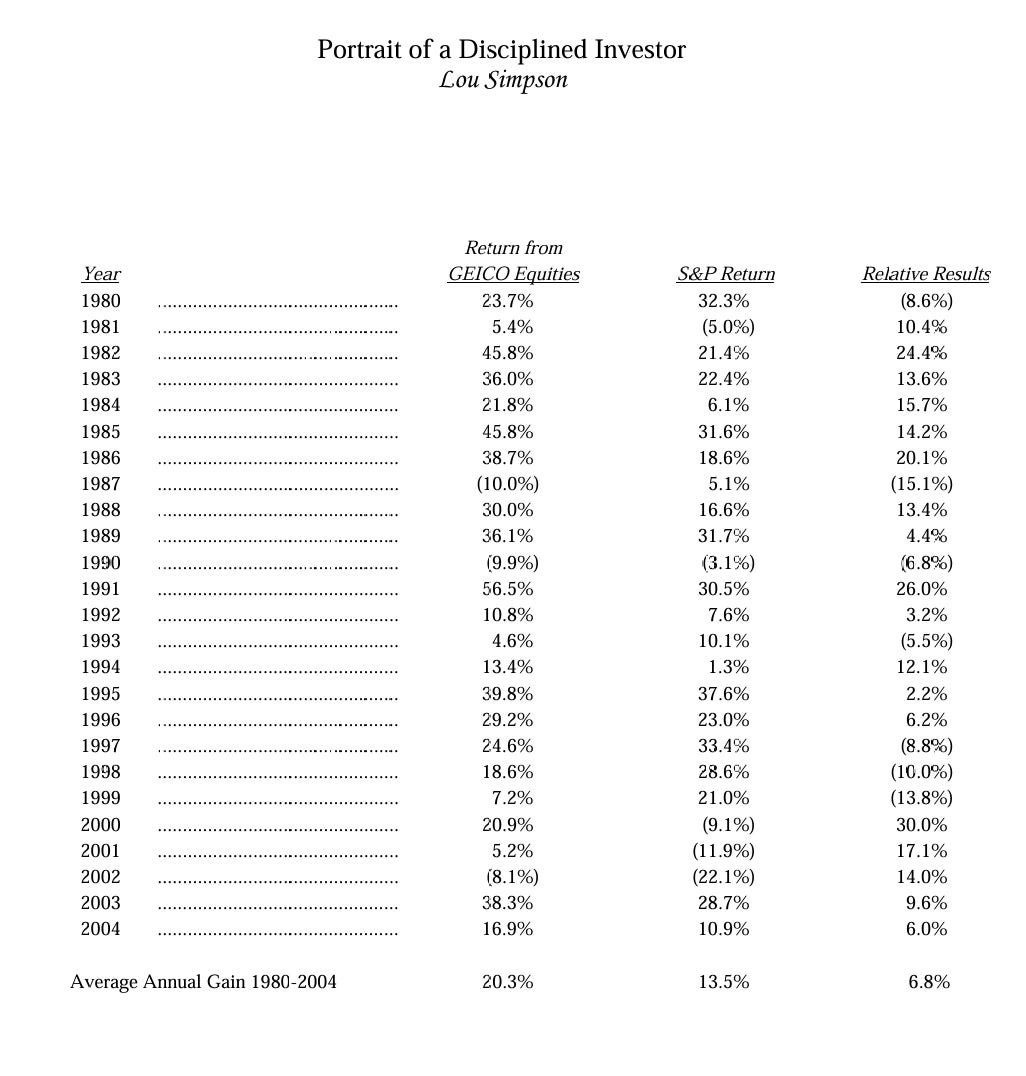
Over roughly 25 years, he generated annual returns of 20.3%, compared to 13.5% for the S&P 500 — an outperformance of 6.8% per year.
While 6.8% annual outperformance may not sound dramatic, the long-term results were extraordinary.
$100,000 invested in GEICO’s portfolio in 1980 would have grown to roughly $10.15 million after 25 years, compared to about $2.37 million if invested in the S&P 500 over the same period.
That additional 6.8% annual return compounded into roughly $7.78 million of additional wealth over 25 years.
That level of sustained outperformance is extremely rare.
It should be noted that while Simpson spoke with Buffett frequently, Simpson had full autonomy over GEICO’s investment portfolio throughout his tenure at the firm.
Per the 2004 Berkshire letter, Buffett said this,
“I typically learn of Lou’s transactions about ten days after the end of each month. Sometimes, it should be added, I silently disagree with his decisions. But he’s usually right.”
One thing I found particularly interesting is that Simpson maintained an independent investment process despite having Warren Buffett as his boss.
Imagine having one of the world’s most well-known and successful investors looking over your shoulder yet still having the confidence to think for yourself and invest differently from the crowd. That level of independence and conviction is rare and likely played a major role in Simpson’s long-term success.
Simpson’s Investing Principles
Simpson’s framework was straightforward, but highly disciplined:
Think Independently
He was willing to deviate from industry norms — particularly in holding a much higher allocation to equities than other insurers.
Invest in High-Return Businesses Run for Shareholders
When evaluating management, he focused on:
capital allocation track record
integrity
whether management acted like owners
Pay a Reasonable Price
Even for great businesses, valuation mattered.
Simpson often focused on price to free cash flow on a per-share basis.
Invest for the Long Term
Turnover was low.
Once he found a great idea, he was willing to hold it.
Avoid Over-Diversification
Simpson believed concentration was essential to outperforming.
“Concentration may be the only way I can add value to the process.”
Be Thoughtful About Buybacks
He looked for companies that repurchased stock when it was undervalued.
At GEICO, more than 50% of shares outstanding were repurchased during his tenure.
Focus on What You Don’t Buy
Simpson once said:
“A record is built as much on what you don’t buy as what you do buy.”
Think More, Act Less
“We do a lot of thinking and not a lot of acting.
A lot of investors do a lot of acting and not a lot of thinking.”
Final Thoughts
Simpson’s approach wasn’t complicated.
But it required:
patience
discipline
independent thinking
and the willingness to concentrate capital
He didn’t need dozens of ideas.
One or two great opportunities per year were enough — if sized correctly.
In many ways, Simpson’s approach reinforces a simple idea:
Outperformance doesn’t come from doing more. It comes from doing less — but doing it better.
Simpson’s investment process remains highly relevant today because the core principles of investing have not changed.
Markets still periodically misprice high-quality businesses, and investors still struggle with overreaction, short-term thinking, and excessive diversification.
Simpson’s record is a reminder that disciplined capital allocation, patience, and concentration in a small number of well-understood ideas can still be a powerful formula for long-term outperformance.
What I Take from This
What stands out to me about Simpson’s approach is how simple it was in principle, but how disciplined it was in execution.
He didn’t try to do everything. He focused on:
a small number of high-quality ideas
understanding downside risk
and sizing positions appropriately
He also recognized that:
a few good decisions per year are enough — if you allocate capital correctly
That’s something I’ve found to be true in my own investing as well.
Most of the work is filtering — going through a large number of ideas and rejecting almost all of them. The goal isn’t to find a lot of investments, but to identify the few that clearly stand out and then size them accordingly.
Simpson’s record reinforces a simple but important idea:
Outperformance doesn’t come from activity — it comes from discipline, selectivity, and capital allocation
*Much of the information for this article comes from Concentrated Investing: Strategies of the World's Greatest Concentrated Value Investors, which covers several successful investors and is worth reading for anyone interested in concentrated value investing.
The underrated skill here is capital allocation courage. Most investors identify good ideas but can’t concentrate into them.
Thank you, interesting article, great to learn about Lou