

Every once in a while, you come across an idea that the market has completely overlooked.
The idea I’m going to talk about today is mispriced primarily because it is small and under the radar of most investors.

MachTen, Inc. (OTC: MACT) is a small telecom company that owns Michigan Broadband. Michigan Broadband’s subsidiaries include Upper Peninsula Telephone Company, Michigan Central Broadband Company, and Alpha Enterprises Ltd. MachTen primarily serves the upper peninsula of Michigan.
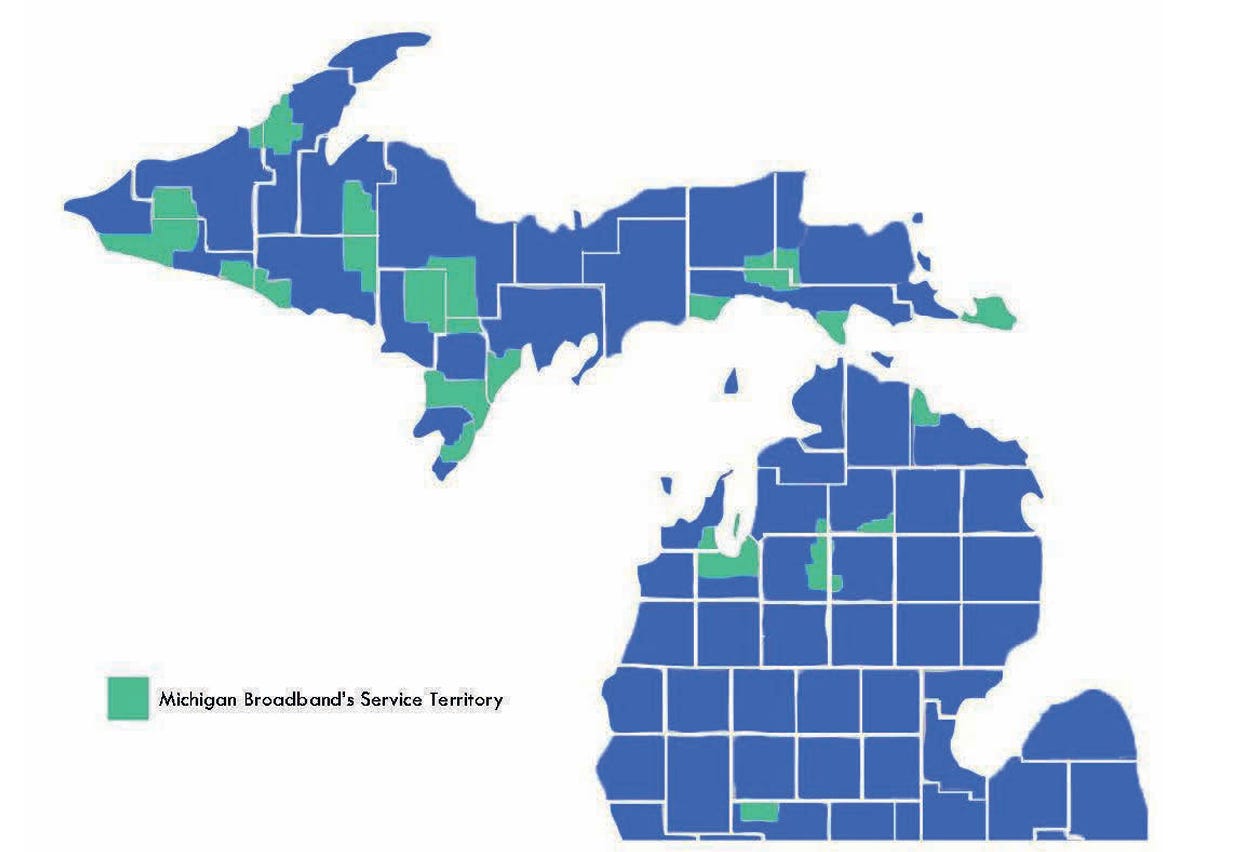
MachTen was spun out from LICT a few years ago and is quietly undertaking a $100 million investment (mostly subsidized by government grants) in fiber infrastructure for Northern Michigan.
MachTen, Inc. recently closed on the acquisition of AT&T’s wireline assets in Michigan’s Upper Peninsula, significantly expanding its network footprint and customer base.
This transaction adds thousands of miles of infrastructure and positions the company to accelerate its fiber upgrade strategy across a much larger service area.
As a result, MachTen now has a substantially greater opportunity to drive subscriber growth, improve margins, and scale its broadband platform over time.
Combined with LICT’s broader history of successful telecom spin-offs and value creation, this suggests MachTen is being led by a management team with proven experience in acquiring, upgrading, and monetizing rural telecom assets.
MachTen’s management team has a successful track record of investing in undervalued telecom companies then selling them at a large premium.
MachTen’s CEO Dan Miller was previously CEO of ICTC Group, a small regional telco in North Dakota. He led the company until it was acquired by BEK Communications in 2018. The acquisition price was at a 300% premium to the share price at the inception of Mr. Miller’s tenure.
What the Market May Be Overlooking
I think the market has mispriced MachTen for a few reasons.
It’s an illiquid microcap and it’s hard for larger investors to build a meaningful position.
MachTen doesn’t pay a dividend, and many telecom investors expect dividend payouts.
The company has negative free cash flow - as I will explain later this shouldn’t be too much of a concern for investors given the company is undertaking a large investment in upgrading to fiber infrastructure.
MachTen’s financials in 2025 have looked relatively weak compared to 2023 and 2024 given the large increase in capital investment to upgrade their network to fiber infrastructure.
Moreover, MachTen’s revenues have been largely flat, and earnings have declined meaningfully year-over-year. For the most recent nine-month period, operating income fell from $4.7 million to $3.5 million, while net income declined by nearly 50%.
But that surface-level view misses what is happening underneath: a capital-intensive transition from legacy copper networks to high-margin fiber infrastructure—funded in large part by government programs like the Universal Service Fund and ReConnect grants.
Depreciation has increased as new fiber assets are placed into service, general and administrative expenses are up as the organization scales, and interest expense has risen as the company funds its network buildout and acquisitions.
The result is a business that appears optically weak today but could generate $10 - 12 million in EBITDA in a few years, which would be a 20 - 50% increase from MachTen’s current EBITDA levels.
In other words, MachTen is spending today to build a significantly more valuable asset base tomorrow. This dynamic—where earnings temporarily compress before improving—is common in infrastructure transitions, but it often leads to mispricing when investors focus on near-term results.
MachTen’s current market cap is roughly $18 million.
MachTen has averaged roughly $8.3 million in EBITDA and ~$1.30 in EPS over the last few years and currently trades at an EV/EBITDA multiple of ~4x, and price to normalized earnings of roughly 3.9x.
Transitioning from Copper to Fiber
MachTen’s core strategy is simple:
Acquire under-earning rural telecom assets
Upgrade them from copper/DSL to fiber
Increase revenue per customer while lowering long-term costs
This is not a growth story in the traditional sense—it’s an asset transformation story.
A typical legacy copper customer might generate $50–70 per month in revenue with relatively high maintenance costs.
A fiber customer, by contrast, can generate $80–120 per month with significantly higher margins and far lower ongoing maintenance.
The result is a dramatic improvement in unit economics:
Revenue per user increases meaningfully
EBITDA per subscriber increases
Maintenance capex declines after the buildout phase
This is why MACT’s current financials are misleading. The company is spending heavily today (~$100 million over several years) not to sustain the business, but to upgrade it into a much more valuable asset.
Government Subsidies Mitigate Some of the Risks with Fiber Buildout
One of the most misunderstood aspects of MACT is its reliance on government support.
Roughly 75% of MACT’s revenue is tied to “network access revenue,” which includes subsidies from programs administered by the Federal Communications Commission. These programs are designed to ensure rural broadband access and include mechanisms like A-CAM (Alternative Connect America Model).
Importantly:
MACT receives ~$9–10 million annually in relatively stable support
These payments extend for 10–15+ years
Additional fiber buildouts are partially funded through grants
For example, one recent ReConnect award covers up to $85 million in project cost, with MACT contributing only ~$16 million. In other words, the government is effectively funding ~80% of the infrastructure build.
This creates a unique setup:
MACT is using subsidized capital to build long-duration, high-return infrastructure.
In the following sections, I show what MachTen’s normalized financials could look like post-buildout, analyze MachTen’s balance sheet strength, provide potential return projections and highlight what MachTen could be worth in an acquisition.
What Are Assets Like MachTen Actually Worth? A Look at Recent Telecom Acquisitions
One of the most important questions in analyzing MachTen, Inc. is simple:
What would a rational buyer actually pay for these assets?
