

Overview
Mestek (OTC: MCCK) is a company based out of Westfield, MA that manufactures and sells heating, ventilation, and air conditioning (HVAC) products.
I stumbled onto Mestek after going through 2,500 stocks that were listed on the over-the-counter markets.
Mestek has minimal debt, ample cash/investment reserves and has grown book value (shareholder’s net worth) by roughly 10.5% per year for the last 12 years.
Mestek is currently trading at 3.5x EV/EBIT and at slightly less than its net current asset value.
Mestek stock is up about 74% in the last year primarily because it has a large commodity trading business and the price of gold has done well over the last year. Gold is up roughly 33% over the last year, having risen from about $2,430 per ounce in mid-May 2024 to about $3,221 at today’s prices.
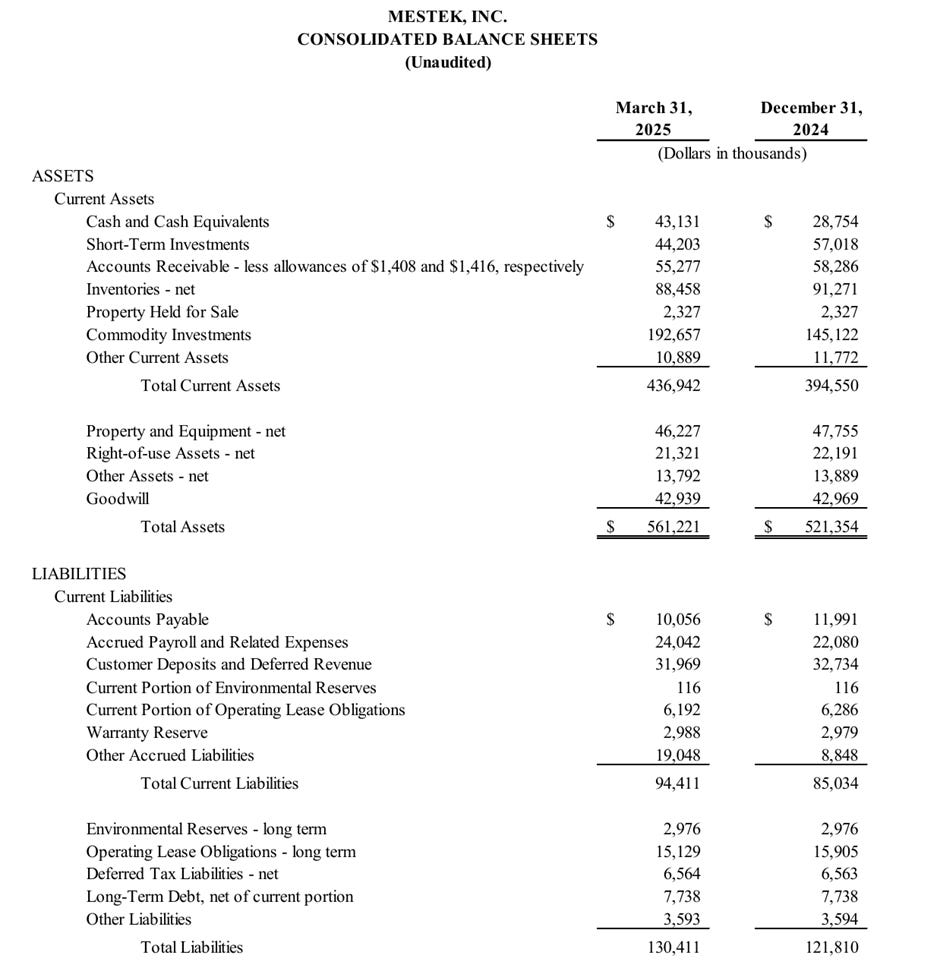
Mestek’s net current asset value (current assets – total liabilities) is $40.62 per share as of the most recent quarter ending March 31, 2025. Book value per share is $57.09. Mestek’s current assets are primarily composed of cash, short-term investments, and commodities. These investments make up about 64% of Mestek’s total current assets. Mestek stock closed at $40 on May 19th, 2025.
As you can see below, Mestek’s current EV/EBIT is 3.5. It should be noted that Mestek has $44.2 million in short-term investments, which consist of CD’s and treasury bills that mature in one year or less, according to the company’s annual report. Short-term investments are not technically supposed to be included in the enterprise value calculation which is why I didn’t include them. However, the company’s short-term investments are about as close to cash equivalents as you can get. A potential acquirer could liquidate these short-term investments in a year or less. If you add these into the enterprise value calculation, then the EV/EBIT is less than 3x.

Commodity Investments
As of the most recent quarter, Mestek reported $192.66 million in commodity investments. Per Mestek’s most recent annual report, “The Company operates a commodity trading business through a brokerage account for speculative commodities purchases and related investments.” While the company doesn’t disclose the specifics of its commodity trading portfolio, the annual report did say “The Company has investments in gold, and other precious metals that are Level I financial instruments…”
For 2024, Mestek reported $41.5 million in commodity trading income, which made up roughly 55% of its EBIT. For 2023, Mestek reported about $20 million in commodity trading income, which made up about 40% of EBIT for 2023.
Mestek reported earnings per share of $7.87 for 2024 and $4.90 for 2023. At the May 19th closing price of $40, that means Mestek’s shares are currently trading at about 5x 2024 EPS.
Since Mestek has a commodity trading business, their recent earnings were better than usual since the price of gold has rallied over the last year. Gold is up roughly 33% over the last year, having risen from about $2,430 per ounce to $3,221.
With the commodity trading business not included, Mestek’s normalized earning power is about 6 – 10% return on equity in any given year. To calculate this normalized return on equity, I went back through the annual reports and calculated Mestek’s average return on equity to be roughly 10% since 2013.
With the commodity trading profits not included, Mestek earned roughly $33.9 million in operating income (EBIT) for 2024. Assuming a 25% tax rate, that would equate to earnings of $25.4 million, or $3.37 per share (11.87x Price to Earnings) with the commodity income not included. Book value for the year ended December 31, 2024, was $52.94 per share, which would imply a roughly 6.4% return on equity excluding the commodity trading income.
Comparable Valuation
To come up with an intrinsic value for Mestek, I looked at five publicly traded companies that specialize in producing and selling HVAC units. The companies used in the comparable valuation analysis are Lennox (LII), AAON, Carrier Global (CARR), Johnson Controls (JCI), and Trane Technologies (TT).

As you can see, the median EV/EBITDA multiple for the five companies is about 20x. Since Mestek is a much smaller, less liquid company than the five companies in the analysis, I applied a 50% discount to the EV/EBITDA multiple to get 10x.
For the last five years, Mestek’s EBITDA margin has averaged roughly 13%.

Applying the average 13% EBITDA margin to 2024 revenues of $398.17 million equals a “normalized EBITDA” figure of about $51.7 million. Remember, Mestek had an unusually good year in 2024 due to the commodity trading income. To be conservative and to get a normalized snapshot of the business, I am taking the average EBITDA margin over the last 5 years. Applying a 10x multiple to the average EBITDA of $51.7 million equals $517 million.
Adding back the net cash of $35.4 million leaves an implied equity value of about $552.79 million, or $73.26 per share. This would imply roughly 83% upside from the current price of $40.
Risks and Takeaways
Chairman and CEO Stewart Reed currently owns about 68% of Mestek shares. Due to the CEO’s majority ownership stake, investors in Mestek won’t have any control over the operational and capital allocation decisions at Mestek. After reading Mr. Reed’s letters to shareholders, he seems to be thoughtful about trying to prudently allocate capital and seems to be looking out for the best interests of all the stakeholders at Mestek. Up until 2018, Mr. Reed published an annual letter to shareholders and was candid in his feedback (both good and bad) on the company and thoughts on capital allocation and creating shareholder value over the long-term.
Mestek stock is thinly traded with large bid/ask spreads. If you are looking to buy some Mestek stock, be sure to use limit orders and be patient when establishing a position. Mestek had an unusually good year in 2024 due to the success in its commodity trading operations. Because of this, the stock looks incredibly cheap trading at only 3.5x EV/2024 EBIT while also at a slight discount to net current asset value. Based on Mestek’s average EBIT margin of 11.8% over the last five years, EV to “normalized EBIT” is roughly 5.7x, still cheap but not as quite as cheap as the 3.5x multiple based on the 2024 EBIT figure. Based on the comparable valuation analysis, Mestek’s stock is likely worth at least $70 per share based on a conservative EV/EBITDA valuation. The stock’s discount to intrinsic value coupled with the low debt and liquid balance sheet should provide Mestek investors with some margin of safety. I recently bought some shares and plan to acquire more over the next several months. The stock could pull back given its runup in price over the last year. However, that should offer patient investors the opportunity to acquire more shares at a better price.