

On Wednesday July 1st, S&P Global officially spun off their mobility business Mobility Global (MBGL).
Mobility has always been a great business hidden inside a much larger S&P Global (SPGI). Now that it’s been spun off, Mobility’s true intrinsic value can be realized as a standalone public company.
Spin-offs have historically been a fertile hunting ground for value investors because they often experience forced, non-fundamental selling immediately after separation. Many shareholders receive the new company involuntarily and sell regardless of valuation, while limited operating history as an independent company creates additional uncertainty. These temporary technical pressures can allow investors to purchase high-quality businesses at prices below intrinsic value.
Wide-moat businesses rarely trade at prices that offer attractive long-term returns. Following its spin-off from S&P Global, I believe Mobility Global may be one of those rare opportunities.
Mobility Global has two business segments – CARFAX and its B2B segment.
CARFAX (65% of Revenues)
CARFAX is the clear leader in the U.S. vehicle history report market, with an estimated 70–80% market share and what was effectively a near-monopoly for many years. Its primary competitor is Experian’s AutoCheck, which has gained traction through partnerships with companies such as Kelley Blue Book, Autotrader, CarMax, and major auto auctions.

While AutoCheck generally competes on price and includes a proprietary vehicle score along with strong auction data, CARFAX remains the preferred choice for many consumers because of its broader maintenance history, more detailed accident reporting, and unparalleled brand recognition. Independent automotive publications routinely describe CARFAX reports as more comprehensive and consumer-friendly, despite their higher cost.
Perhaps the strongest evidence of CARFAX’s competitive advantage is its pricing power. Industry estimates suggest that dealers pay more for a CARFAX subscription than for AutoCheck, yet many continue to choose CARFAX because consumers actively expect to see a CARFAX report when shopping for a used vehicle.
In many cases, the absence of a CARFAX report can itself become a negative signal, leading dealers to view the subscription as a necessary cost of doing business. That dynamic is remarkably difficult to replicate and illustrates how CARFAX’s consumer brand reinforces its dealer relationships, creating a self-reinforcing competitive moat.
CARFAX has established itself as the gold standard in the industry for vehicle history reports. CARFAX has 38 billion vehicle history records from more than 177,000 sources through data partnerships with automotive industry players including more than 92,000 dealers and service shops, 6,300 police agencies and 36 OEMs as of December 31, 2025.
“Show me the CARFAX” has been a phrase that is associated with making a good purchase and avoiding buying a lemon or a damaged car. CARFAX has more than 13 billion transaction records and approximately 832 million unique VINs tracked.
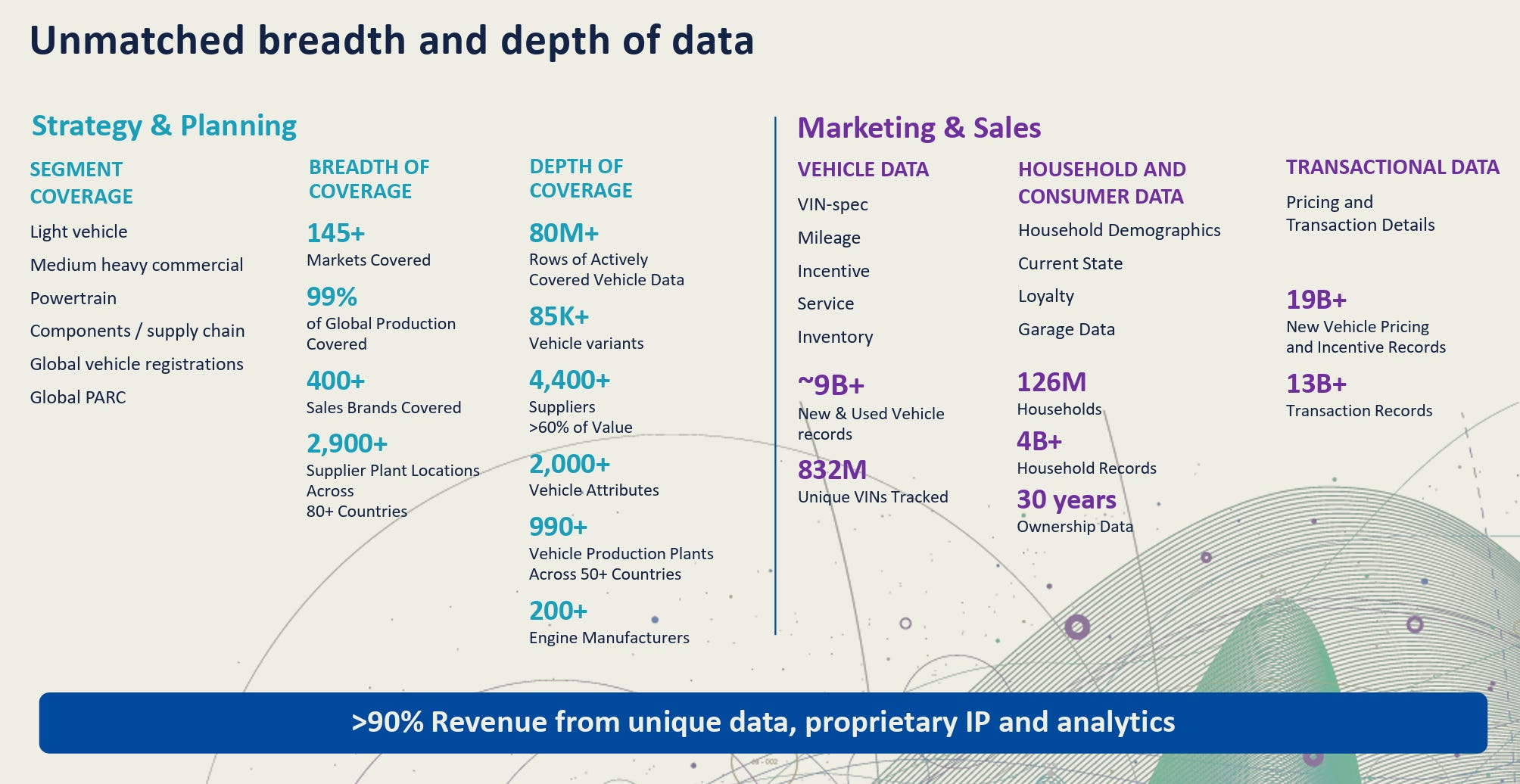
Consumers have come to rely upon CARFAX to make well-informed purchasing decisions. This is evidenced by the fact that CARFAX is the #1 most visited automotive website in the U.S. Mobility Global reports that they have 23 million monthly average unique visitors to the CARFAX U.S. website/apps and more than 28 million monthly average CARFAX vehicle history report views.
While CARFAX receives most of the attention, the B2B business transforms mobility from a consumer brand into critical infrastructure for the automotive ecosystem.
B2B (35% of Revenues)
Beyond CARFAX, Mobility’s B2B segment provides mission-critical software and data solutions to dealerships, automakers, suppliers, lenders, and insurers. Its flagship products include automotive Mastermind, a predictive analytics platform that helps dealers identify customers most likely to purchase a vehicle; Polk Auto Marketing Solutions, which enables targeted marketing using proprietary vehicle and ownership data; Market Scan Pricing Solutions, which powers real-time vehicle pricing and payment calculations; and Recall, which helps dealerships identify VIN-specific recalls and drive service revenue. Together, these products leverage Mobility’s proprietary automotive data and are deeply integrated into customer workflows, creating high switching costs and recurring revenue streams.
Mobility Global’s AI Opportunity
Artificial intelligence also represents a meaningful long-term growth opportunity for Mobility Global. Unlike many companies that are still searching for practical AI applications, Mobility already possesses the most important ingredient: proprietary data. With more than 38 billion vehicle history records, 177,000 data sources, and decades of automotive expertise, the company is uniquely positioned to use AI to enrich its existing products and create entirely new ones.
Management has outlined four primary AI initiatives: improving operating efficiency, extracting additional insights from increasingly complex data sources, embedding AI throughout its core products, and developing new AI-native products and predictive analytics.
Examples include AI-generated CARFAX vehicle history summaries, dealer valuation engines, enhanced behavior prediction models, and more sophisticated pricing and market response analytics for OEMs and dealerships. Rather than disrupting Mobility's business, I believe AI has the potential to increase the value of its proprietary data, strengthen customer workflows, improve operating leverage, and further widen the company's competitive moat over time.
Valuation
Because Mobility Global has grown through acquisitions, much of its balance sheet consists of goodwill and acquired intangible assets, including proprietary databases and customer relationships. The company is therefore required to record significant non-cash amortization expenses, which reduces reported EPS despite having no impact on cash flow. Mobility’s pro forma EPS for 2025 was roughly $0.47 per share.
For this reason, I believe free cash flow—or what Warren Buffett refers to as “owner’s earnings”—provides a much better measure of the company’s true earning power. Mobility Global generated $460 million in free cash flow in 2025, or $1.56 per share. That implies a roughly 7.8% free cash flow yield at current prices in the low 20’s.
After the first trading day, Mobility Global shares closed at $21.19. That implies roughly 13.5x price to free cash flow and about 12.5x EV/EBITDA.
Based on my discounted cash flow analysis, I estimate Mobility Global’s intrinsic value to be roughly $28–30 per share, implying meaningful upside from current price levels. This estimate is also supported by relative valuation. High-quality data service and analytics businesses such as Verisk Analytics (VRSK) and former parent company S&P Global (SPGI) trade at roughly 17× EV/EBITDA, well above Mobility’s current valuation. While I am not assuming Mobility deserves to trade at the same multiple today, I believe the current discount more than compensates investors for the uncertainty associated with a newly independent public company. More importantly, I believe Mobility has the ability to compound intrinsic value at 10%+ annually through a combination of organic growth, disciplined capital allocation, modest margin expansion, and ongoing share repurchases.
Management is targeting 7.5% - 10% organic revenue growth, 8% - 11% EBITDA growth, and a 20 - 25% payout ratio. Management is targeting to return 75% or more of annual free cash flow to shareholders.
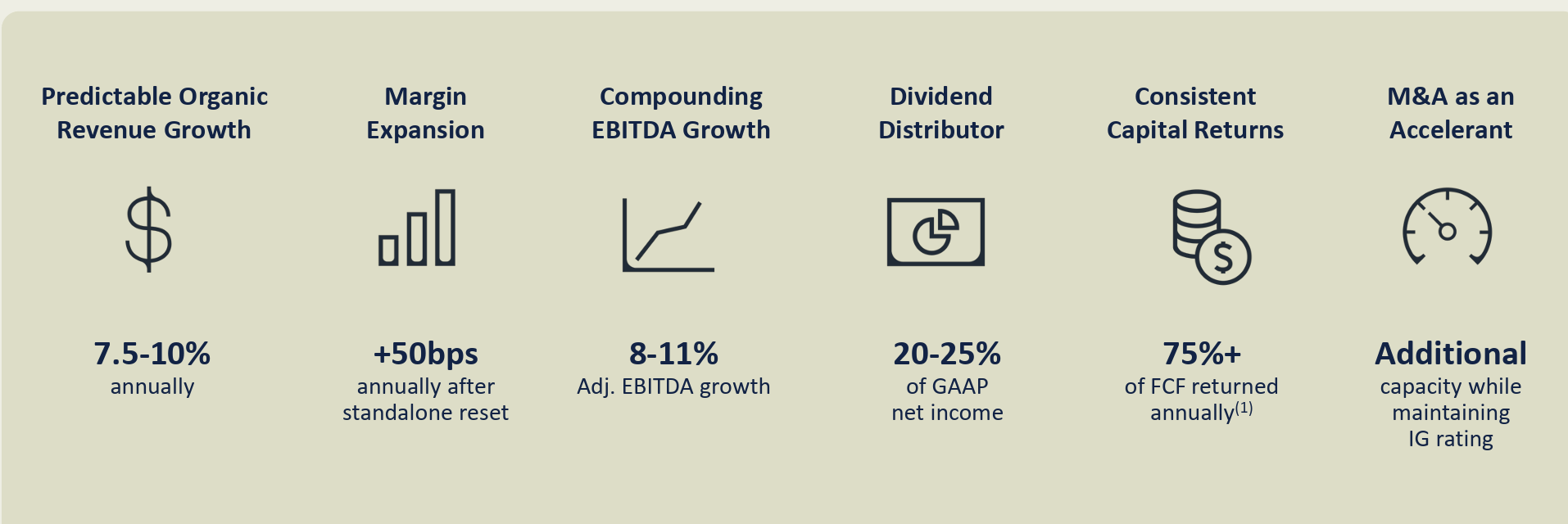
The dividend is likely to be small (around 0.5% - 1% at current prices) but share buybacks could be meaningful if Mobility’s management is able to return 75% of free cash flow.
At current prices, I estimate shareholders have the potential to earn approximately 15–18% annualized returns over the next five years—a rare opportunity for a business with what I believe is a wide and durable competitive moat.
Mobility Global currently has $1.85 billion in net debt, so current net debt to EBITDA is 2.6x. Mobility has robust free cash flow margins, which have averaged roughly 25.7% over the last three years. Adjusted EBITDA margins have been roughly 40% for the last three years.
Risks
No investment is without risk, and Mobility Global is no exception. While the company’s recurring revenue and diversified customer base help reduce cyclicality, a prolonged slowdown in new and used vehicle markets could pressure growth.
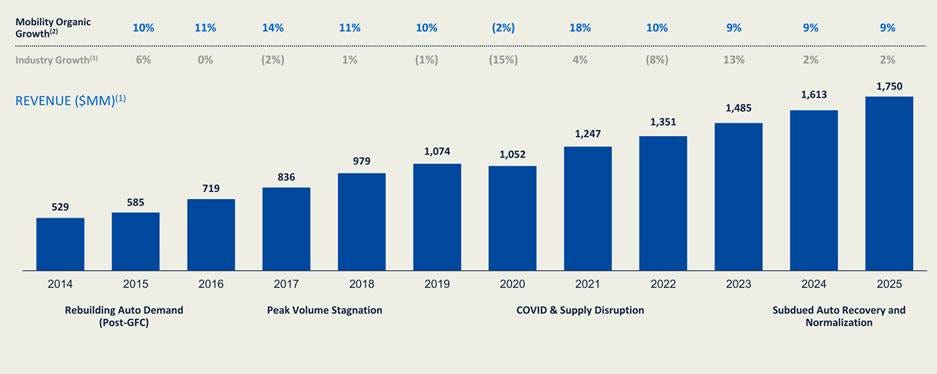
Mobility Global is not as susceptible to the cyclical downturns in the auto market as OEM’s and dealers are. Roughly 80% of Mobility Global’s revenue is sticky, subscription-based revenue and Mobility’s organic growth has been very resilient even through the COVID supply disruptions of 2020 and the challenging market in 2022.
The company also faces competition from Experian’s AutoCheck and other automotive software providers, although CARFAX’s superior brand recognition, proprietary data estate, and embedded dealer relationships have historically allowed it to maintain premium pricing.
One notable strategic development in recent years was CARFAX’s expansion into online vehicle listings and other consumer-facing services. That move placed the company in more direct competition with Cox Automotive, which owns both Autotrader and Kelley Blue Book. In response, Cox ended its long-standing relationship with CARFAX on its vehicle display pages and switched to Experian’s AutoCheck. From Cox’s perspective, the decision was understandable—they no longer wanted to direct valuable consumer traffic to a company that had become an emerging competitor.
While losing such an important distribution partner was undoubtedly a setback, the episode also highlights the strength of the CARFAX brand. Despite Cox’s decision, CARFAX remains the most visited automotive website in the United States and hasn’t seen any declines to revenues or profits, suggesting that consumers actively seek out CARFAX reports rather than simply relying on whichever vehicle history report happens to appear on a listing.
In my view, the long-term impact of Cox ending their partnership with CARFAX is likely to be modest, as the company’s competitive advantage stems from its proprietary data, consumer brand, and deep integration across the automotive ecosystem rather than any single distribution partner.
Over the longer term, one of the biggest risks is data ownership. As vehicles become increasingly connected, automakers may seek to retain more proprietary vehicle data, potentially limiting the information available to third-party providers like CARFAX. Finally, as a newly independent public company, Mobility must demonstrate that management can continue executing its growth strategy, integrate acquisitions successfully, and allocate capital prudently without the support of S&P Global.
Takeaway
Mobility Global strikes me as one of the more compelling spin-offs to come public in recent years. The company combines many of the characteristics I look for in a long-term compounder: a dominant market position, a powerful consumer brand, recurring revenue, high switching costs, significant pricing power, and an unrivaled proprietary data asset that becomes more valuable as additional vehicles are bought, sold, financed, insured, and serviced. These qualities have enabled the business to generate consistently high margins, minimal capital requirements, and substantial free cash flow.
At approximately 13.5× price to free cash flow and 12.5× EV/EBITDA, I don’t believe the current valuation fully reflects the quality of the franchise. While the stock is unlikely to produce the 30%+ returns sometimes available in distressed or deep-value situations, I believe Mobility offers something that is arguably even harder to find: a high-quality, wide-moat business available at a reasonable price. My estimate of intrinsic value is approximately $28–30 per share, implying meaningful upside from current levels. Assuming the business compounds intrinsic value at roughly 9–10% annually through organic growth, disciplined capital allocation, and share repurchases, I believe shareholders have the potential to earn mid- to high-teens annualized returns over the next five years.
Wide-moat businesses rarely trade at valuations that offer attractive prospective returns. Whether Mobility ultimately proves to be one of those rare exceptions remains to be seen, but based on everything I’ve learned so far, it appears to be one of the more compelling combinations of quality and value that I’ve come across in quite some time.
*This article reflects my personal opinions and is intended for informational and educational purposes only. It is not investment advice or a recommendation to buy or sell any security. Investors should conduct their own due diligence, carefully evaluate their own financial circumstances and risk tolerance before making any investment decisions. I own shares in Mobility Global (MBGL).
Sources:
I like this bussines a lot. It's the type of company I'd like to see in my portfolio. However I came to OE yield closer to 5,8%. It's not that bad ATM, but I am afraid it will end up lower in the future. Why?
" Expect one-time stand-up / transition cost of ~$75-100M over 12-18 months."
"Expected incremental ~$20-25M in run-rate costs to operate as a standalone company compared to historic SPGI allocations:
• Concentrated in standalone public company functions, IT infrastructure, facilities / international
costs"
"Equity compensation to be aligned with public company peers to attract and retain talent" - this especially means that SBC will be higher. I wonder if management will use this as a chance to significantly boost their renumeration. "Aligned with public company peers". What does it even mean? CCC IS for example has 7x SBC more than Mobility with lower revenue. On a SBC/revenue basis it's like a 1% to 10%. It kinda worries me. I want to see full year as a standalone company, ideal 18 months to determine whether it's worth pulling a trigger.
https://heraldofthehudson.substack.com/p/you-can-be-a-stock-market-genius