

Overview of Perimeter Solutions
Headquartered near St. Louis, MO, Perimeter Solutions (NYSE: PRM) is a provider of firefighting products and lubricant additives for the fire safety and specialty products industries. One of Perimeter Solutions’ fire-retardant products is the “red or pink stuff” that you may have seen being dropped by an aircraft during a wildfire. Perimeter Solutions also provides firefighting foams, and the service and equipment needed to facilitate firefighting efforts. Perimeter’s other business line is specialty products where it has been the market leader in producing phosphorus pentasulfide (P2S5), which is used in the production of engine oil additives, pesticide/mining chemical applications, and electric battery technologies.
Replicating the TransDigm Playbook
To truly appreciate this opportunity in Perimeter Solutions, we first need to look at the TransDigm Group (NYSE: TDG). TransDigm was co-founded by Nick Howley in 1993. The TransDigm Group designs, produces and is a supplier of aircraft components. TransDigm’s business units produce everything from mechanical actuators to lap belts on large jet aircraft. Most of TransDigm’s products are “sole-sourced,” meaning they are the only supplier and don’t have any other competitors. Because most of TransDigm’s products are small dollar amounts (relative to the total cost of a jet aircraft such as a 737) and there is substantial regulatory burden, it does not make financial sense for competitors to try to compete with TransDigm. Per Morningstar, “The firm [TransDigm] specializes in providing parts that are complex and proprietary, but do not usually represent a large portion of the value or cost of maintaining the given aircraft or vehicle for which they were designed. Indeed, the company has commented in the past that up to 80% of its sales come from products for which it is the only producer. This means that the cost to switch providers, from a buyer point of view, is effectively infinite, but because of the relatively low value of the given parts, the reward for a competitor to begin making the same part is low.”
TransDigm targets companies that make niche “sole source” components for aircraft but make up a low total dollar spend of the overall final product. In TransDigm’s case it’s airplanes. In Perimeter’s case, it’s primarily fire suppression.
What makes TransDigm unique is their focus over the years on capital allocation and increasing “intrinsic value per share.” Managers of TransDigm’s business units are compensated more on generating intrinsic value per share and less on cash compensation. Per former CEO and co-founder Nick Howley, “we wanted to underpay people in cash compensation. We wanted to over equitize them, but we wanted to pay them when they generate intrinsic value.” This was from William Thorndike’s podcast 50x, which highlights companies that have grown at least 50x. The strategy worked. Since its IPO in March 2006, TransDigm stock is up more than 55x. With special dividends included, annual returns for TransDigm’s shareholders have compounded at more than 30% annually since its IPO in 2006.
Now back to Perimeter. I mentioned TransDigm because I believe Perimeter Solutions is following the same playbook that TransDigm so marvelously executed over the past 19 years as a public company. Of Perimeter Solution’s ten board members, five worked for TransDigm or were previously on TransDigm’s board. TransDigm co-founder Nick Howley, William Thorndike (author of the Outsiders: Eight Unconventional CEOs and Their Radically Rational Blueprint for Success) and Perimeter CEO Haitham Khouri owned 3.1%, 2.4%, and 1.6% of Perimeter shares, respectively as of the last proxy filing.
Perimeter Solutions follows TransDigm’s operating model and capital allocation playbook. Like TransDigm, Perimeter Solution’s goal is to offer “private equity like returns in the public market.” TransDigm focused on increasing shareholder value by making shrewd acquisitions – mainly acquiring companies with proprietary, “sole-source” products in which there was significant aftermarket potential. Moreover, TransDigm focused on buying back shares when the stock was depressed, paying out special dividends and effectively using leverage. Per co-founder Nick Howley when referring to acquisition opportunities at TransDigm, “You had to see a clear path to a more than 20% IRR on a five-year hold.” This capital allocation playbook is exactly what Perimeter Solutions is aiming to do.
Latest Annual Results
For the full-year 2024, Perimeter Solution’s consolidated revenue increased 74% to $561 million, while adjusted EBITDA increased 190% to $280.3 million. Free cash flow for 2024 was $172.9 million. As previously mentioned, (like TransDigm), Perimeter is focused on buying back stock when the share price is below intrinsic value. In 2024, Perimeter repurchased 3 million shares at an average price of $4.81, which represented a 160% return on investment.
Understanding Perimeter Solution’s Competitive Moat
Fire Suppression
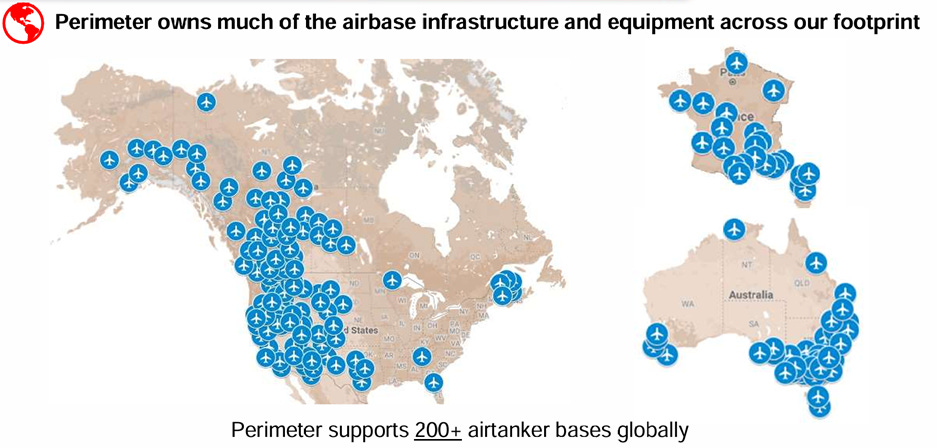
Perimeter Solutions is the only company that sells fire retardant to the United States Forest Service. Supplying fire retardant is very difficult due to the specialized nature of firefighting chemicals and the infrastructure needed to supply it. Perimeter also offers specialized equipment and services that are needed to supply air tankers and other firefighting vehicles with fire retardant. This equipment and services include specialized air base retardant storage, mixing, and delivery equipment. Per Perimeter Solutions most recent annual report, “Our service network can meet the emergency resupply needs of over 150 air tanker bases in North America, as well as many other customer locations globally.”
Perimeter Solutions - UBS Global Materials Conference, September 2024
Put simply, Perimeter Solutions has a monopoly in the niche fire retardant market. The reason is due to Perimeter Solutions’ vast scale of air tanker bases and its reputation for doing a great job servicing its customers. This reliability is extremely important in a mission critical process such as fighting wildfires. In fact, per this Fire & Safety Journal article, the US Forest Service choose not to enter a contract with Compass Minerals (the only other potential competitor to Perimeter), after “inspections revealed corrosion in airtankers used for distributing the company’s fire retardants.” This illustrates the challenges of operating in the fire-retardant industry. Not only do you have to have the right chemicals and make sure they are safe to load into an air tanker, but you also must have the scale of air tanker bases to effectively respond to wherever the wildfire may be. This is very difficult to do, and Perimeter Solutions has been the only company to do it effectively over many years. Again, Perimeter is the only supplier to the U.S. Forest Service for its fire-retardant product. Many companies and organizations do not like to be dependent on one supplier to meet their needs but if the contract represents a small amount of overall spend, they are less likely to care about trying to get another supplier on board. Moreover, competitors are less likely to enter a niche market that accounts for a low percentage of overall spend in an industry. In Perimeter’s case, fire retardants are a critical component when it comes to fighting wildfires, yet retardant makes up only about 3% of overall fire suppression costs. Perimeter Solutions has 200 air tanker bases globally, and they estimate it costs $3 million to fully develop an air tanker base. That means it would cost $600 million for a competitor to try to match the scale of Perimeter’s tanker base network. And because fire retardant only makes up 3% of overall fire suppression costs, it is very unlikely a potential competitor would want to enter the market. So, like many of TransDigm’s business units, Perimeter Solutions has a monopoly in a niche market, and it likely does not make financial sense for a potential competitor to try to compete.
For context, Fire Safety made up roughly 78% of Perimeter Solution’s sales in 2024 while the specialty products segment accounted for roughly 22%.
Specialty Products Division
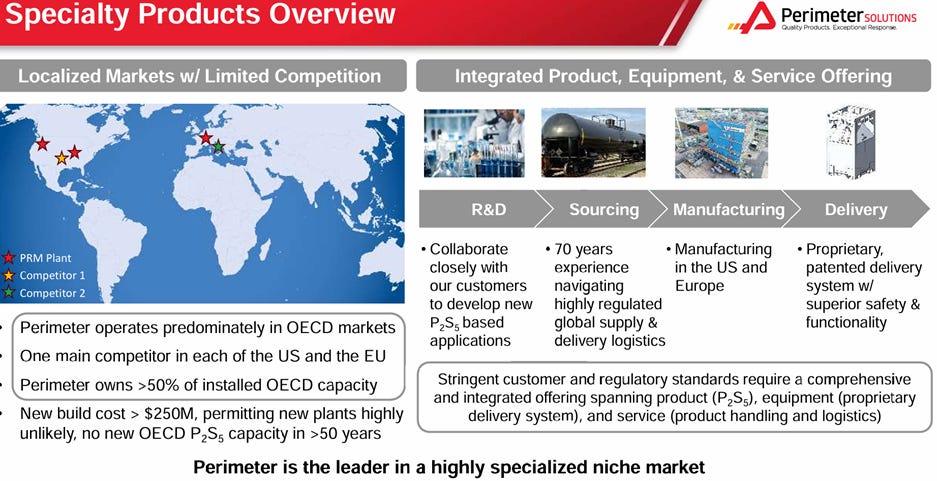
In the Specialty Products division, Perimeter Solutions only has one competitor in each of the US and EU. Moreover, Perimeter owns more than 50% of the global installed capacity. As mentioned previously, the primary end market application for the specialty products segment is phosphorus pentasulfide (P2S5), which is used in the production of engine oil additives, pesticide/mining chemical applications, and electric battery technologies.
Perimeter Solutions - UBS Global Materials Conference, September 2024
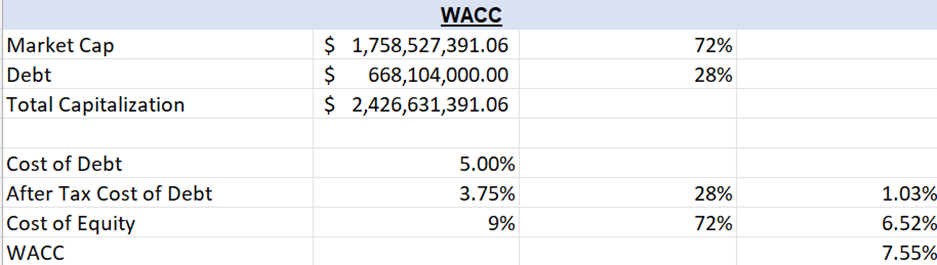
Perimeter Solutions currently has a weighted average cost of capital of 7.55%, assuming a 9% discount rate, 25% tax rate, and 3.75% after tax cost of debt. I assumed a long-term growth rate of 3% to be conservative. Subtracting the 3% growth rate from the WACC, leaves a capitalization rate of about 4.55%.
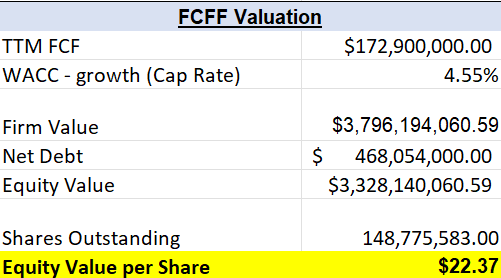
Capitalizing the $172.9 million in free cash flow by the cap rate of 4.55% leaves an estimated enterprise value of roughly $3.8 billion. Subtracting net debt of roughly $468 million from the enterprise value of $3.8 billion leaves an implied equity value of $3.328 billion, or $22.37 per share. (~89% upside from current price of $11.82 as of May 12, 2025).
Founder Advisory Agreement
Perimeter Solutions has a founder advisory agreement in place with its founding team. This agreement can make Perimeter’s financial statements a little confusing at first glance, which is why the company reports adjusted figures. Per the company’s most recent 10-K filing, “the Fixed Annual Advisory Amount is equal to 2,357,061 shares of Common Stock (1.5% of 157,137,410 shares outstanding as of November 9, 2021) for each year through December 31, 2027…”. The advisory agreement also stipulates that the founders receive 18% of the increase in the average share price over the average price established in the agreement. “The EverArc Founder Entity did not qualify to receive Variable Annual Advisory Amount for 2024 as the average price of $12.85 per share for 2024 was lower than the average price of $13.63 per share established in 2021.” For 2024, the founders choose to receive 78% of the fixed advisory amount in common stock. Since Perimeter is operating like a private equity firm in the public markets, this Founder Advisory agreement is similar to a typical “2 and 20” fee structure found in hedge funds and private equity firms. Perimeter Solutions founder advisory agreement is a 1.5% and 18% structure, but the difference is that the founders are electing to take a majority of their fees in shares which should align their interests with shareholders. Moreover, the founding team has a history of creating substantial shareholder value. As previously mentioned, Nick Howley co-founded and was CEO of TransDigm, a company that has more than 50x’d over the last 19 years since IPO. The fixed annual advisory fee will cease in 2027, and the variable advisory fee lasts through 2031. There will be some dilution due to this advisory agreement, but the substantial share repurchases should more than offset any dilution. For instance, on November 9, 2021, there were 157,137,410 shares outstanding. There are currently 148,775,583 shares outstanding. The company repurchased nearly 3 million shares in 2024 and more than 12 million shares in 2023.
Takeaway
Perimeter Solutions is an under the radar stock with a monopoly in a niche industry. Perimeter Solutions has a wide competitive moat due to its extensive network of air tanker bases and its long-term operating history. Perimeter has compounded EBITDA by 17% annually since 2010 and its goals are to deliver at least 15% annual returns in its share price. Unfortunately, wildfires are not likely to go away, and Perimeter offers the best solution to fight the growing problem of wildfires.
Full Disclosure: I own shares in Perimeter Solutions (PRM)