

While I don’t think one or two quarters means a whole lot in terms of investment performance, my goal is to provide transparency about my investment performance so readers can see how my investments are doing.
The last thing I want Clayton Capital Insights to be is a generic stock pitch service that focuses on quantity over quality.
My goal is to provide readers and subscribers with quality value investment ideas and more importantly share my thoughts for how I’m constructing my portfolio to compound at high rates of return over the long-haul while mitigating downside risk.

My main objective is to construct a portfolio that can compound at ~20–25%+ annually over time, while avoiding permanent capital loss.
For Q1, my portfolio was up 0.37%. This might not look like much, but I think it was a good quarter considering the NASDAQ, S&P 500 and Dow were down roughly 7%, 4% and 3%, respectively.
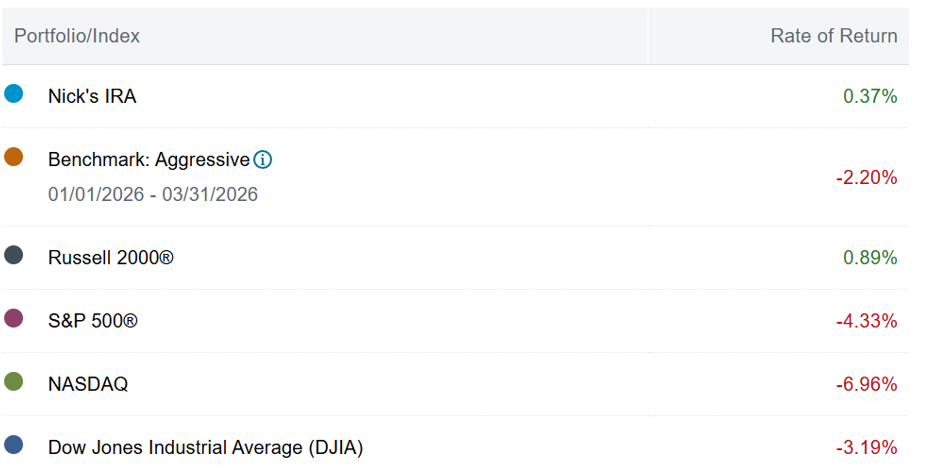
More importantly than my returns, I’m focused on whether the underlying businesses are progressing as expected.
Here is a breakdown of my previous writeups and how they have performed:
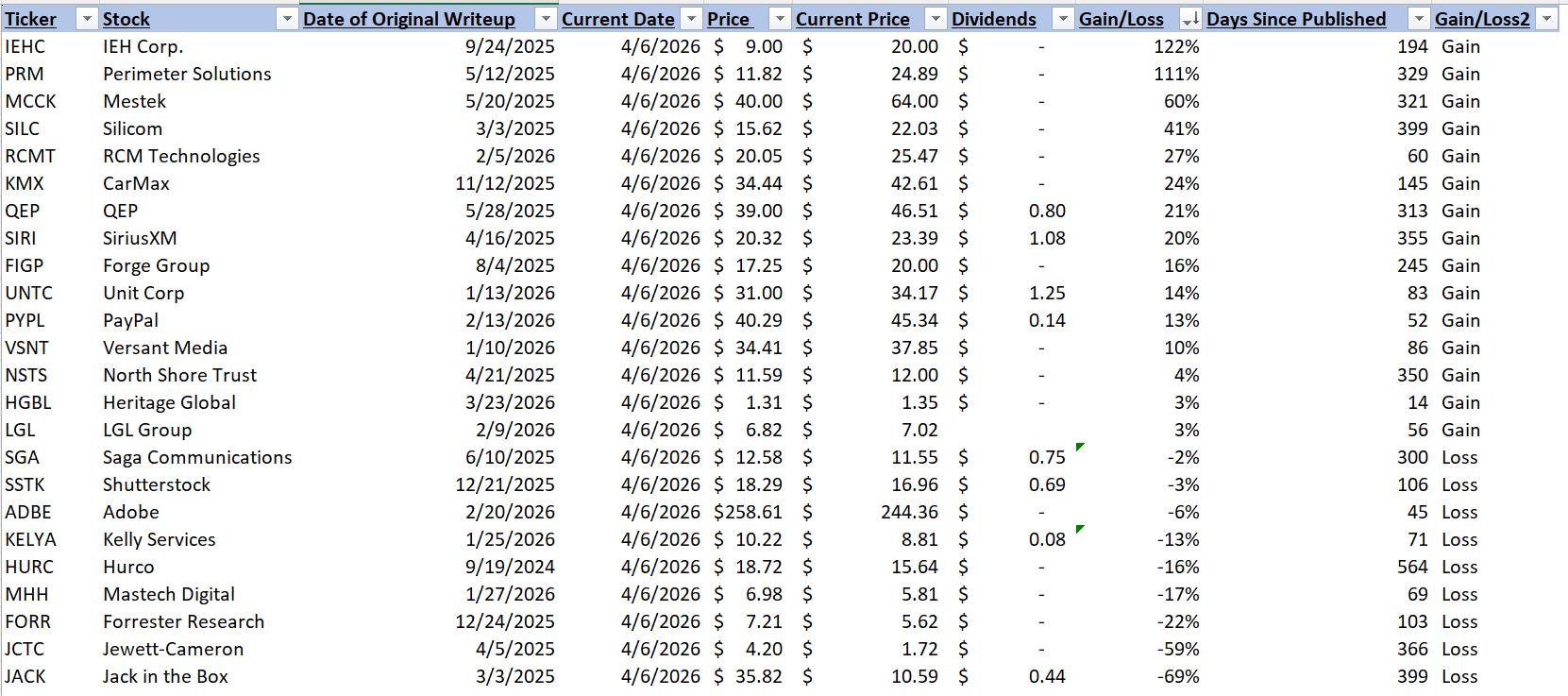
I currently have roughly 2/3 of my portfolio in my top seven positions. These positions include PayPal, Heritage Global, IEH Corp., Versant Media, Forge Group, QEP, and Unit Corp.
My Strategy
For those who don’t know, I am a concentrated value investor. I prefer investing in small/micro-cap companies that are under-the-radar of Wall Street analysts.
Here’s a brief background about my strategy: Start Here: Welcome to Clayton Capital Insights.
I believe my edge comes from focusing on underfollowed securities where institutional capital either can’t or won’t go—small caps, special situations, and misunderstood balance sheets. I also am willing to concentrate in my best ideas, often only holding 7 - 12 stocks in my portfolio.
The bottom line is simple: the more stocks you own, the harder it becomes to meaningfully outperform the market.
In A Value Investor's Portfolio Construction Playbook, I highlighted the optimal number of stocks an investor should own if their goal is to outperform the market indexes over time.
How are you supposed to know how much of your portfolio to allocate to one stock? The Kelly Criterion can help with this. In How to Properly Size Investment Positions, I cover the Kelly Criterion in more detail which can help a lot when trying to decide how much of your portfolio you should put into one stock.
I tend to focus on lower beta, idiosyncratic stocks. That is, stocks that will have little correlation to the overall stock market indexes. In Why I’m Shifting a Portion of My Portfolio Toward Event-Driven Returns, I discussed the importance of thinking about beta in overall portfolio construction. I don’t view a higher-beta stock as inherently “riskier” simply because it’s more volatile. Instead, I think of beta as a measure of how closely an investment’s outcomes are tied to the broader market.
This means that I am probably more comfortable owning less liquid microcap stocks than the average investor might be. If that’s not your style or you’re not comfortable with that, that is ok. It all depends on an investor’s preferences and risk tolerance.
When analyzing investments, I tend to think more about the downside risks than how much I can make. I find that when I do that, I am more comfortable owning larger positions and that the upside tends to take care of itself.
I prefer owning stocks with strong balance sheets. i.e. companies with little to no debt and ample cash balances. I also prefer to own stocks where the management team owns a large percentage of the stock.
Typically, when I look at a stock - I like to see a past track record of profitability and prefer paying no more than 5x Enterprise value/owner’s earnings. Owner’s earnings is a rough proxy for free cash flow (with a few adjustments) and is equal to net income + depreciation & amortization - maintenance capital expenditures (CapEx) +/- changes in working capital.
Some Lessons Learned
Ultimately, investors must learn from their mistakes, or they risk being forced out of the game. One of the biggest risks in value investing is investing in a “value trap.”
When initially analyzing an investment, it’s not always easy to tell whether there’s just a temporary mispricing or the market is correctly pricing permanent impairment and long-term secular decline.
That being said, valuation alone is not enough. A low multiple can just as easily signal a deteriorating business as it can a genuine opportunity. Investors need to look beyond the numbers and evaluate the durability of the underlying business—its future prospects, industry structure, and whether it possesses any real competitive advantage.
This means asking tougher questions: Does the company have pricing power? Are its returns on capital sustainable or already in decline? Is management allocating capital intelligently? And just as important—what could erode this business over time?
A cheap stock without a moat often stays cheap, or worse, becomes cheaper. The real opportunity comes when you find a business that is both undervalued and competitively advantaged—one that can sustain or grow its earnings power over time. That’s where multiple expansion and earnings growth can work together, which is ultimately what drives outsized returns.
Watering the Flowers and Cutting the Weeds
One concept I’ve come to appreciate more over time is the idea of adding to winners. Many investors are quick to trim or sell a stock simply because the price has gone up.
But price alone obviously doesn’t determine value. If the underlying business is performing better than expected and your conviction has increased, it can make sense to add to the position—even at a higher price.
In many cases, the highest returning investments are the ones where the thesis continues to strengthen over time. Letting winners run is important, but selectively adding to them when the fundamentals improve can be just as powerful.
At the same time, discipline on the downside is equally important. If the original investment thesis breaks—whether due to deteriorating fundamentals, poor capital allocation, or a structural change in the industry—it’s critical to reassess quickly and act accordingly.
Cutting losses early can be one of the most important drivers of long-term compounding, as it prevents capital from being tied up in situations where the probability of success has materially declined.
Ultimately, portfolio management is a constant process of updating probabilities. When the odds improve, I believe it’s prudent to add to your position. When they deteriorate, it’s better to cut your losses and move to a better idea. This dynamic approach—adding to strength and cutting weakness—is a key part of maximizing long-term, risk-adjusted returns.
Wrapping Things Up
At the end of the day, successful investing isn’t about finding one perfect stock—it’s about consistently applying a sound process over time. That means focusing on downside protection, being selective with position sizing, and staying disciplined when new information emerges.
There will always be mistakes and periods of underperformance, but what matters most is how you respond to them and whether your overall approach is improving.
My goal with Clayton Capital Insights is not just to share investment ideas, but to provide a transparent look into how I think about portfolio construction and capital allocation in real time. If I can continue refining this process while compounding capital at attractive rates over the long haul, I believe the results will take care of themselves.
What stands out here is the consistent focus on downside risk rather than chasing upside. That discipline—especially in micro-caps—is often what separates durable investors from lucky ones.
Also appreciated the reminder that valuation alone isn’t enough; durability and capital allocation ultimately determine whether something is truly undervalued or just cheap.