

QVC is often written off as a “melting ice cube.” Cord-cutting, declining TV audiences, leverage, and bad headlines dominate the conversation.

But credit investing isn’t about narratives or growth stories. Bondholders get paid based on priority, structure, and survival—not popularity.
At prices in the mid-40s, I believe QVC’s senior secured notes offer an attractive opportunity for equity like returns with the bonds likely well protected by asset coverage and going concern value.
The QVC bonds are senior secured claims at the operating company (OpCo) level, backed by inventory, receivables, and cash at the operating company.
Even if QVC ultimately restructures sometime in the next few years (which is a strong possibility), the senior secured notes should fare well and recover much more than their current prices. Worst case scenario, senior secured bondholders shouldn’t lose much given their strong position in the capital stack.
Where the QVC Senior Secured notes sit in the capital structure:
The QVC bonds are QVC operating-company senior secured notes, ranking:
Pari passu with each other
Pari passu with the $2.9B senior secured credit facility
Ahead of all unsecured debt, preferred, and common equity
Based on QVC’s most recent quarterly filing, QVC has roughly:
$2.9B senior secured revolver
~$2.1B senior secured notes total
~$6.6B total consolidated debt
These notes are secured by substantially all assets and equity pledges of QVC subsidiaries.
This is why QVC’s bonds are far more interesting than its equity at current prices.
The Key Misunderstanding and The Opportunity
There’s a common assumption that investing in high-yield, or “junk,” bonds is inherently risky. That isn’t necessarily true if you understand where the debt sits in the capital stack and how it is treated under the absolute priority rule.
Investing in distressed debt is probably best done as a small percentage of a diversified portfolio. For investors who understand capital structure, recovery dynamics, and process risk, it can nonetheless be a potentially attractive source of returns.
Two years ago, I bought a small amount of Qwest 7.75% notes due Feb. 15, 2031, for roughly 33% of par value. Today those bonds trade near 92% of par. I sold the position too soon but suffice it to say that there can be opportunities for a high yield bond investor.
If you’re interested in learning more about distressed bond investing, two great books I read were Distress Investing: Principles and Techniques by Martin Whitman and Corporate Financial Distress, Restructuring, and Bankruptcy: Analyze Leveraged Finance, Distressed Debt, and Bankruptcy by Edward Altman.
Here’s why distressed bond investing can be an interesting investment opportunity in a well-diversified portfolio.
Bondholders:
sit above equity in every scenario
benefit from contractual claims – i.e. no one can takeaway a creditor’s right to payment
distressed bonds can earn equity-like returns without requiring a full business recovery
The market price on QVC’s senior secured bonds reflects uncertainty and forced selling, not necessarily expected recovery.
A Word of Caution
It should be noted that my base case is that QVC undertakes a balance-sheet restructuring within the next 12–18 months. This is not a worst-case outcome, and neither is it a certainty.
Importantly, the investment thesis does not depend on avoiding Chapter 11; it depends on senior secured recoveries exceeding current prices across a range of plausible outcomes. Even if QVC files for Chapter 11 bankruptcy, the base case recovery estimates for the senior secured debt is 70 - 90%.
Investors who are not comfortable owning a security through a potential restructuring or Chapter 11 process should avoid this opportunity, as periods of illiquidity and uncertainty are likely.
While Unlikely to Liquidate, QVC’s Asset Values Protect Most of the Senior Bonds
In most realistic downside cases, QVC would continue operating. Recoveries are therefore driven by enterprise value, not fire-sale asset values.
While it’s very unlikely that a restructuring ends in a Chapter 7 liquidation, courts still perform a liquidation analysis to ensure that creditors receive at least as much value under a going-concern reorganization as they would in liquidation. In that sense, liquidation value represents a hypothetical “floor value” for bond recoveries.
Here’s what a bear case, hypothetical liquidation value might look like based on QVC’s balance sheet as of their most recent filing:
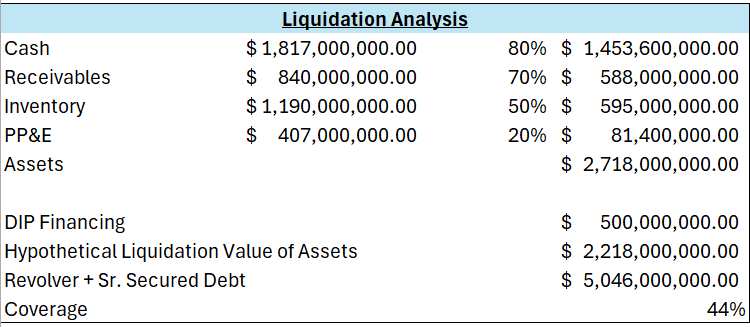
Debtor-in-possession (DIP) financing is new funding provided after a company files for Chapter 11 bankruptcy to keep the business operating, and it typically has super-priority status that sits ahead of existing debt.
Although not every restructuring requires it, I’ve taken a very conservative approach here by haircutting cash, recognizing that some of it is usually consumed by DIP financing needs and restructuring-related expenses.
Haircutting cash upfront builds in a margin of safety by assuming that some liquidity will be consumed by operations and admin/restructuring expenses rather than distributed to creditors. By doing so, the analysis implicitly stress-tests DIP needs and reduces the risk of overestimating recoveries in scenarios where priming DIP financing is required.
As you can see, even in a conservative liquidation analysis, the senior secured notes would likely be covered by the asset value. The 2028, 2034 and 2043 senior secured notes currently trade in the low-to mid-40’s, which represents the percentage of par value. If you don’t apply a haircut to cash, then the senior secured revolver and debt is covered at ~50%.
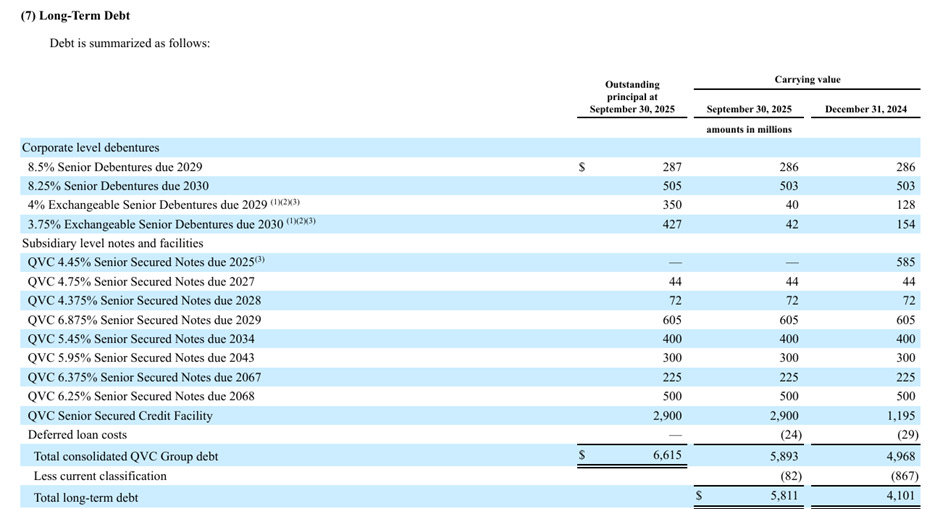
The chart above shows all of QVC’s current long-term debt.
The corporate level debentures of roughly $1.57 billion are structurally subordinated to the subsidiary level notes.
In plain English, the senior secured notes and credit facility would get paid before the corporate level debentures.
For this analysis, I’ll be reviewing the 2028, 2034, and 2043 senior secured notes.
Where the Market Gets It Wrong
QVC’s bonds are priced as if:
a restructuring is inevitable
recoveries will be mediocre
capital will be tied up for years
But distressed debt markets often price path risk, not terminal value.
Forced institutional selling, mandate constraints, and complexity aversion frequently push prices far below expected recoveries.
That gap is where opportunity lives.
What This Means for Returns
At current prices, QVC bonds embed asymmetric optionality:
downside protection through seniority
upside through refinancing or rational restructuring
meaningful cash coupons while you wait
This is not a binary bet on equity survival — it’s a probability-weighted wager on outcomes that don’t require perfection.
The sections below are available to paid subscribers only and include return estimates, comparison of the 2028, 2034, and 2043 notes, estimated recovery rates, and portfolio sizing guidance.
