

Today I wanted to update readers on my investment process and my portfolio’s performance for 2025.
For those who don’t know, I am a concentrated value investor who believes in allocating more capital to my best ideas. My goal is to earn at least 20% annual returns over the long-term. I’m not an investment professional, but I’ve spent years studying value investing and its history.
I tend to hold anywhere from 7–10 stocks and invest in businesses I understand that are trading at a discount to private market value, or intrinsic value. Intrinsic value is simply the present value of all future cash flows a business is likely to generate.
I try to be conservative in my estimates and don’t place much weight on future growth prospects. I prefer to invest in companies with rock-solid balance sheets and stable earning power over the long-term.
I also allocate a portion of the portfolio to special situations and event-driven investments, such as spin-offs and arbitrage opportunities. These are situations where returns are driven less by market sentiment and more by identifiable corporate events.
For 2025, my portfolio was up roughly 41% while the S&P 500 was up about 19% and the Dow Jones Industrial average was up roughly 16%.
2025 was likely an unusually good year, and I’d be happy if I could get 10 percentage points above the indexes over the long-term.
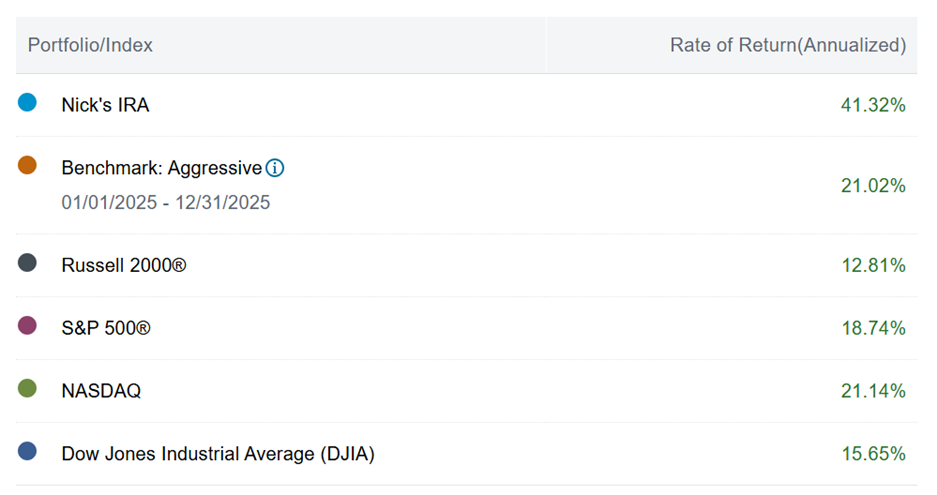
While one year is not enough time to judge investment performance, my hopes are that I can continue compounding capital at high rates of return for a long-time.
The biggest single contributor to my performance in 2025 was Perimeter Solutions. You can read my original write up here and why I ended up selling it.
I bought the stock around $9.50 per share and sold it after it had nearly tripled to around $28. At the time I bought the stock, it was my second largest holding. Now, you can see why concentration works. If a stock gains 50% and it only makes up 2% of your portfolio, then it only contributes 1% to your overall portfolio. If it’s 20% of your portfolio, then that gain makes up about 10% of your portfolio. This is why I believe in concentrating on my best ideas.
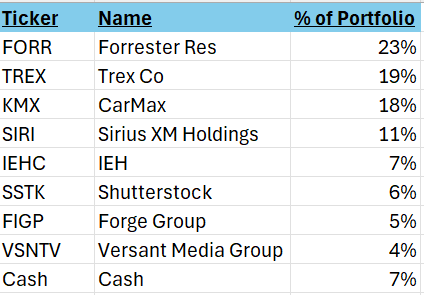
I bought CarMax (KMX) after the stock price got obliterated and was trading near a 13-year low. I also recently bought Forrester Research (FORR), which was priced at roughly 2.5x EV/EBIT when I bought it. Forrester also has a majority of their entire market cap in net cash. I believe Forrester is a low-risk bet with a large “margin of safety” and offers at least a 30% earnings yield at current prices. The stock price has increased a bit since I wrote about it, but I still think it’s substantially undervalued.
I trimmed my positions in CarMax and Trex to fund a purchase of Forrester Research, which I believe offered a higher earnings yield and a wider margin of safety at the time. I continue to hold both CarMax and Trex as core positions and remain positive on their long-term prospects.
I manage a relatively small amount of capital across two personal IRAs and a joint account for my wife and me.
In 2025, the portfolio generated investment gains comparable to what I would have earned in my day job, which led me to spend more time focused on investing and writing.
I believe that consistent outperformance requires a meaningful investment of time and effort. Developing high conviction in a small number of positions requires a deep understanding of each business, which naturally leads to a more concentrated portfolio.
This approach is not unique. Many long-term value investors have emphasized concentration as a way to align knowledge, conviction, and risk management.
I don’t write primarily for the money. I write because the process strengthens my investment theses and forces me to clarify my thinking around why I own a stock. That discipline matters, especially when taking a contrarian approach and holding positions that many people temporarily disagree with.
Warren Buffett put it well in the early 1960s:
“You will not be right simply because a large number of people momentarily agree with you. You will not be right simply because important people agree with you. You will be right, over the course of many transactions, if your hypotheses are correct, your facts are correct, and your reasoning is correct. True conservatism is only possible through knowledge and reason.”
— Buffett, 1961 Partnership Letter
Here’s my current portfolio:
Thanks for reading and wishing you a prosperous 2026!
Perfect quote from Buffet.
If you are interested, being based here in Taiwan, I can share my insights on TSMC's competitive advantages with you. I believe I can provide a much deeper perspective than most. =)