

When I started Clayton Capital Insights, I wanted a place where I could create a written track record of my investment process and performance.
Writing on a public forum helps me clarify my investment theses and more importantly keeps me accountable for what I write about.
Every investment writeup is published in real time, and the results, whether good, bad, or ugly, remain part of the public record.
My hope is that this transparency allows readers to evaluate not only the outcomes, but also the quality of the underlying investment process.
Performance of Previous Stock Writeups
After more than 18 months of publishing stock writeups, I thought it would be worthwhile to review the results.
Here’s a snapshot.
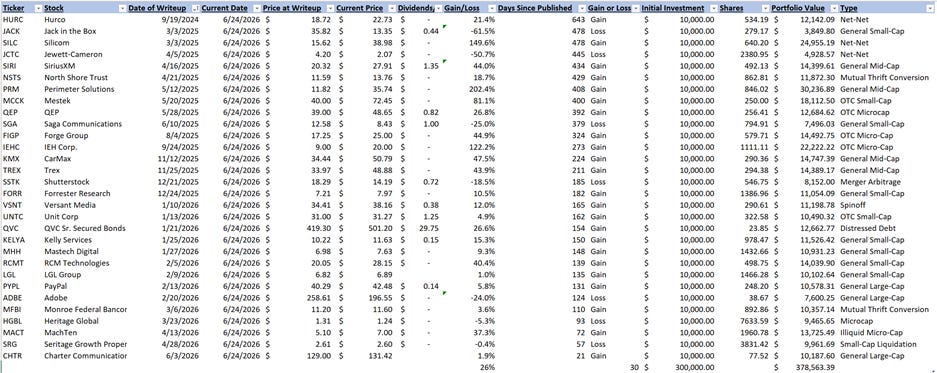
*Current prices are as of market close on June 24, 2026. The more illiquid stocks were quoted at their last traded price. These figures do include dividends but do not include trading costs. Performance is based on publicly quoted market prices. Certain holdings are thinly traded, and actual transaction prices may differ from quoted prices.
Since launching the newsletter, I’ve published writeups on 30 different securities ranging from microcaps and over the counter (OTC) stocks to larger companies such as Adobe, PayPal, Charter Communications, and CarMax. I also wrote about one distressed debt investment. Most of the ideas, however, come from the neglected corners of the market where I spend most of my research time.
If an investor had hypothetically invested $10,000 into each stock on the day the writeup was published and held through today, the portfolio would have generated a total gain of approximately 26.2%, or $78,563.39 on $300,000 invested.
Because the ideas were published over different time periods, a more meaningful measure is the annualized return. Since inception, a hypothetical portfolio consisting of a $10,000 investment in each published idea on the date of publication has generated a 38.2% annualized money-weighted return (XIRR) through June 24, 2026.
While the overall return is encouraging, what I find more interesting is the composition of the results.
Here are the top 10 best performers:
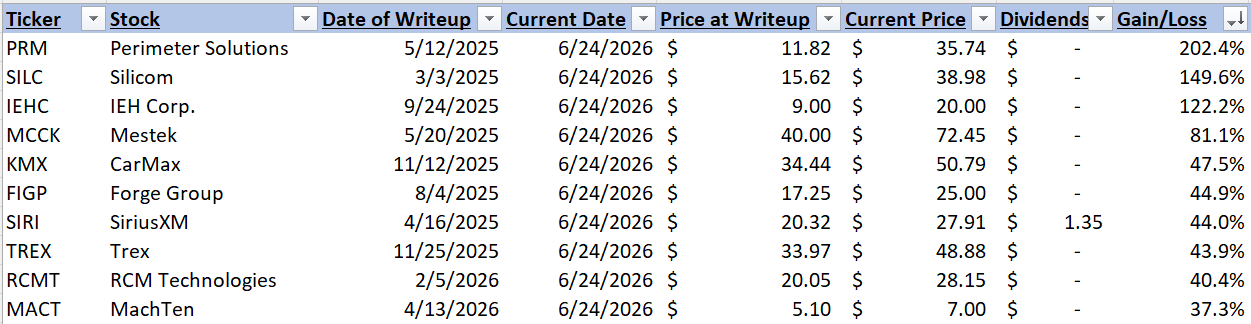
Several ideas have more than doubled since publication. Perimeter Solutions has gained over 200%. IEH Corporation appreciated more than 120%. Silicom has increased roughly 150%. Mestek advanced more than 80%. Other ideas such as CarMax, Forge Group, RCM Technologies, and SiriusXM also produced solid gains.
Not every investment worked. Jack in the Box declined more than 60% from the publication date. Shutterstock, Saga Communications, Jewett-Cameron, and Adobe have also been disappointing so far. Investing is an exercise in probabilities, not certainties, and some losses are inevitable.
Here are the top 5 worst performers:

What stands out is that the winners have generally been much larger than the losers.
Across all published ideas, approximately 77% have been profitable – 23 have been profitable while 7 have shown a loss. The average winning investment generated a gain of roughly 42%, while the average losing investment declined by roughly 26%. In other words, the gains from successful investments have significantly outweighed the losses from unsuccessful ones.
How My Actual Portfolio Has Performed
While the equal-weight performance of the published writeups is one way to evaluate the idea generation process, the more important metric is how my actual portfolio has performed.
I invest in what I write about. However, my portfolio returns have not perfectly matched the performance of the published writeups. The primary reason is position sizing: not every idea receives the same allocation, and some of the biggest winners were not my largest positions.
In addition, I maintain cash reserves at times, selectively choose which ideas to invest in, and occasionally exit positions earlier than a hypothetical buy-and-hold portfolio would. As a result, the performance of the writeups and the performance of my actual portfolio should be viewed as related but distinct measures of investment success.
Over the last two years (since June 24, 2024), my IRA has generated a cumulative return of 63.2%, which equates to an annualized return of 27.8%.
Over the same period, the S&P 500 returned 17.6% annually, the Russell 2000 returned 22.9%, and the Nasdaq returned 21.08%.
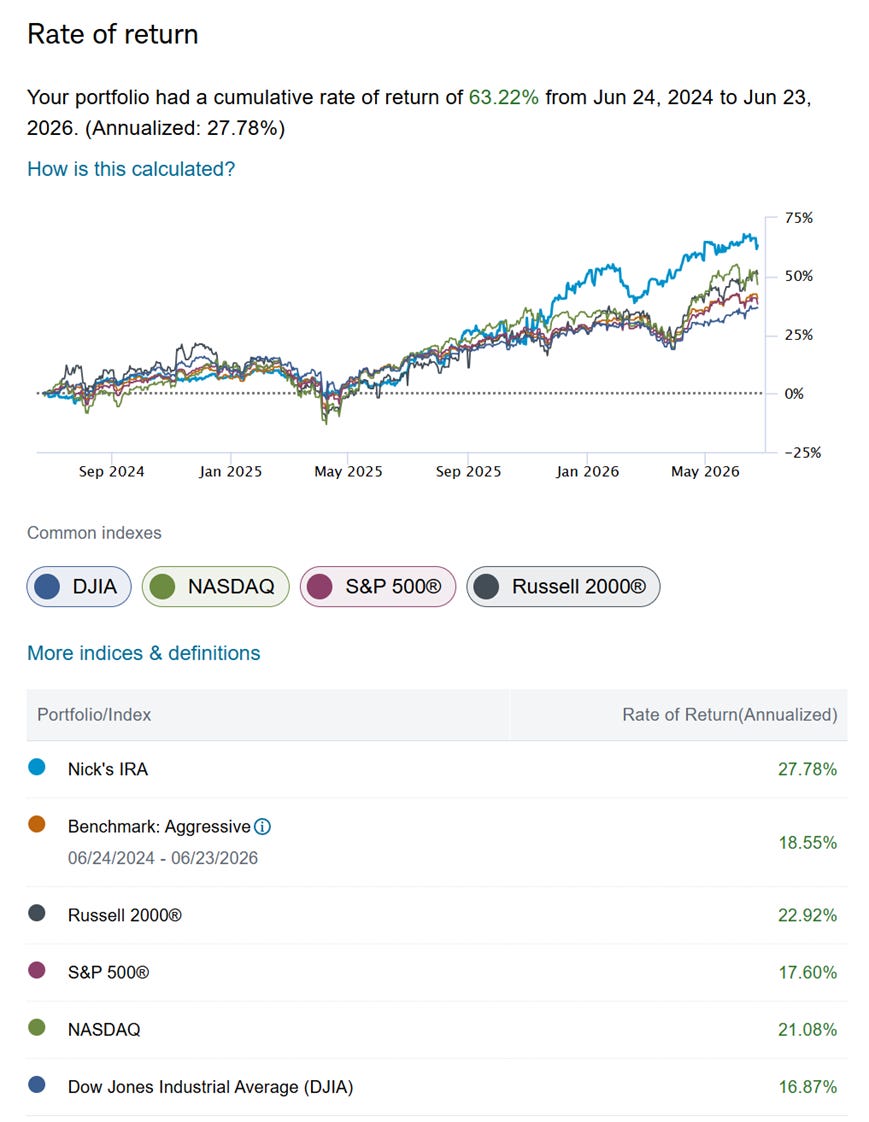
In other words, the portfolio has outperformed each of the major indexes despite maintaining significant exposure to small/micro-caps, special situations, and areas of the market that are often considered less attractive than large-cap technology stocks.
What I find particularly encouraging is that the results were not driven by a single position. Instead, performance has come from a collection of successful investments including Perimeter Solutions, IEH Corporation, Silicom, Mestek, CarMax, Forge Group, and several others. At the same time, there have been meaningful mistakes, including Jack in the Box, Shutterstock, and a few positions that have yet to play out as expected.
The portfolio has also experienced periods of underperformance. There were stretches when it lagged the broader market and times when individual positions appeared to be moving in the wrong direction. Those periods can be frustrating, but they are an unavoidable part of a concentrated value investing approach. The market rarely recognizes undervaluation immediately, and in many cases an investment thesis requires months—or occasionally years—to unfold.
Importantly, these returns were achieved without relying on leverage, options speculation, or frequent trading. The strategy remains focused on identifying securities trading at significant discounts to intrinsic value and allowing the gap between price and value to close over time.
A sample period of less than two years is far too short to draw definitive conclusions. However, the early results provide evidence that the process is working and that opportunities continue to exist for investors willing to look beyond the most widely followed companies and sectors.
Takeaways and Lessons Learned So Far
My experience with value investing and writing has reinforced several lessons.
First, opportunities still exist in small and overlooked companies. Many of the best-performing ideas were businesses that received little institutional attention and had minimal analyst coverage. The market remains remarkably efficient in some areas and surprisingly inefficient in others.
Second, valuation continues to matter. Nearly every major winner began as a company trading at a substantial discount to intrinsic value. While valuation alone is not enough, it remains one of the most reliable starting points for generating attractive long-term returns.
Third, patience is often the hardest part of investing. Some of the best-performing positions looked wrong for weeks or months before the market eventually recognized their value. In a world dominated by short-term news and price movements, maintaining a long-term perspective remains a competitive advantage.
Finally, this exercise reminded me that investing is a continual learning process. Some ideas worked for reasons I expected. Others worked for entirely different reasons. Likewise, several of the losers have provided valuable lessons that will likely improve future decision-making.
Going forward, I expect to continue focusing on the areas where I believe I have the greatest edge: special situations, microcaps, asset-based value investments, spinoffs, and companies trading at substantial discounts to intrinsic value.
One year is far too short a period to draw definitive conclusions. Markets are noisy, and luck always plays a role over shorter time horizons. Nevertheless, I am encouraged by the early results and remain optimistic that a disciplined value-oriented approach can continue to generate attractive returns over the long run.
One of the biggest lessons I’ve learned over the last few years is that finding investment opportunities is often easier than most people think. There are thousands of publicly traded companies, and if you’re willing to spend the time reading annual reports, industry publications, and regulatory filings, attractive opportunities regularly present themselves.
The more difficult challenge is understanding a business well enough to identify what could go wrong.
A stock can look statistically cheap, but if you don’t understand the industry dynamics, competitive threats, capital allocation risks, balance sheet risks, or management incentives, it’s easy to walk into a value trap. The downside is often far more important than the upside.
Even when you’ve identified a compelling opportunity, another challenge remains: position sizing. The difference between a good investment result and a great one is often not finding the idea itself but determining how much capital to allocate relative to the opportunity and the associated risks.
Every investment competes for scarce capital, and portfolio construction ultimately requires balancing conviction, valuation, downside protection, and diversification.
In my experience, investment success is less about finding a handful of hidden stocks and more about accurately assessing risk, avoiding permanent capital impairment, and allocating capital rationally when attractive opportunities arise.
As always, thank you for reading and following along.
Thank you for sharing your process.
Hi Clayton, thanks for the great write up! I saw you mentioned that "many of the best-performing ideas were businesses that received little institutional attention and had minimal analyst coverage" and was wondering if, across your portfolio of neglected microcaps, you're finding that the mispricing tends to come purely from being underfollowed and overlooked by the market — rather than from any deeper structural or governance issues at those companies — since that distinction seems key to knowing which of these names could actually be ripe for an activist-style catalyst versus just staying cheap and ignored indefinitely.