

The Opportunity

Saga Communications owns and operates AM/FM radio stations throughout the U.S., primarily in the Midwest and on the East Coast. Nearly 90% of Saga Communication’s revenue comes from local advertising. Saga Communications is a microcap stock that trades on the NASDAQ and currently has a market capitalization of roughly $77 million. Saga Communications could very well be a classic Ben Graham “cigar butt.” It’s cheap for a good reason, as radio appears to be in a long-term secular decline. However, as I’ll explain in this article, Saga Communications still offers a compelling opportunity given its deep discount to fair value and potential sale of its noncore radio towers. Thus, I believe investing in Saga’s stock can still offer investors a good investment outcome at current prices.
This article doesn’t attempt to make a case for the long-term prospects of the radio industry. Like newspapers, radio appears to be in a long-term secular decline. Younger listeners are gradually shifting to podcasts and streaming services such as Spotify and Apple Music. Moreover, many vehicles in the U.S. come installed with services such as Apple Car Play/Android Auto and Sirius XM radio. Despite the long-term secular decline in the radio broadcasting industry, Saga Communications still offers an asymmetric risk/reward setup for value investors given the company has minimal debt, a high cash balance and is selling at a deep discount to book value. Net cash (cash less debt) currently represents nearly 30% of Saga Communication’s entire market cap!
2025 1st Quarter Earnings Snapshot
Here’s a quick snapshot of Saga’s most recent quarterly earnings for the quarter ending March 31st, 2025.
Saga reported a 4.3% decline in net revenue to $24.2 million, with a $1.6 million net loss, roughly flat year-over-year. Saga’s operating loss slightly improved to $2.3 million, and capital spending declined to $700,000. Same-station revenue fell 6.6%, but same-station expenses dropped 5%, driven by cost savings in compensation and digital services. Interactive revenue rose 14% with a 51% margin, and online news revenue nearly doubled. Second-quarter pacing shows signs of improvement. Saga paid a $0.25 dividend, maintains a strong $27 million cash position, and plans to fund stock buybacks via potential noncore asset sales. Full-year expenses are expected to be flat or slightly down, with ongoing investment in digital and blended advertising initiatives.
Normalized Valuation
Over the last 10 years, Saga Communication’s earnings per share have averaged roughly $1.72 per year. Whenever I analyze an investment, I like to look back over a 5 – 10-year period to get a better sense of the “normalized earnings” of a business since business performance tends to revert to the mean over an entire business cycle.
Over the last 10 years, Saga’s average EBIT (operating income) margin has been about 12.33%. Multiplying 2024’s revenue of $113 million by 12.33% yields a “normalized operating income” of about $13.93 million. Assuming a 25% tax rate, Saga’s “normalized net income” is about $10.45 million. Since Saga’s average depreciation expense has been roughly $5.9 million over the last 10 years, I added that back to net income since depreciation is a non-cash charge. This would yield an after-tax EBITDA of about $16.35 million. Deducting average capital expenditures of $5.2 million equates to a normalized “owner earnings” figure of about $11.15 million. Since 2018, Saga Communication’s average free cash flow has been $11.43 million so this “adjusted earnings” is a rough approximation of free cash flow, or “owner’s earnings”.
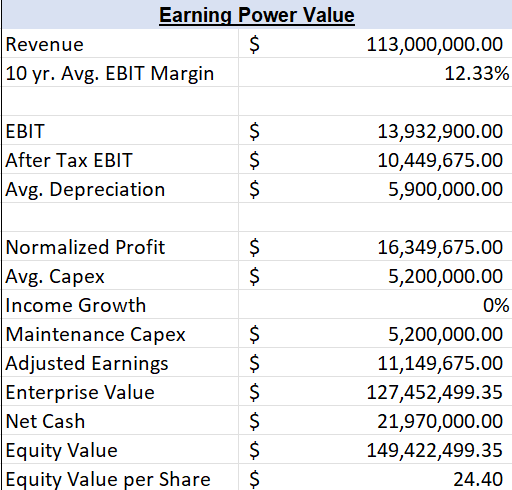
I estimated Saga’s cost of capital to be roughly 8.75%. Saga only has $5 million of debt and $26.97 million in cash and short-term investments leaving net cash at $21.97 million, or $3.59 per share, which is nearly 30% of the market cap. Capitalizing the normalized owner earnings of $11.15 million by the cost of capital of 8.75% yields an implied enterprise value of roughly $127.4 million ($11.15 million / 8.75%). This valuation model assumes zero growth. Typically, to get a capitalization rate you would subtract the long-term projected growth rate from the weighted average cost of capital. In this case, I am assuming a zero percent growth rate for Saga to be conservative. Adding back the net cash of $21.97 million leaves an equity valuation of $149.4 million, or $24.40 per share. I don’t think this valuation is much of a stretch since Saga’s stock traded in the low to mid 20’s for much of 2020 – 2024. Saga’s stock traded much higher prior to 2020 and briefly traded over $50 per share.
Saga’s current enterprise value is roughly $55 million. Based on the long-term average EBIT margin of 12.33% and average depreciation and amortization charges, Saga’s normalized EBITDA is roughly $19.83 million. This means that Saga stock is currently trading at roughly 2.78x EV/normalized EBITDA.
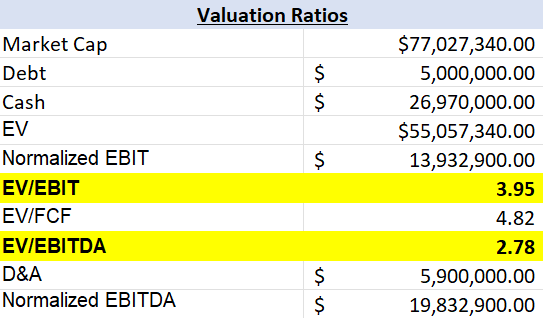
I think Saga is likely worth at least 6x EV/EBITDA to an acquirer and the $24.40 fair market value I previously mentioned would imply roughly 6.43x EV/normalized EBITDA. It is possible Saga could be worth closer to 7 – 8x EV/normalized EBITDA, which would imply a share price range from $26 - $29.50 based on normalized EBITDA. This valuation range doesn’t seem like too much of a stretch either since Saga’s book value is currently $26.71 per share.
Dividend
Saga Communications just declared a $0.25 quarterly dividend, which would imply an annualized dividend yield of nearly 8% at the current price of $12.58 (as of market close on June 10th, 2025). If Saga didn’t have the large cash balance, I would say their current dividend is not sustainable and at high risk of being cut. However, they can likely supplement the dividend payments with the excess cash on the balance sheet. The dividends in 2025 will cost them about $6.12 million, which is less than a quarter of their current cash balance. If profit margins and earnings continue to contract, then the dividend is at risk of being cut. Saga only earned $0.55 per share in 2024 and about $0.70 per share in free cash flow. Saga did not give full-year guidance for 2025 in its first quarter earnings call. Even if Saga were to cut the dividend by half, it would still yield close to 4% at the current price levels.
Projected Returns at Current Price Levels
As previously mentioned, I projected Saga communications normalized “adjusted earnings” (which is a rough proxy for free cash flow) to be $11.15 million, or $1.82 per share. For context, Saga has earned an average of roughly $1.90 per share in free cash flow over the last 7 years. If Saga can return to earning this amount, I think the stock is probably worth $24 - $26 per share. If the stock were to return to the mid-20’s over the next 5 years, then the 5-year projected IRR would be at least 19%, with dividends included. As you can see, this projection assumes zero growth and a constant payout ratio. Obviously, ad spending would need to pick back up since most of Saga’s revenue comes from advertising.
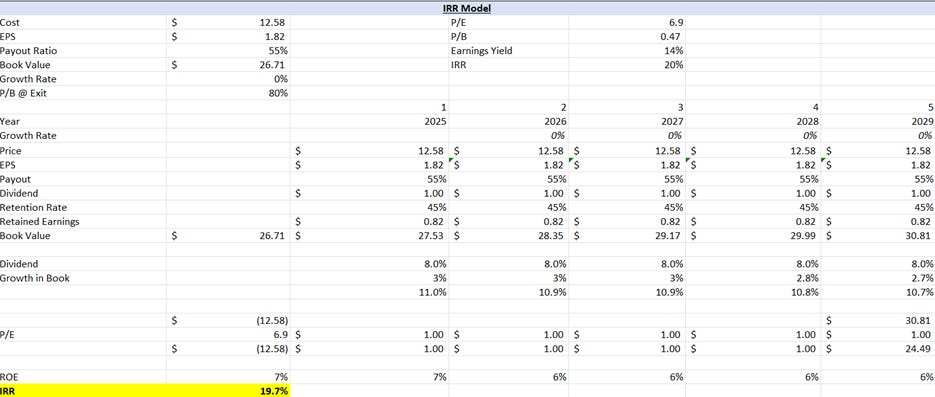
Even if Saga’s revenues continue to fall and profitability levels remain depressed, the large cash balance offers investors a downside margin of safety. Even in a pessimistic scenario where Saga earns only half of what they have in the past and revenues decline around 5% per year, my projected IRR (with dividends included) is around 9 – 11%. Moreover, the risk of permanent capital loss is very small, given Saga’s high cash balance and minimal debt.
A Potential Catalyst on the Horizon
Saga is currently in negotiations to sell some of their tower sites and may use the proceeds to buy back stock which would add a lot of value for Saga’s shareholders since the stock is currently trading at 47% of book value.
CEO Chris Forgy had this to say on the 1st quarter earnings call, “… we've had multiple interactions with companies that have been interested in one or more of the towers we own. We are currently evaluating a nonbinding letter of intent to purchase some of our tower sites. The Board is committed to using a significant portion of the proceeds from such a sale for stock buybacks.”
Saga’s potential sale of noncore radio towers and stock buybacks could be a catalyst that unlocks value for Saga’s shareholders.
Takeaway
I believe Saga Communications currently offers value investors an interesting setup with mitigated downside risk given that one-third of Saga’s entire market cap is in cash and the stock trades at more than a 50% discount to book value. Moreover, the management team has stated they intend to buy back stock assuming they are able to sell some of their noncore assets. Repurchasing stock at a steep discount to book value increases book value per share and could serve as a catalyst for a share price revaluation. Moreover, Saga could pay out more special dividends and/or buy back stock since Saga has a large amount of cash on their balance sheet. In fact, Saga has a history of paying special dividends, having paid them in 2021, 2022, 2023, and a variable dividend in 2024. Buybacks would make more sense for Saga at the current share price since the stock is trading at a steep discount to book value. This is what the management team is looking to do assuming they sell their non-core radio towers. I believe the projected annual returns for Saga at the current price levels could be 15 – 20%+. More importantly, Saga’s large cash balance and minimal debt offer investors a downside margin of safety in a worst-case scenario.