

Seritage Growth Properties (NYSE: SRG) has been aggressively selling properties and paying down debt over the last four years since they announced a liquidation in order to maximize value for shareholders.
Over the last four years, the former REIT has sold off ~160 properties and paid off most of its debt.
What’s left now is a simplified real estate portfolio with minimal debt. Seritage now has a property portfolio that is likely worth somewhere between $400 - $600+ million. This while only having roughly $61 million in total liabilities. The company’s real estate is valued at roughly $310 million on its books and Seritage is currently priced at 45% of book value.
This has left an interesting setup where shareholders could realize a solid IRR through the continued liquidation of the property portfolio. Moreover, at current price levels there appears to be a large margin of safety because even a very conservative, bear case sum of the parts valuation suggests mitigated downside risks.
Seritage Properties currently trades around $2.60 per share, while a base case sum-of-the-parts analysis suggests a materially higher liquidation value.
As previously mentioned, the company has spent the last several years selling assets, paying down debt, and simplifying its portfolio. Today, what remains is a smaller collection of higher-quality properties, including a handful of large redevelopment sites.
This is not a simple arbitrage between price and value. It’s a time-dependent liquidation with execution risk, where returns are driven as much by when assets are monetized as by what they’re worth. The market seems to be fearing that a liquidation will drag on for years, which would reduce returns.
Next, I’ll take a look at two of the larger properties in Seritage’s portfolio and do a brief overview of the remaining seven properties.
The Current Property Portfolio
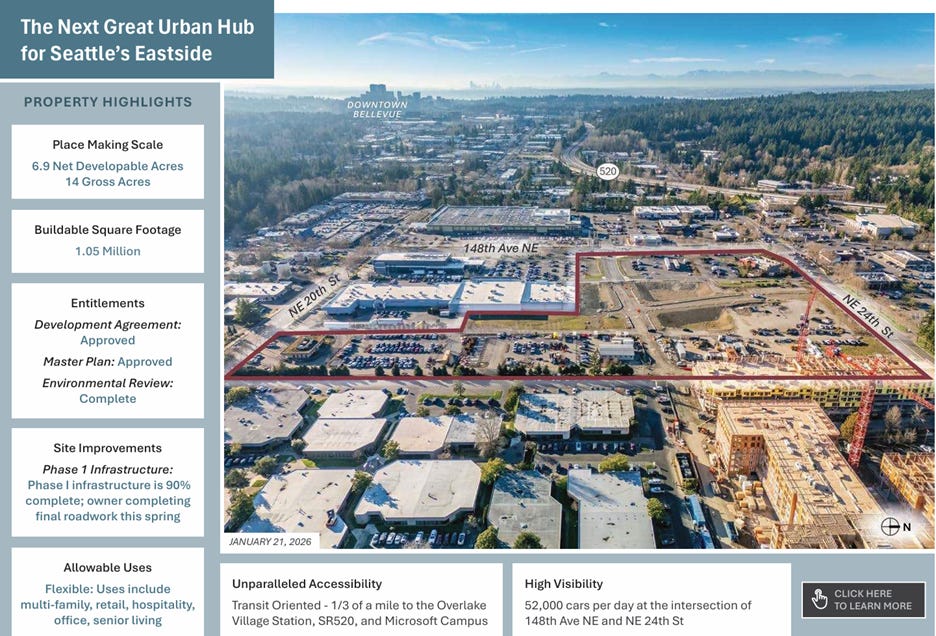
The most important is the Redmond, WA site near Microsoft’s campus:
~14.8 acres
Fully entitled with development agreement approved
Infrastructure largely complete
This is not raw land—it’s shovel-ready institutional development land in a top-tier tech corridor.
A reasonable estimate:
$130M – $170M+ value
This single asset likely represents ~$2.50 – 3.00+ per share of value on its own.
Seritage currently has this property listed for sale and the deadline for investor proposals was March 27th, 2026.
Westfield Shopping Mall – San Diego, CA
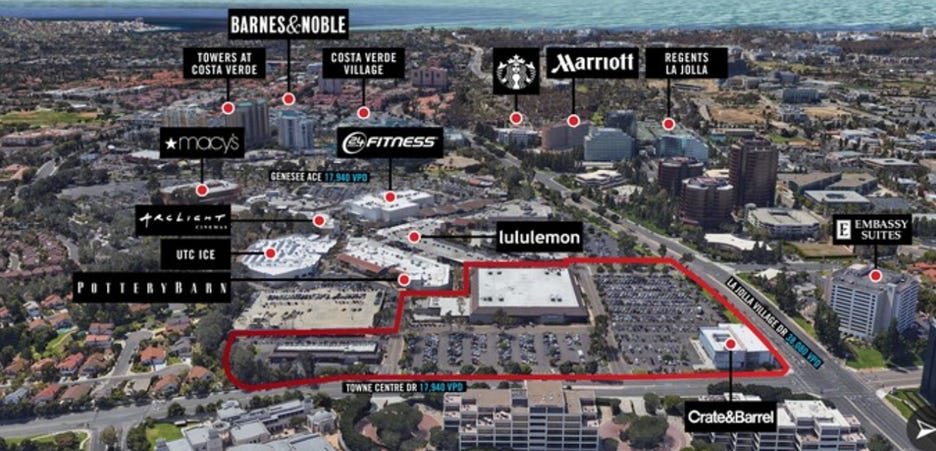

The Westfield property is a high value; Class A mixed use asset located in San Diego and Seritage owns 50% of this property through a joint venture with Invesco. According to Seritage’s most recent annual report, Amazon is the main tenant and leases 98.9% of the GLA.
Using the UTC / 4575 La Jolla Village Dr JV financials, the property generates about $8.4M of NOI, which on an estimated ~210,100 sq ft footprint implies roughly $40 per square foot in rent—very reasonable for a San Diego asset with an Amazon tenant.
Applying a 5.25%–6.25% cap rate yields a value of approximately $140M–$160M (about $660–$760 per sq ft), putting SRG’s 50% stake at roughly $70M–$80M, or about $1.33 per share at the midpoint of $75M.
If we assume a midpoint value of $2.75 per share for the Redmond property and $1.33 for the San Diego property, that equals $4.08 per share. Seritage has roughly $62M in cash. Adding back the cash leaves a value of $5.18 per share.
Assuming we deduct Seritage’s total liabilities of $61 million and preferred stock of $70 million (total of $131 million, or $2.33 per share), were left with an implied equity value for the common stock of roughly $2.85 just for the Redmond and San Diego properties!
At the current price around $2.60, you’re basically getting Seritage’s other seven properties thrown in for free with an extra $0.25 left over. There’s a reason for this as I’ll explain later - the market seems to be assuming that the burn and liquidation costs will be higher than people suspect and will eat into the equity value over time. This could happen but at the current prices, it seems that investors will be more than compensated for these timing/cost risks.
The Remaining Properties
For the sake of brevity, I’m not going to go through a deep dive on each of the remaining seven properties. Instead, below is a summary of all of Seritage’s properties, including ownership percentages and my estimated value ranges under both a bear and base case.
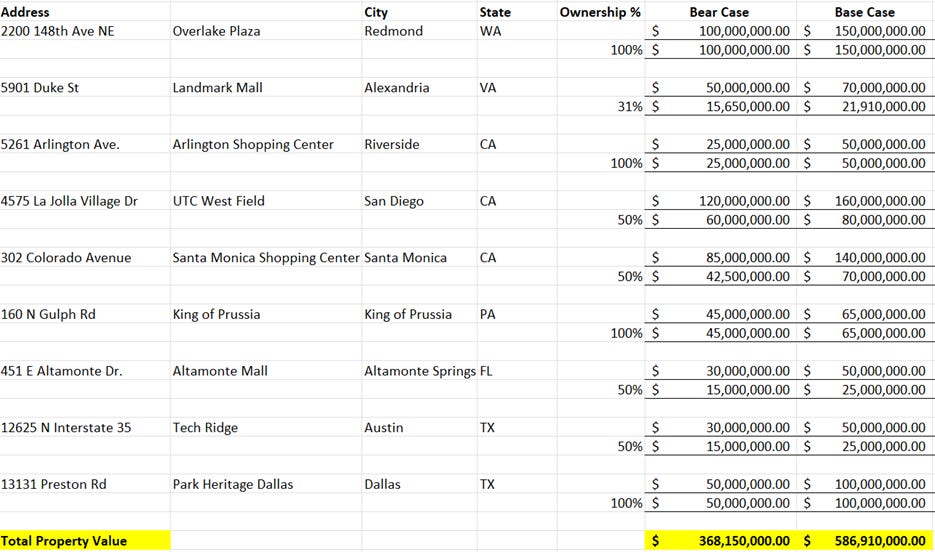
*These are rough estimates and I am by no means a commercial real estate expert. These are probable valuation ranges based on widely published real estate market data, and the values could be more or less.
As shown, I estimate the total value of Seritage’s property portfolio to be roughly $368M to $587M. I realize that’s a fairly wide range, but it reflects different potential outcomes across varying economic environments.
The key takeaway, in my view, is that even under more conservative assumptions—higher interest rates and continued pressure in commercial real estate—I still arrive at a portfolio value in the $350M to $400M range.
For reference, Seritage currently carries these properties on its books at approximately $311M, which provides a useful baseline for comparison.
A Reasonable Valuation Range
After adjusting for:
Ownership percentages
Preferred equity (~$70M)
Remaining liabilities
Liquidation costs
Multi-year cash burn
A realistic estimate for total equity value is:
$5.00 – $7.00 per share (base case)
At ~$2.60, that implies:
~92-169% upside
A mid-teens to low-20s IRR depending on timing
The Real Variable: Time
The biggest mistake you can make analyzing Seritage is to treat it like a static NAV discount.
A realistic timeline looks like:
Years 1–2: Smaller assets sold
Years 2–4: Mid-tier properties monetized
Years 3–6: Large development sites (Redmond, Dallas)
The key implication:
$6.00 in 3 years → ~32% IRR
$6.00 in 5 years → ~18% IRR
$6.00 in 7 years → ~13% IRR
These IRR projections assume the payout is received at the end of the period. The IRRs would be higher if more of the distributions are received earlier.
The value shareholders are likely to receive from here is a stream of lumpy special dividends as the company sells off properties and continues its liquidation.
Cash Burn and Friction
Another major factor is ongoing cash burn.
Even with a simplified structure, Seritage still incurs:
General and admin expenses
Property carrying costs
Legal and advisory fees
A reasonable estimate:
~$120M – $150M total cash burn over the liquidation period
This is the “leak” in the system—value that never reaches shareholders.
It also explains why the stock trades at a discount. The market is not ignoring asset value. It is discounting time and friction. Put another way, I think the market is pessimistic on the timing of the payouts and assumes the liquidation will take longer than expected and the costs may be higher than expected.
The Financing Overhang
One of the more recent developments is the company’s acknowledgment that:
The ~$50M term loan maturing in 2026
Cannot be repaid with current cash + signed asset sales
This creates “substantial doubt” language in filings.
In practice, there are three likely outcomes:
Extension or amendment (most likely)
Additional asset sales to cover the gap
A low-probability Chapter 11 restructuring
Importantly, even in a Chapter 11 scenario, this is likely a liquidity issue, not a solvency issue.
With asset values well above liabilities, equity would likely retain meaningful value, though:
Timing could extend
Costs could increase
Returns could compress
Why Does This Opportunity Exist?
Seritage sits in an uncomfortable middle ground:
Too complex for most investors
Too slow for arbitrage funds
Too uncertain for income-focused REIT buyers
It also carries baggage:
Legacy ties to Sears
Perceived governance risk with Edward Lampert (who owns ~24% of the shares)
No current dividend
As a result, it lacks a natural buyer base.
The Short Thesis
Short sellers are not arguing that Seritage is worthless.
They are arguing:
Liquidation will take longer than expected
Costs will be higher
Asset values are slightly overstated
In other words:
“You’re right on value, but wrong on IRR and liquidation payouts”
That’s a reasonable argument—and one worth taking seriously.
Next, I’ll review projected returns on this investment, the expected value of Seritage (after deducting all liquidation costs and cash burn), and how much I am allocating to my current portfolio.
