

Silicom (NASDAQ: SILC) is an Israeli based networking and data infrastructure company that helps its customers build out cloud and data center infrastructure. Silicom’s product offerings include server adapters, edge networking solutions, and bypass switches to name a few.
What has Created this Opportunity?
Silicom shares have declined nearly 70% from a high around $50 a few years ago to current levels around $15. Revenues fell more than 50% from $124 million in 2023 to $58 million in 2024. Per the 2023 earnings report, Silicom’s CEO said “We are facing a tough transition period fueled by macro-economic headwinds and customer drawdowns of stockpiled inventories.”
Silicom posted a positive EPS ever year from 2014 – 2022 and its stock traded in the $30 - $50 range from 2021 to mid-2023. Silicom’s stock price as of March 3rd, 2025 is $15.62. The share price decline makes sense because revenues fell more than 50% from $124 million in 2023 to $58 million in 2024. Silicom’s management team projects that revenues for the first quarter of 2025 will range from $14 million to $15 million. Per the most recent earnings release, “growth in 2025 is expected to be in the low single digits, with strong double digit annual growth rate materializing gradually from 2026.” Management’s guidance would imply $60 million annualized run rate revenue for 2025, which would be about 3.5% growth and is in line with management’s guidance.
Dirt Cheap Valuation
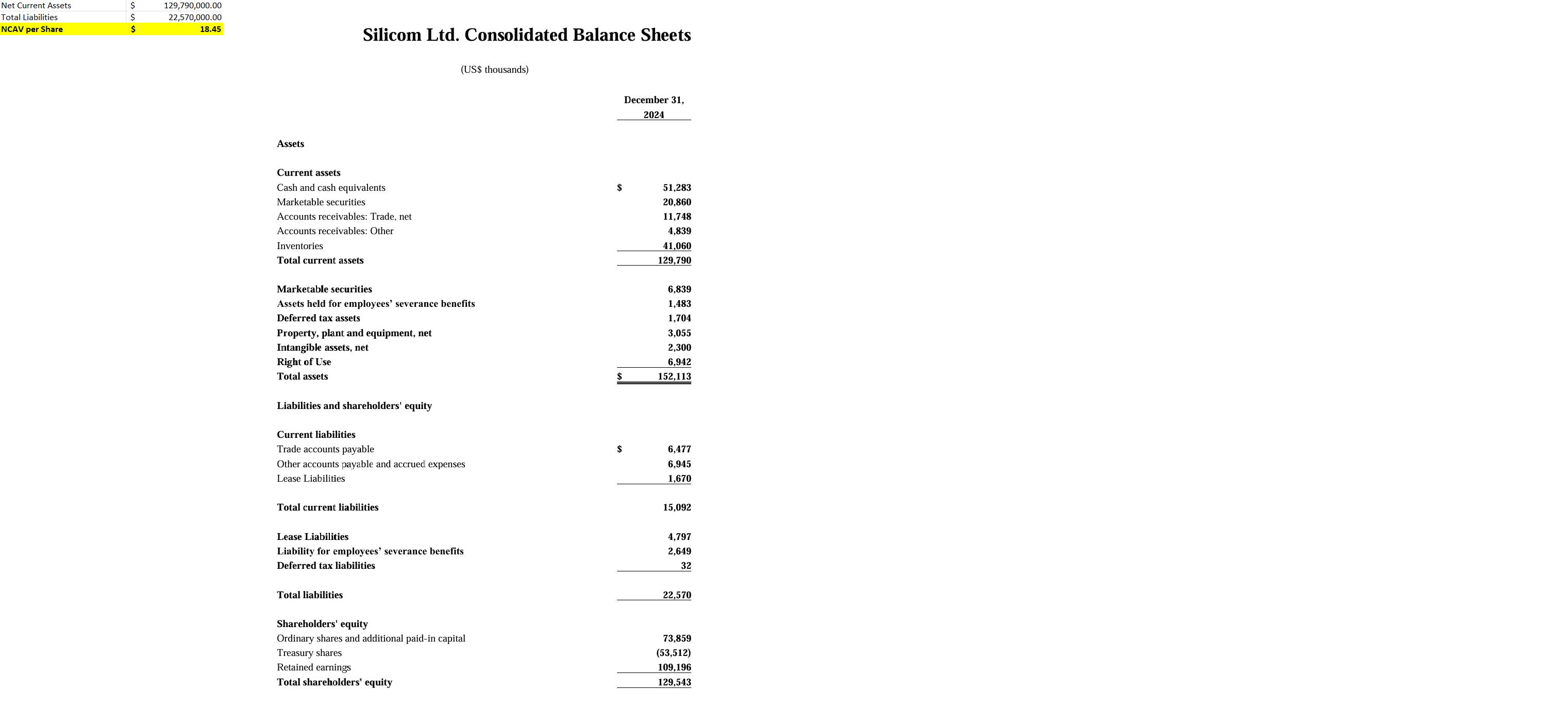
Silicom shares are cheap and at current price levels there is a margin of safety built in for patient investors. Silicom’s stock currently sells at a 15% discount to its net current asset value of $18.45. Silicom trades at a 31% discount to its book value of $22.29 per share.
Buybacks at Below Intrinsic Value a Sign of Shareholder Friendly Management
In its earnings call, Silicom’s management team said it generated $17.3 million in cash in 2024 and spent $10 million buying back 650,000 shares, which would imply an average purchase price $15.38. Buying back stock at less than book value is a shareholder friendly move because it increases book value per share. Book value is the shareholder’s net worth in the company. The fact that Silicom is buying back stock at less than net current asset value is a great sign for investors that management’s main priority is maximizing shareholder value. Too many companies’ buy back their stock at a price greater than intrinsic value which is not always in the best interests of shareholders. Not Silicom; however, they are making prudent repurchases of their stock when it is clearly undervalued.
Warren Buffett mentioned in his 2020 letter to shareholders, “In no way do we think that Berkshire shares should be repurchased at simply any price. I emphasize that point because American CEOs have an embarrassing record of devoting more company funds to repurchases when prices have risen than when they have tanked. Our approach is exactly the reverse.”
Projected Upside
I won’t try to project long-term revenues and earnings for Silicom because, quite frankly, that is hard to do with any degree of accuracy. Silicom’s future does look bright, however, based on management’s comments from the most recent financial report. Silicom CEO Liron Eizenman highlighted some potential customer deals in the works and stated that the company is on track for strong double-digit growth in 2026 and beyond. Silicom’s goal is to get back to $150 million in revenue with EPS of $3 per CEO Eizenman. “Looking forward, we continue to focus on creating strong, long-term value for our shareholders, aiming at an EPS above $3 based on annual revenues of $150 - $160 million.”
These financial goals don’t seem like too much of a stretch given Silicom earned $2.69 per share on $151 million in revenue in 2022. If Silicom can restore revenues to prior levels and deliver on its $3 EPS goal, its shares would likely trade back up in the $30 - $60 range, which would imply 10x -20x P/E and 2 – 4x upside from current levels. At a $45 share price (midpoint of $30 - $60), shares would trade at 15x PE, which is below Silicom’s historical PE norms above 20x.
Conclusion
Silicom has substantial upside given its deeply discounted stock price which currently sells for less than net current asset value. Even if management isn’t able to deliver on its stated goal of $150 million and $3 EPS, shareholders have downside protection given the stock is currently selling at a discount to likely liquidation value. Moreover, Silicom’s management team has demonstrated that they have shareholders’ best interest in mind (via the stock buybacks) which is a great sign for investors.
Full Disclosure
I own shares of Silicom and started buying them last year around $13 per share. The stock currently represents 2.7% of my portfolio.