

The following ten questions form the foundation of my investment process for long-term stock investments.
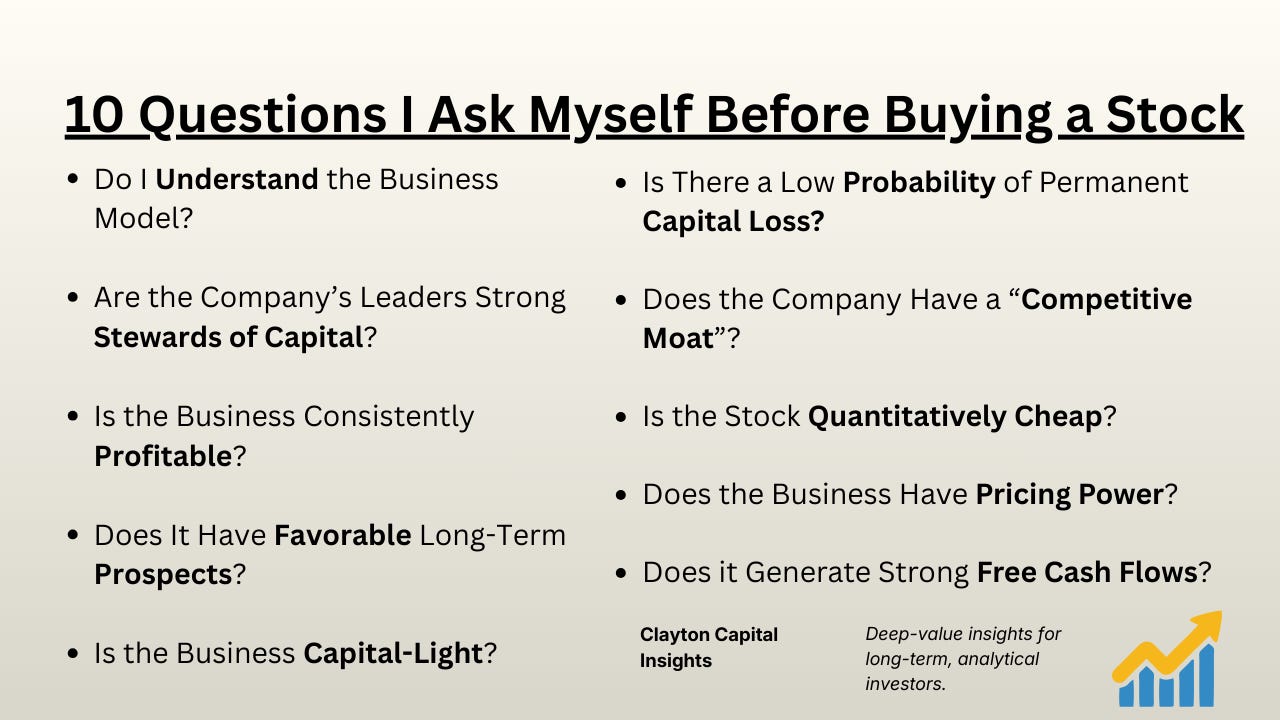
Let’s jump in…
#1 – Do I Understand the Business Model?
Legendary investors like Warren Buffett, Charlie Munger, and Peter Lynch consistently emphasize the value of staying within your “circle of competence.”
By buying stocks in industries that you understand well, you will have more conviction on the competitive positioning of the company and have a much higher likelihood of being able to hold the positions regardless of short-term price fluctuations.
#2 – Are the Company’s Executives Strong Stewards of Capital?
Assessing whether management is truly aligned with shareholders is one of the hardest things for investors to evaluate. Without inside information, it’s not always obvious whether the executive team and board are acting in shareholders’ best interests.
In my own process, I look for managers who buy their own stock or hold a meaningful ownership stake. I also pay close attention to smart capital allocation—especially opportunistic share repurchases made when the stock trades well below intrinsic value.
Equally important is how management approaches mergers and acquisitions.
Good capital allocators are disciplined: they avoid empire-building, refuse to overpay, and focus on deals that create clear long-term value rather than trying to increase revenues and earnings per share in the short-term. They pursue acquisitions only when the expected return on invested capital exceeds what the company could earn organically or by simply returning capital to shareholders.
#3 – Is the Business Consistently Profitable?
If you’re a value investor like me, you’ve probably gotten excited about a stock because it looked cheap or the current year’s financial reports looked good at first glance. Most financial websites only show the current year’s results, which makes it easy to assume that a company’s latest earnings represent its “normal” level of performance.
It’s important to take a step back and look several years back over the prior financial reports to get a better sense of the companies normalized revenues and earnings through a full economic cycle. I will typically review at least the prior 10-year history to understand a company’s normalized financial performance.
Financial statements won’t tell you everything, but they tell you a lot. Businesses that maintain steady margins and earnings across economic cycles usually have some degree of competitive advantage.
Businesses that post several years of negative earnings are usually an indicator that something is amiss. Unless it’s a rare exception such as Amazon or Netflix in their early days - however, the discerning value investor will usually wait to buy into these types of stocks until they become profitable.
It’s just too hard to predict what company will become the next Amazon, Netflix or Nvidia and the market typically punishes these types of “growth stocks” if revenue growth slows and there’s no profits to show. Unless you have an extremely high level of conviction and are willing to endure brutal drawdowns, buying expensive growth stocks is typically not a recipe for successful investing over the long-term.
Unless there’s a fundamental shift in operations, future performance often mirrors the long-term past. There will always be exceptions, but I prefer to stay conservative and avoid building investment theses on aggressive growth assumptions.
#4 – Does the Business Have Favorable Long-Term Prospects?
When evaluating a business, I look for companies whose core products or services are unlikely to be disrupted by new technology such as AI.
These are usually industries with stable demand, slow-changing customer preferences, and high switching costs.
A business with favorable long-term prospects typically has durable competitive advantages, strong pricing power, and a clear path for steady value creation over time.
#5 – Is the Business Capital-Light?
An ideal business is one that does not require heavy capital investment to grow or maintain its operations—what investors call “capital-light.”
In contrast, one of the worst setups is a company operating in a cyclical industry that carries significant debt and requires constant, expensive capital spending just to stay competitive. Those are the types of businesses I generally try to avoid.
I will occasionally make exceptions when I have deep industry knowledge. For instance, some would classify automotive stocks as requiring heavy capital investment and they are in a cyclical industry.
I currently own CarMax because my years in the industry gave me a detailed understanding of their economics and competitive advantages.
In my view, the dealer sector offers the most attractive economics in the automotive supply chain. Dealerships don’t have the heavy fixed-cost burden of manufacturers and used-vehicle retailers such as CarMax benefit from not being dependent on a single brand.
#6 – Is There a Low Probability of Permanent Capital Loss?
Assessing the probability of permanent capital loss can be tricky, but I always try to form a reasonable estimate.
My risk assessment typically focuses on factors like debt levels, free cash flow generation, interest coverage ratios, and overall financial resilience.
Companies with strong cash flows, low leverage, and solid coverage ratios tend to carry a lower risk of permanent impairment. On the other hand, businesses with weak profitability, an unmanageable debt load, and exposure to challenging or cyclical industries usually come with a much higher chance of permanent capital loss.
#7 – Does the Company Have a Competitive Moat?
Let’s face it, it’s hard to find stocks with “wide moats” trading at bargain valuations.
I like to look in overlooked, niche industries where there are only a few companies and one or two companies have a majority market share in their industry. See my writeup on Trex that holds a 60% market share in composite decking.
These companies may be temporarily out of favor, or the market is pricing in low to no growth. This is the place that you can sometimes find a company with a significant competitive advantage that also trades at a value multiple.
For instance, I have written a few pieces on SiriusXM (SIRI). I would argue that SiriusXM does have a competitive moat given they hold a majority market share in satellite radio. Moreover, SiriusXM is factory installed on most new cars in the U.S. and the market hates the stock right now.
SiriusXM is dirt cheap (trading at 10-year lows) and is currently selling for roughly 6x free cash flow and at a substantial discount to book value. While SiriusXM does have a moderate amount of debt, most of their revenue comes from subscriptions (which is stickier than ad revenue) and they have some of the lowest churn rates among their audio streaming competitors such as Spotify.
I also wrote about Perimeter Solutions back in May. This was a small-cap stock with a monopoly and traded for about 9x price to normalized earnings when I wrote it up.
#8 – Is the Stock Quantitatively Cheap?
I look for investments trading at less than 10x “owner’s earnings” (a rough proxy for free cash flow) and offering a projected annual return of at least 20% using very conservative assumptions. I also prefer stocks selling for one-third or less of my conservative intrinsic value estimate. While this approach doesn’t guarantee success, buying at a low multiple to owner’s earnings provides a meaningful margin of safety. For a deeper dive into this concept, chapter 20 of The Intelligent Investor is a great resource.
#9 – Does the Business Have Pricing Power?
This ties into rule number seven because businesses with strong competitive moats can usually raise their prices. While not necessarily a requirement of mine for an investment, a business that can continually raise prices should fare better during a bear market.
#10 – Does the Business Generate Strong Free Cash Flows?
Ultimately, a business is worth the present value of the future cash flows it can generate.
I like to look for companies with strong free cash flows and/or cash conversion cycles. The cash conversion cycle measures how long it takes a business to turn inventory spending into cash from customer sales. A shorter cycle means the business gets paid faster, which improves cash flow and reduces financing needs.
One of the most overlooked advantages of Amazon’s early business model was its negative cash conversion cycle. Amazon often received payment from customers before it had to ship products or pay suppliers.
That dynamic helped the company survive the dot-com crash while many competitors failed. A business with a negative cash conversion cycle is essentially financed by its suppliers — a concept similar to “float” in the insurance industry and one of the reasons Warren Buffett loves insurance businesses.
This is one of the reasons I really like Sirius XM stock. They currently have a negative cash conversion cycle, which is part of the reason why they generate such robust and stable free cash flows. Also, most of Sirius XM’s revenue is subscription based so it tends to be sticker revenue.
I also look for companies with recurring-revenue and/or subscription models. Amazon and Costco are two of the most successful retailers in history, and both built powerful membership ecosystems that produce recurring, predictable revenue. Companies with some form of recurring revenue tend to compound value over long periods.
While this is the framework I rely on most, I occasionally make exceptions in event-driven investing situations—such as merger arbitrage, spin-offs, liquidations, or other special situations where the risk-reward profile is driven by catalysts rather than long-term business quality.
Finding companies that check most, or all of these boxes can meaningfully reduce risk while enhancing long-term returns.
Great article & list. Makes me think a lot about the way in which pilots use checklists to prevent them from making sloppy mistakes. I find a checklist prior to hitting the buy button prevents me from getting myself into trouble due to overconfidence. If you haven’t read “The Checklist Manifesto,” I highly recommend it.
Wild that most investors skip straight to Question #8 and never bother with the first seven.
This is such a clean framework — simple enough to follow, hard enough to fake. Good read, thanks.