

Fifty years ago, in May 1976, GEICO was on the verge of collapse. The stock had fallen from $61 per share a few years earlier to just $2.
The company had announced the worst underwriting loss in its history — a staggering $190 million underwriting loss in 1975 — and had suspended its dividend. Angry shareholders stormed the annual meeting and were demanding answers. Ultimately, the board was forced to replace the management team.
Enter Jack Byrne.
Byrne had previously been instrumental in turning around Traveler’s home and auto insurance business and was summoned to become GEICO’s new CEO.
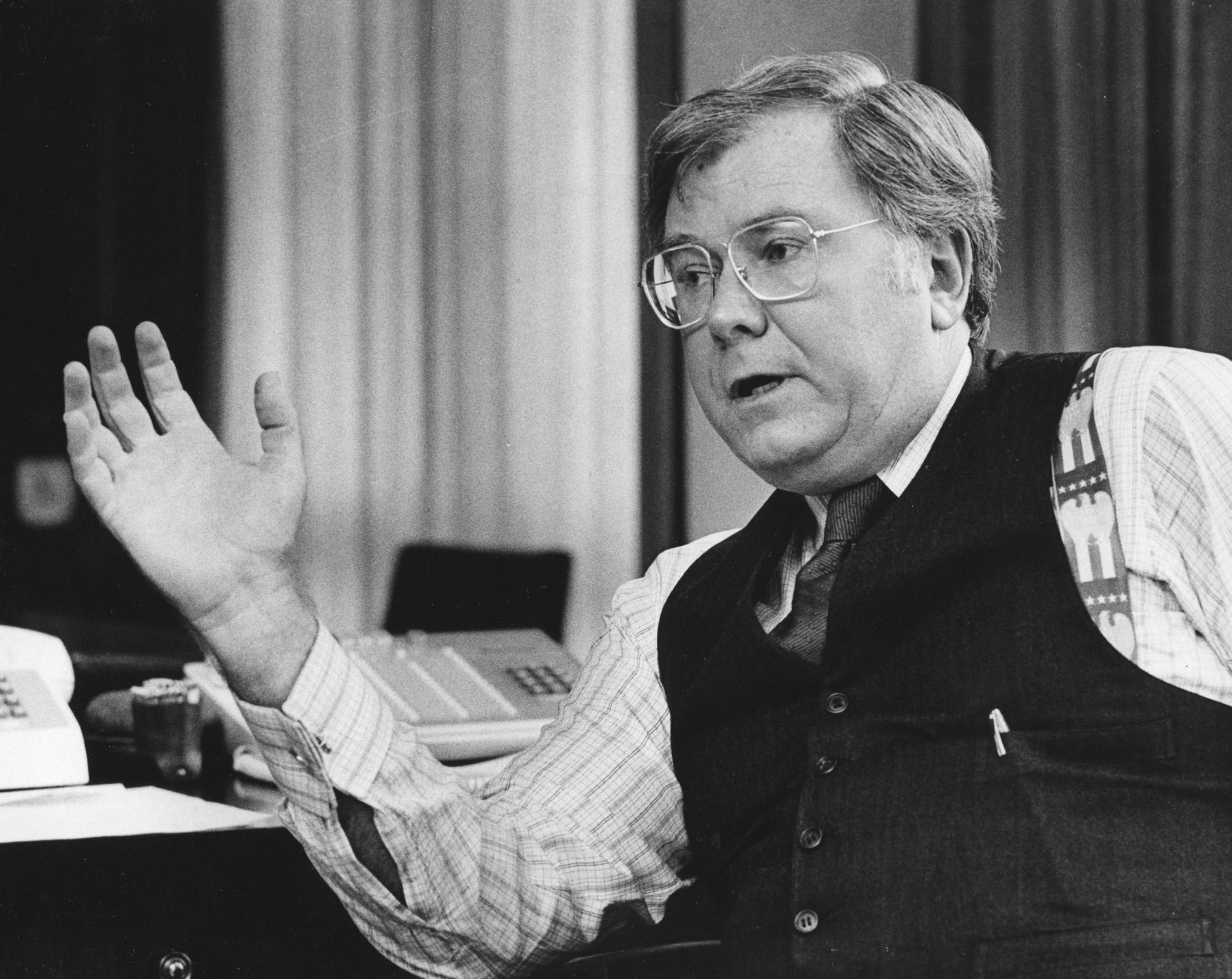
Jack Byrne, the turnaround CEO brought in to rescue GEICO during its 1976 crisis. Source: GEICO historical archives.
A plan had been devised to raise money and have other insurance companies reinsure GEICO’s claims. After State Farm and Traveler’s balked, Byrne was left scrambling to come up with other ways to save the company.
In May 1976, Byrne received a call from Washington Post CEO Kay Graham. Graham said she had someone she wanted him to meet.
In response, Byrne replied “Who’s Buffett?”
At the time, most investors assumed GEICO was finished. Warren Buffett, the contrarian value investor, saw something different.
What Led to GEICO’s Troubles
Today, GEICO stands as one of the most successful property and casualty insurers in the industry. But in 1976, GEICO was on life support. GEICO was dealing with reserve deficiencies, massive underwriting losses, regulatory scrutiny, lawsuits, and severe capital problems. GEICO grew far too aggressively and focused on growth at all costs.
GEICO’s net premiums earned grew from roughly $377.3 million in 1971 to $603.3 million in 1975, a nearly 60% increase. The problem with this rapid growth in premiums was that GEICO’s claims soared because the insurer had prioritized growth over underwriting discipline.
In 1971, GEICO realized $14 million in underwriting income. By 1975, it took a $190 million underwriting loss! GEICO’s combined ratio went from 95.4% in 1971 to 124.2% in 1975. A combined ratio under 100% means an insurer earns an underwriting profit.

Buffett later said:
“I looked again at GEICO and was startled by what I saw. It was clear in a sixty-second examination that the company was far under reserved [for claims] and the situation was getting worse.”
The numbers from the 1975 annual report were alarming.
GEICO generated:
$603 million of earned premiums
a $190.9 million underwriting loss
and a net loss of $126.5 million for 1975.
The company had to strengthen reserves multiple times as inflation drove medical and auto repair costs sharply higher. At one point, regulators in several states threatened to suspend or revoke GEICO’s ability to write new business.
This was not a normal cyclical downturn. Investors genuinely believed GEICO might fail.
Yet Buffett became interested.
Why Buffett Invested
What Buffett recognized was that GEICO still possessed an important structural advantage despite the chaos. The company historically operated with underwriting expenses that were substantially less than the industry average because of its direct-to-consumer model.
The problem was not that GEICO lacked a competitive advantage. The problem was that management had abandoned underwriting discipline in pursuit of growth. GEICO had expanded too aggressively, underpriced risk, and failed to reserve adequately for future claims. Inflation then exposed those weaknesses all at once.
When Buffett finally got the meeting with Byrne and was waiting for GEICO’s CEO to arrive, he told Don Graham, “This is risky” and that “[GEICO] could go completely out of business.”
Buffett believed the core franchise still had value if the company could survive and restore underwriting discipline. Buffett also believed Byrne understood insurance underwriting extremely well and had both the analytical ability and personality needed to stabilize the business.
“…in insurance it’s very hard to get an edge, and they have an edge. If they got the right person in to run it, I think he could turn it around.”
Importantly, Buffett did not blindly buy the stock simply because it looked cheap.
He first wanted confidence that:
the company could survive
reserves were being addressed
and management understood the severity of the problem.
Buffett initially invested about $4 million into GEICO’s common stock during the crisis.
Buffett told a lawyer friend,
“it’s pretty uncharacteristic of me, but today I bought some stock that really might be worthless tomorrow.”
At the time, the investment looked incredibly risky.
But Buffett understood something many investors missed:
GEICO did have an edge and if it ultimately survived, the upside was enormous relative to the price being paid. From 1971 - 1974, GEICO’s average EPS was $1.60. At the low point of $2 - $3 per share, GEICO shares were selling at 1.25 - 1.9x normalized price to earnings.
What Saved GEICO
GEICO ultimately slashed 40% of its customers, sold half of its profitable life insurance company to raise cash and withdrew from all but seven states plus Washington D.C.
Byrne also aggressively cut costs, increased rates, and re-underwrote GEICO entire book of business. Byrne was forced to fire more than half of GEICO’s employees, closed most of its offices, and exited states that would not grant rate increases.
Ultimately, John Gutfruend and Saloman agreed to underwrite a $76 million convertible stock offering. Buffett and Berkshire ended up getting a quarter of the stock offering.
As confidence slowly returned, GEICO’s stock recovered dramatically. Within weeks after the emergency financing came together and many reinsurers stepped in to cover GEICO’s claims; the stock quadrupled from around $2 to roughly $8 per share.
Byrne was able to get rate increases in New York and cancelled policies in New Jersey after the state commissioner was unwilling to grant a rate increase. In a later interview, Byrne said,
“…I was going to fight for the life of this company no matter what, including walking out of a state, which wasn’t done back then.”
Byrne was so successful that GEICO returned to profitability in just one year and recorded the highest surplus in its then 43-year history.
How the GEICO Investment Turned Out for Berkshire
Over the following decades, GEICO became one of Berkshire Hathaway’s crown jewels.
Below is a table showing Berkshire Hathaway’s equity holdings at the end of 1976.
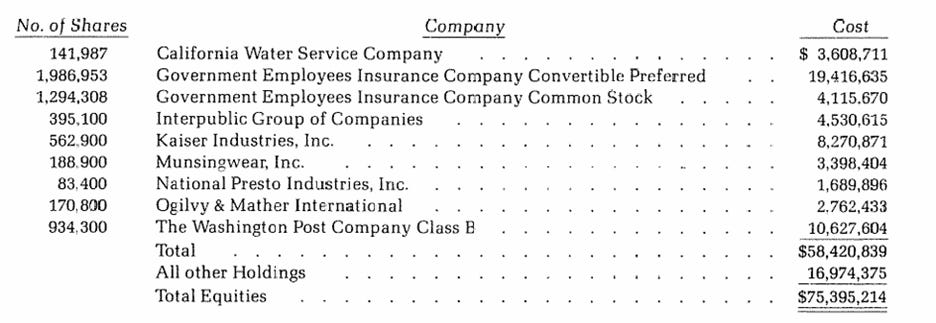
By the end of 1976, GEICO made up over 30% of Berkshire’s equity holdings.
Five years later, Berkshire was up more than 4x on its GEICO investment.
Ten years later, it was up nearly 15x.
In 1994, right before Berkshire acquired all of GEICO, the investment had increased nearly 37x and Berkshire’s ownership stake had increased to roughly 50%, primarily due to share buybacks. It’s hard to estimate exactly, but Berkshire likely earned an annual rate of return of at least 20% on its GEICO investment.
Key Lessons
Even the best businesses can encounter severe but fixable problems.
GEICO had long been viewed as one of the strongest companies in the insurance industry, with a significant underwriting advantage and a stock that appreciated more than 500x between 1948 and 1973. Yet despite that success, the company became complacent and nearly collapsed in the mid-1970s. The episode is a reminder that even great businesses with strong competitive positions are still vulnerable to management mistakes, poor capital allocation, and industry downturns.
A good CEO/management team is often the most important factor in turnaround situations.
This case study also highlights the importance of management quality and capital allocation. CEO Jack Byrne was instrumental in GEICO’s turnaround and was willing to make difficult decisions that many executives likely would have avoided. Byrne had previously helped turn around Travelers’ insurance business, and Buffett viewed his operational and underwriting discipline as critical to GEICO’s survival. One of the lessons from this is the importance of backing management teams with a demonstrated track record of creating value and successfully navigating difficult situations.
Be wary of companies and management teams pursuing “growth at all costs” or empire building.
It’s more common than many investors realize, and in many cases, aggressive growth destroys shareholder value rather than creating it. Whether through overpaying for acquisitions, taking on excessive leverage, or issuing dilutive equity, expansion is difficult to execute successfully and can quickly lead to value destruction if not managed with discipline.
GEICO’s problems were largely self-inflicted through aggressive growth and poor underwriting discipline. When inflation accelerated, claim costs became far more expensive than GEICO had originally projected, contributing to severe underwriting losses and inadequate reserves. The turnaround only became possible once leadership changed and the focus shifted back toward disciplined underwriting and balance sheet repair.
You don’t get rewarded for feeling comfortable - Some of the biggest rewards come when things feel the worst
Buying GEICO in 1976 did not feel comfortable. The headlines were terrible, the financials looked disastrous, and bankruptcy risk appeared very real. Opportunities like this rarely feel obvious when they are happening. Yet that discomfort is often what creates the opportunity in the first place.
Even though Berkshire’s initial $4 million investment in GEICO common stock may have appeared highly speculative at the time, it still represented less than 6% of Berkshire’s overall portfolio. This was not a “bet-the-company” investment.
Buffett understood there was a meaningful possibility Berkshire could lose its entire initial investment in GEICO, which is why he initially kept the position in the common stock relatively small within Berkshire’s portfolio. Only after a major investment bank agreed to backstop the financing, reinsurers had stepped in to cover GEICO’s claims, and Buffett developed high conviction in Jack Byrne’s operational capabilities did Berkshire commit the bulk of its capital to the convertible preferred stock.
More importantly, while the probability of a total loss may have been significant, the potential upside was extraordinary. A rational investor could have viewed the situation as follows: if GEICO survived, the investment was being purchased at roughly a 50% - 80%+ earnings yield (1.25 - 2x price to average EPS from 71 - 74) with the possibility of a 5–10x return over time. If the company ultimately failed, the downside would be manageable because the position size was relatively small compared to the overall portfolio.
The GEICO investment illustrates an important principle in investing: occasionally, a great business encounters severe but temporary problems that create extraordinary opportunities for investors willing to think independently and focus on long-term intrinsic value.
*Much of the background information for this article comes from The Snowball by Alice Schroeder, as well as GEICO’s 1975 and 1974 annual reports and a case study from Wedgewood Partners, all of which provide fascinating insight into one of the most important investments of Buffett’s career.
Great read Clayton, thanks for sharing. Another take-away that may not be so obvious for most investors here is: economic moat matters most. It is the structural, competitive advantage - something that prevents competitors from taking your share.
Today we see many AI businesses rising but we never ask for their moat, and technological leadership is hardly defensible for decades.
Thanks for sharing