

Imagine two companies.
The first grows earnings at just 5% per year and is hated by investors.
The second grows earnings at 20% per year, dominates its industry, and is one of the most admired companies in the market.
Five years later, which investment produced the better return?
Most investors would choose the second company without hesitation.
Yet the answer might surprise you.
The reason comes down to one of the most important concepts in investing: valuation.
Being a value investor means being a contrarian. It requires going against the crowd and thinking independently. It isn’t easy to be among the few people buying a stock when everyone else is selling or selling stock when everyone else is buying.
It can feel like you're alone on a deserted island, looking wrong while the crowd looks right. That's often the psychological price value investors pay in exchange for the opportunity to earn above-average returns.

Whenever a stock trades at a “value multiple,” it’s usually because the market believes the company’s profits and cash flow are unsustainable and will decline over time.
The market rarely offers bargains without a reason. The value investor’s job is to determine whether those fears are justified by assessing the company’s competitive position, future growth prospects, balance sheet, and earning power.
Psychologically, it’s much easier to buy a stock that the market loves. The narrative is positive, the growth outlook appears bright, and investors are confident about the future. The market recognizes the company’s competitive advantages and, often, prices those advantages accordingly.
But as Warren Buffett has famously said, “you pay a very high price in the stock market for a cheery consensus.”
On the other hand, stocks trading at deeply discounted valuations are often ugly. Growth may have slowed, margins may be under pressure, management may be unpopular, or investors may simply have lost interest. It is far more difficult to buy a stock when the headlines are negative and the future appears uncertain.
But this leads to one of the most important principles in investing:
A great business can still produce a mediocre or even poor investment outcome if an investor pays too high a price for it.
Conversely, a mediocre business can produce an excellent investment outcome if purchased at a sufficiently attractive price.
Why?
It comes down to simple math.
What Drives Long-Term Stock Returns
Over the long run, your annual rate of return is largely determined by three factors:
Expected Return ≈ Earnings Yield + Reinvestment Return + Change in Valuation Multiple
Let’s start with earnings yield.
Earnings Yield
Traditionally defined, earnings yield is simply the inverse of the price-to-earnings ratio:
Earnings Yield = Earnings Per Share ÷ Stock Price
However, earnings per share can be influenced by accounting decisions and may not always reflect the true earning power of a business.
Free cash flow is often a better measure because it adds back non-cash expenses and deducts capital expenditures and is harder to manipulate. However, free cash flow can also be distorted by large year-to-year changes in working capital.
My preferred metric is owner’s earnings, a concept popularized by Warren Buffett. Owner’s earnings attempt to measure the cash that can be distributed to owners after deducting only the capital expenditures required to maintain the business.
For valuation, I prefer enterprise value rather than market capitalization because it incorporates leverage and reflects the effective price a buyer would pay to acquire the entire business.
Enterprise Value = Market Capitalization + Debt – Cash and Investments
As a result, my preferred valuation metric is:
Enterprise Value to Owner’s Earnings (EV/OE)
The corresponding earnings yield is simply:
Owner’s Earnings ÷ Enterprise Value
Free cash flow can be used as a rough approximation when owner’s earnings are difficult to estimate.
Most investors focus almost exclusively on the quality of the business. Far fewer focus on the price being paid for that quality.
The stock market doesn’t reward investors for buying great companies. It rewards investors for correctly assessing the difference between expectations and reality.
The best investments are often found where expectations are low, valuations are depressed, and the future turns out to be merely better than feared.
Valuation may not matter much over a few months or even a few years. But over long periods of time, valuation acts like gravity. Eventually, it exerts an enormous influence on investment returns.
Let’s look at two examples.
Unloved Value Stock vs. The Growth Stock Everyone Loves
Company A is the “Unloved Value Stock.” The headlines are ugly, all the analysts are downgrading the stock, and they just missed the earnings forecast and lowered guidance for the year. On top of that, the CFO just left and a talking head on CNBC just said that all stocks in their industry would struggle for the next year.
However, you tune out the noise and do a deep dive on the company. The company has a solid track record of profitability, a strong balance sheet, and has previously had a decent reputation in its industry. Company A’s stock is trading at 5x earnings and 50% of book value. Company A has historically traded at an average earnings multiple of 8x.
Company B is the “Growth Stock Everyone Loves.”
The company dominates its industry; beats earnings expectations quarter after quarter and is featured regularly on financial television as one of the best businesses in the market. Analysts are constantly raising price targets, management has a stellar reputation, and investors are convinced that the company’s growth runway extends for many years into the future. Every earnings call is met with enthusiasm, and any temporary weakness is viewed as a buying opportunity. The company has earned a 20% return on equity for years, revenue is growing rapidly, and management reinvests every dollar of earnings back into the business. As a result, investors are willing to pay 30 times earnings and six times book value for the stock. The long-term average earnings multiple for company B is 20x.
Most market participants would have no hesitation owning Company B and would likely consider it far less risky than Company A. Yet despite its superior business quality, much of that future success is already reflected in the stock price. The question is not whether Company B is a great business—it clearly is. The question is whether the future will be even better than the market already expects.
The chart below breaks down the math of investing in company A vs. company B and the resulting annual rates of return.
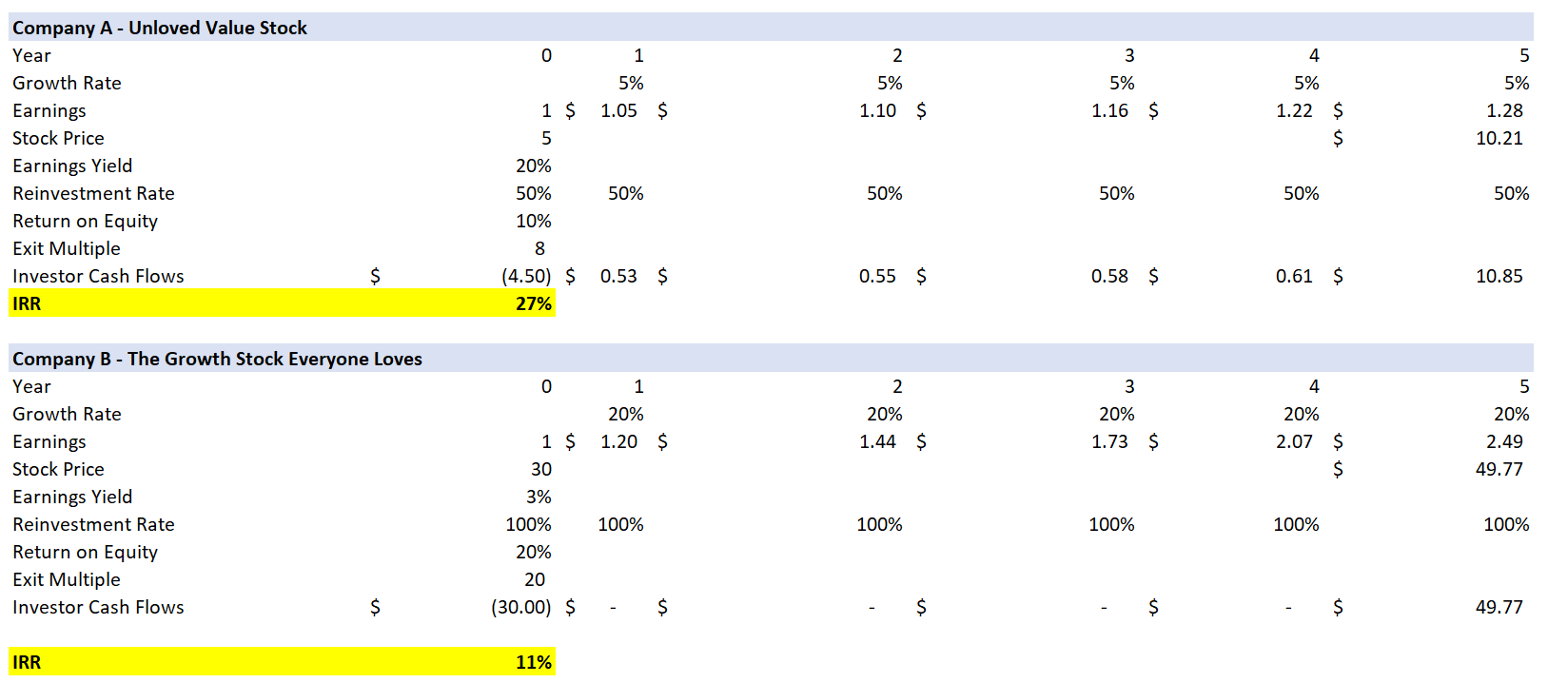
Notice that Company B grows earnings nearly five times faster than Company A (20% versus 5% annually), yet Company A produces more than double the shareholder return. The difference is not business performance—it is the valuation paid for that performance.
The results may seem counterintuitive at first. Company B is clearly the superior business. It earns twice the return on equity, reinvests 100% of its earnings, and grows profits at 20% annually compared to just 5% for Company A.
Over the five-year period, Company B’s earnings increase by 149%, while Company A’s earnings grow by only 28%.
Yet despite its slower growth and lower-quality economics, Company A generates a 27% annualized return for shareholders compared to just 11% for Company B.
The reason is starting valuation and the risks of multiple compression.
Investors purchasing Company A begin with a low 5x earnings multiple, (or 20% earnings yield) and benefit from the stock rerating from 5x earnings to 8x earnings. Investors purchasing Company B start with only a 3.3% earnings yield and suffer from multiple compression as the valuation declines from 30x earnings to 20x earnings.
This example highlights one of the most important lessons in investing: a great business can be a poor investment if purchased at too high a price, while an average business can become an outstanding investment if purchased at a sufficiently large discount to intrinsic value.