

Many investors understand the concept of dividends. A company pays out excess profits that it doesn’t need for reinvestment in the form of dividends.
Fewer investors understand stock buybacks and how they impact investment returns. Stock buybacks can be one of the most powerful forms of capital allocation available to management.
Dividends and buybacks are both methods of returning excess capital to shareholders.
However, unlike dividends, the value created by a buyback depends heavily on the price paid for the shares. Buybacks can be a more tax efficient way for companies to return capital to shareholders.
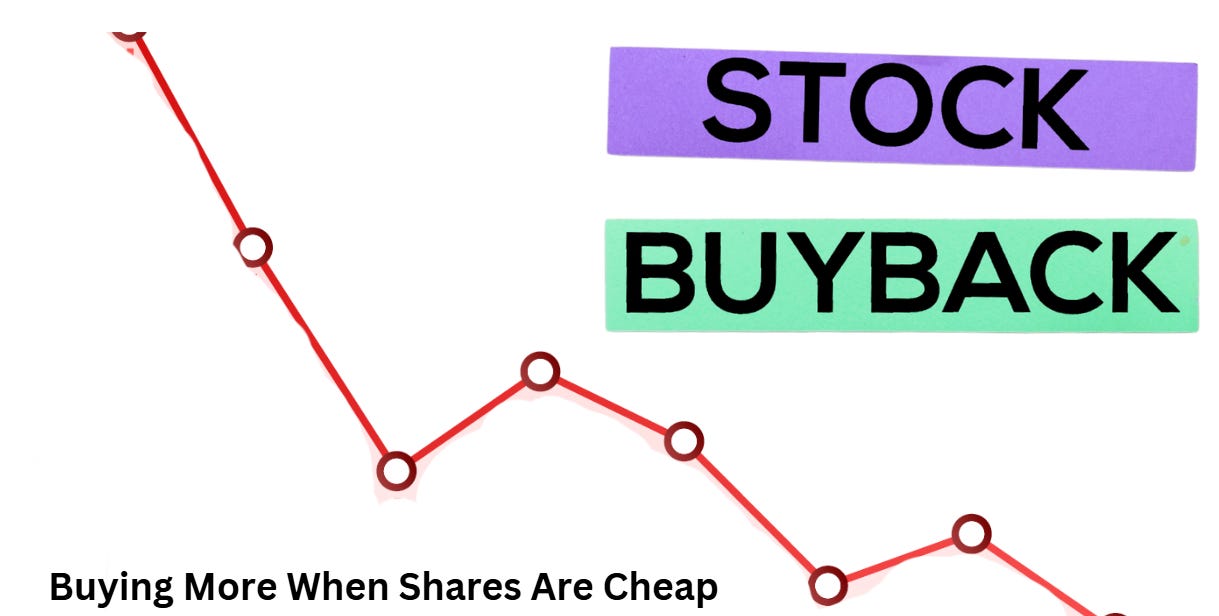
When executed at prices below intrinsic value, buybacks can create enormous shareholder wealth without requiring any growth in the underlying business. When management teams buy back stock at prices below intrinsic value, buybacks can create tremendous shareholder value.
Not all buybacks are equal, however.
Why Companies Buy Back Stock and Why Most Don’t Add a lot of Value
Many companies follow a set schedule of buying back stock regardless of whether the stock price is cheap or expensive.
Companies do this for a variety of reasons.
Some of the primary reasons include:
· Offsetting the dilution that comes from stock-based compensation
· A more tax efficient way to return capital to shareholders. Dividends are subject to double taxation – once at the corporate level and once at the individual shareholder’s level.
· To boost earnings per share.
· To try to signal to the market that their shares are undervalued
Buybacks executed at inflated valuations can destroy shareholder value, particularly when they are used primarily to offset stock-based compensation or are financed with excessive debt.
The Math Behind Value-Creating Buybacks
Suppose stock XYZ earns $5 per share and its stock trades at $50. Its price to earnings ratio is thus 10x. Now suppose all the companies in their industry trade at 20x P/E. Assuming stock XYZ is in good financial condition and performing in line with its industry, the stock should be valued at $100. Management teams can take advantage of this value discrepancy by buying back shares that are worth $100 for $50. In this case, repurchasing stock might be the best form of reinvestment for a company since it likely offers the highest IRR.
Management is effectively purchasing an asset worth $100 for $50. In other words, the company is buying a dollar for fifty cents. Few acquisitions or internal projects can offer that kind of potential return.
Unfortunately, many executive teams fail to capitalize on this opportunity and don’t increase repurchases when their shares are cheap. This can happen because the market sometimes views stock repurchases as a weakness and a sign that the company doesn’t have a lot of reinvestment opportunities. However, a management team should be repurchasing stock if it offers the highest return opportunities when compared to other available reinvestment options.
The companies that do increase repurchases when their shares are cheap can create huge amounts of shareholder value.
While this sounds obvious in theory, very few management teams behave this way in practice. One notable exception was Henry Singleton of Teledyne.
Henry Singleton and Teledyne
In the Outsiders, William Thorndike highlights the power of buybacks and explains how Henry Singleton created huge value for shareholders through opportunistic share repurchases – that is, buying back stock when Teledyne was undervalued.
Between 1972 and 1984, in eight separate tender offers, Singleton bought back an incredible 90% of Teledyne’s outstanding shares. Singleton believed that share repurchases were a far more tax-efficient way to return money to shareholders. Singleton was very selective with the repurchases and generated a 42% compounded annual rate of return for Teledyne through the repurchases.
From 1963 to 1990, Singleton delivered a remarkable 20.4% annual return for Teledyne shareholders, compared to 8% return for the S&P 500.
Adobe Case Study
Adobe provides a useful example of how buybacks can create enormous value when a company’s shares trade below intrinsic value.
Despite generating industry-leading margins, double-digit revenue growth, and billions of dollars in annual free cash flow, Adobe’s stock has fallen sharply as investors worry that artificial intelligence will disrupt its creative software franchise. Whether those fears ultimately prove justified remains to be seen, but the market’s current pricing implies a far more pessimistic future than the company’s operating results suggest.
At recent prices around $195 per share, Adobe trades at a valuation typically reserved for mature or declining businesses. Yet Adobe continues to generate approximately $10 billion of annual operating cash flow and recently authorized an additional $25 billion share repurchase program.
To put that into perspective, Adobe’s current market capitalization is roughly $77.5 billion. If the company can execute the full authorization at depressed prices, it could retire approximately 20% to 25% of its outstanding shares over the next several years, even after accounting for dilution from stock-based compensation.
This is where the power of buybacks becomes apparent.
Suppose Adobe’s business merely grows at a moderate rate over the next five years. Revenue growth doesn’t need to accelerate dramatically. Margins don’t need to expand. The combination of modest business growth and a significantly reduced share count could still result in substantial growth in earnings per share.
The market is currently focused on whether AI will disrupt Adobe. Management appears to be taking advantage of that uncertainty by repurchasing stock at what may prove to be a highly attractive valuation. Adobe repurchased 8.5 million shares in Q2 2026, putting the company on pace to take out roughly 8% of its shares in fiscal year 2026 if the stock price remains where it is today.
I believe Adobe’s intrinsic value is materially higher than today’s stock price. Thus, every dollar spent on repurchases creates value for remaining shareholders. In effect, management is buying a larger ownership interest in a high-quality business on behalf of investors.
The lower the stock price remains, the more powerful those buybacks become.
Takeaway
Investors often focus on revenue growth, earnings growth, and market share. While those metrics are important, they can sometimes overshadow an equally important driver of long-term returns: intelligent capital allocation.
When a company repurchases stock below intrinsic value, it is effectively investing in itself at an attractive rate of return. In many cases, it may be the highest return opportunity available to management.
The key insight is that buybacks are not inherently good or bad. Their value depends almost entirely on the price paid in relation to the underlying intrinsic value.
A company that repurchases stock at an inflated valuation may destroy shareholder value. A company that repurchases stock at a significant discount to intrinsic value can create enormous wealth for continuing shareholders.
This is one of the reasons Warren Buffett has often emphasized the importance of opportunistic repurchases. The mathematics are simple: buying a dollar’s worth of value for fifty cents benefits every remaining shareholder.
Investors should therefore spend less time looking at the size of a buyback authorization and more time asking a different question:
What is the company paying for its own stock?
The answer to that question often determines whether a buyback becomes a footnote in a company’s history—or one of the primary drivers of long-term shareholder returns.
“The No. 1 test of whether a repurchase program creates value is whether the stock is bought below intrinsic value.” – Warren Buffett
What about the buyback where the shares outstanding does not come down. Buyback used to sop up employees share issuance is not really a buyback but a fancy way to pay employees salary.
What about the buyback where the shares outstanding does not come down. Buyback used to sop up employees share issuance is not really a buyback but a fancy way to pay employees salary.