

Trex (NYSE: TREX) company is the world’s largest producer of “wood alternative” composite decking, deck rails and other outdoor products. Trex invented the composite decking category more than 30 years ago and is now estimated to have a 50 – 60% market share in the composite decking industry and a 14% market share of the entire U.S. decking/railing market.
Recent 3rd Quarter Earnings
Trex stock sold off sharply following the company’s third quarter earnings release.
Here’s a snapshot:
Trex reported net sales increasing 22% to $285 million. Adjusted EBITDA rose 33% to $90 million.
Gross margin improved to 40.5%, aided by higher volumes and efficiency gains, though elevated branding and R&D spending lifted SG&A.
Despite these positives, management noted weaker-than-expected Repair & Remodel (R&R) demand in the back half of the season and anticipates continued softness in the 4th quarter of 2025. Management noted that production will be cut and inventory levels should start to normalize.
Year-to-date results show more modest momentum, with sales up 3% to $1.0 billion but margins down meaningfully as the company laps tougher comps and absorbs expenses tied to new facilities and product conversions.
EBITDA margin fell to 29.7% from 33.7%, though adjusted figures show some stabilization. Railing remains a key bright spot, tracking toward double-digit growth for the year, while management continues investing heavily in product innovation, digital tools, and brand visibility to capture long-term conversion from wood to composite materials.
Looking ahead, Trex lowered its full-year 2025 revenue and margin guidance, now expecting flat year-over-year sales of $1.15–$1.16 billion and adjusted EBITDA margins of 28.0–28.5%.
Management also warned that 2026 gross margin could decline roughly 250 bps due to mix effects and higher depreciation. However, the company remains confident in its long-term growth runway, supported by new product launches, expansion of its Sun Comfortable™ technology, and strengthening brand equity. Reinforcing that confidence, the board authorized a $50 million share repurchase program, underscoring Trex’s solid cash generation and belief in its intrinsic value.
Investment Thesis
Despite broad weakness across the housing and construction sectors driven by elevated interest rates, Trex remains a fundamentally strong business with durable competitive advantages. While the company is not immune to macro headwinds, its underlying performance tells a different story: Trex maintains industry-leading margins, exceptional balance-sheet strength, and a dominant market position supported by a clear economic moat.
The market’s reaction to Trex’s third-quarter update appears significantly overdone. Shares now trade at a meaningful discount to their long-term historical valuation ranges on both price-to-earnings and price-to-book metrics. This disconnect between Trex’s short-term sentiment and long-term fundamentals creates a compelling opportunity for investors to accumulate a high-quality, market-leading compounder at an unusually attractive price.
Here’s my checklist that I use to pick winning stocks:
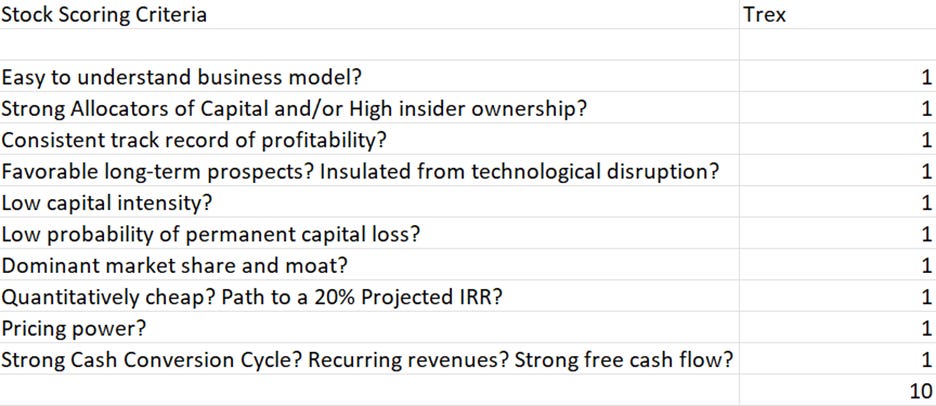
As you can see, I believe Trex currently scores a 10 out of 10 which is rare.
The only other stock I have written about that met all 10 of these criteria is Perimeter Solutions (PRM). Here’s the write-up on Perimeter Solutions for those interested. Perimeter Solutions is now up nearly 3x since I wrote about it and I now think it scores 9 out of 10, just because it is no longer quantitatively cheap.
Trex’s Moat
Trex’s moat is built on a combination of scale, brand strength, and a deeply entrenched distribution network that smaller competitors struggle to match.
Trex’s scale and proprietary manufacturing processes give the company a cost advantage. As the largest composite decking manufacturer in the world, Trex benefits from significant economies of scale in manufacturing, procurement, and logistics, allowing it to produce high-quality, low-maintenance decking at lower costs than its competition.
The Trex brand is widely known for its durability and is popular among contractors, creating high switching costs throughout the value chain.
While a Trex deck initially costs a little more than a wood deck, the composite material in a Trex deck lasts much longer than a wood deck. Thus, the total cost of ownership of installing a Trex deck is much lower than a wood deck. The company estimates that the long-term ownership of a Trex deck is about half of a traditional wood deck.
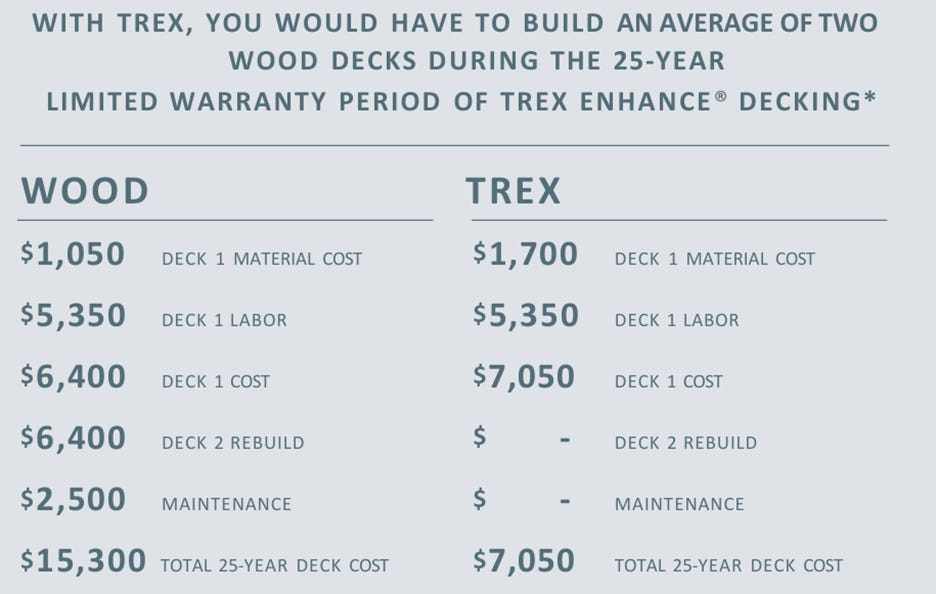
Trex Company, Inc. (2025). Investor Presentation [PDF]. Trex Company Inc.
Additionally, Trex’s continuous product innovation—such as heat-mitigating technology and new composite formulations—further differentiates its offerings, making it difficult for competitors to replicate the full package of performance, reliability, and distribution reach.
Strong Historical Financials
Trex has stellar financials if you look back over the last 10 years.
From 2015 – 2024:
Average return on equity (ROE) = 34% per year
Operating (EBIT) margins = 24.4% per year
Book value annual growth = 27%
EPS growth = 21% annually
Created more than $1 in market value for every $1 retained in the business (more on this later)
Minimal debt with a current debt to equity ratio of about 10%
Opportunistic Share Buybacks
Trex’s management team has opportunistically bought back shares when the stock price has declined. Buybacks at prices below intrinsic value increase shareholder value and can amplify long-term returns.
Management repurchased 6.5 million shares in 2022 when there was a substantial decline in Trex’s stock price due to rising interest rates, high inflation and supply chain issues which caused a slowdown in homebuilding. Management bought back 8x the number of shares in 2022 versus 2021!
For those who may not know, opportunistic share repurchases create tremendous value for shareholders. You want a management team that buys back stock when the stock is trading at a significant discount to intrinsic value.
Most companies have a set buyback schedule and repurchase a set amount of shares each year regardless of the stock price. Stock repurchases at prices above intrinsic value destroy shareholder value. Trex’s leadership team has a history of increasing buybacks when its stock is undervalued, which is a great value add for shareholders.
Buffett’s $1 Test
In Berkshire Hathaway’s 1984 letter to shareholders, Warren Buffett wrote:
“Unrestricted earnings should be retained only when there is a reasonable
prospect - backed preferably by historical evidence or, when
appropriate, by a thoughtful analysis of the future - that for
every dollar retained by the corporation, at least one dollar of
market value will be created for owners. This will happen only
if the capital retained produces incremental earnings equal to,
or above, those generally available to investors."
Buffett’s one dollar test determines how efficiently management is using retained earnings to create value for shareholders. Retained earnings are the earnings that are reinvested back into the business.
Over the trailing twelve months, Trex’s retained earnings were roughly $1.75 billion. At the end of 2015, retained earnings were $119 million. That means Trex has retained roughly $1.63 billion in earnings over the last 10 years.
Trex’s current market capitalization is roughly $3.43 billion. In late November 2015, Trex’s market cap was roughly $1.17 billion. So (even after the recent sell-off), Trex’s market cap has increased $2.26 billion.
Trex has retained $1.63 billion and created $2.26 billion in market value for shareholders. This means that Trex passes the “one dollar test”, because they have created about $1.39 in market value for every dollar retained. Prior to the recent price drop, Trex had created over $2 per share in market value for every dollar retained.
Valuation and Projected Returns
Any way you look at it, Trex is undeniably cheap at its current price levels. I believe the market overreacted to the 3rd quarter earnings call and now Trex stock is trading well below its long-term historical valuation multiples. For instance, Trex’s average price to earnings multiple has been in the mid-30’s for much of the past 10 years.
Trex earned $2.09 per share in 2024 so it’s currently priced at roughly 16x last fiscal year EPS. This is roughly half of its historical average over the last 10 years.
Assuming a stock is bought and sold at the same price to book multiple, an investor’s long-term return will equal the return on equity, assuming no share buybacks. Opportunistic share repurchases would likely increase the investor’s return.
Given Trex’s competitive moat and long-term tailwinds, (Trex has close to a 60% market share in composite decking/railing and composite decking only makes up about 25% of the entire decking and railing market), I strongly believe Trex can sustain at least 20% annual returns on equity over the long-term. As previously mentioned, Trex’s average return on equity over the last 10 years has been about 34%.
Trex’s current price to book value of 3.5x is at historical lows. The median price to book value for Trex has been roughly 12.2, according to GuruFocus.
Assuming an investor bought Trex stock at today’s prices and Trex could achieve an annual 20% return on equity over the next 5 years, then book value would be $24.19 at the end of five years. Assuming Trex was sold at a 3.5x book value at the end of five years, that would imply a share price of roughly $85, good for a return of about 20% annually. The return would likely be higher if Trex’s management continues to opportunistically repurchase stock at a discount.

Takeaway
Trex has a dominant position in composite decking and railing – holding a nearly 60% market share. This gives Trex a wide competitive runway, especially given that composite decking still represents only about 25% of the overall decking and railing market.
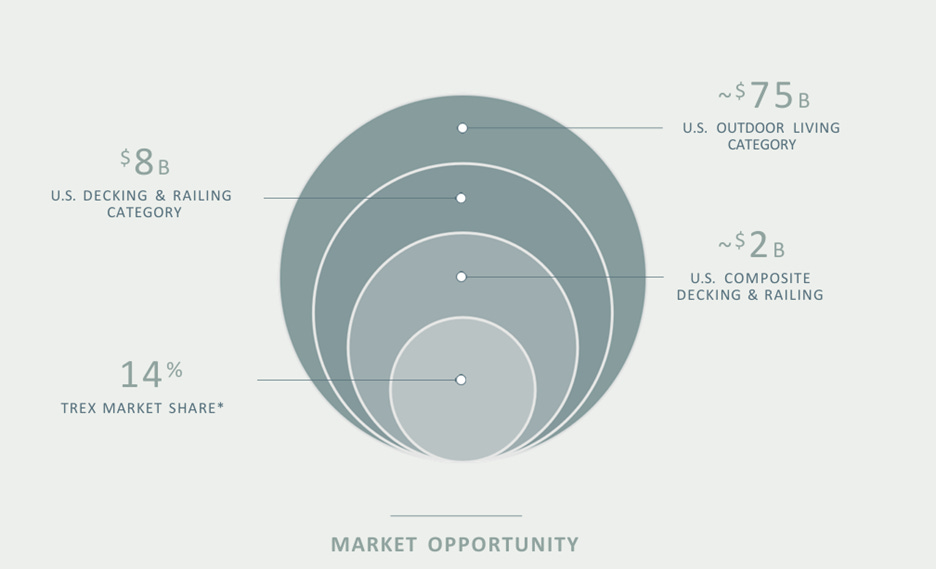
Trex Company, Inc. (2025). Investor Presentation [PDF]. Trex Company Inc.
As homeowners increasingly prioritize sustainability, durability, and lower maintenance costs, Trex is well-positioned to benefit from a long-term structural shift toward composites. These tailwinds, combined with the company’s brand strength, scale advantages, and cost efficiency, support a compelling long-term growth thesis.
Still, investors should monitor several risks: a prolonged slowdown in repair-and-remodel activity could weigh on short-term volume growth; input-cost inflation (particularly in recycled plastics) could pressure margins in the near-term; and competitive intensity could rise as smaller players attempt to capture share in the growing composite category.
Even with these risks, Trex remains a high-quality business with a long runway for expansion as the industry continues its transition toward sustainable composite solutions.
I believe Trex stock is incredibly cheap at the current price levels in the low 30’s. For some historical context, Trex’s current price to earnings ratio is less than it was at the depths of the Covid-19 crash in early 2020. Trex intraday low price on March 16th, 2020, was $31.50 (split adjusted) and EPS for 2019 was $1.24, implying a 25.4x price to earnings multiple. Trex’s current price to earnings multiple is lower than it was at the depths of the Covid-19 crash! I also went back and read the 2008 and 2009 annual reports to see how Trex fared during one of the worst financial crises in modern American history. Trex weathered that storm even though they were in a much weaker financial position in 2009 than they are today. Readers should know that I always look at the downside risks and always invest with a “margin of safety!”
*Full disclosure: I own shares of Trex and the stock makes up about 8.5% of my portfolio.