

Comcast is spinning off its cable networks into a new company called Versant Media Group. Versant Media Group’s brands include CNBC, The Golf Channel, USA Network, E!, MSNOW (formerly MSNBC), GolfNow, SportsEngine, Fandango and Rotten Tomatoes.
The Versant Media Group spinoff may offer investors a rare chance to buy a diversified portfolio of established media assets at a meaningful discount to intrinsic value.
Versant Media generates stable, high-margin cash flows from well-known brands such as CNBC, USA Network, Golf Channel, SYFY, E! and GolfNow—assets that remain widely distributed across cable, satellite, and fast-growing virtual MVPDs like YouTube TV.
Despite this stability, historical spin-off behavior suggests Versant could experience 20–30% forced selling in the first few months of trading as index and dividend funds along with non-media shareholders are forced to sell the stock. This forced selling for non-fundamental reasons has created repeatable opportunities across past media spin-offs, and I believe Versant will be no different.
Why Spinoffs Create a Structural Advantage for Value Investors
Spinoffs are one of the few places in public market investing where value investors enjoy a built-in structural advantage. This structural edge is formed by the predictable selling behavior of large institutional investors following a spinoff.
Here’s why spinoffs consistently create opportunities for value investors:
1. Forced Selling by Institutions (Regardless of Fundamentals)
When a parent company distributes shares of a smaller business, the new stock often ends up in the portfolios of investors who never wanted it in the first place.
Many institutional investors have mandates that prohibit holding certain types of companies — whether it be size, liquidity, sector, index inclusion, or dividend policy.
This is why it’s common to see spinoffs fall 20–30% in the first few days or weeks of trading. The decline has nothing to do with the fundamentals of the newly spun off company. It’s caused by the forced selling of institutional investors and excess supply hitting the market.
2. Index Funds Must Automatically Sell
A major structural tailwind comes from benchmark-following funds.
Take Versant as an example:
Comcast is in the S&P 500.
Versant, a much smaller entity, won’t qualify for inclusion.
Therefore, every S&P 500 index fund that held Comcast will automatically receive shares of Versant – and then must sell them immediately. Even if they believe Versant to be a good business, they have no choice but to sell it.
That’s thousands of forced sellers hitting the market at once.
3. Dividend and Income Funds Must Sell Too
If the new company doesn’t pay a dividend (as is the case with Versant today), dividend-focused funds and ETFs are required to sell as well. None of this reflects a view on the business quality; it’s simply mandate-driven liquidation.
4. Lack of Analyst Coverage Creates Temporary Uncertainty
Most spinoffs launch with:
No analyst coverage
No historical standalone financials
Management teams still communicating their long-term plan
Without clarity, many investors dump their shares immediately. Ironically, this lack of coverage is one of the reasons spinoffs outperform — price discovery happens slowly, and fundamental value investors can get a head start.
5. The Parent Often Hides a Good Business
Another structural quirk: conglomerates frequently bury attractive segments within reporting lines that obscure true profitability.
Once separated:
Margins expand
Capital allocation improves
Management incentives are tied directly to value creation
Strategic flexibility increases
Joel Greenblatt — who documented spinoff outperformance in You Can Be a Stock Market Genius — noted that newly independent management teams often pursue value-enhancing strategies that the parent company never could.
6. After Forced Selling Ends, Prices Mean-Revert Toward Intrinsic Value
Once the mechanical selling pressure exhausts itself, supply/demand stabilizes. At that point:
Analysts initiate coverage
Investors begin modeling standalone economics
Management articulates strategy
Fundamentals finally matter
Historically, this is when spinoffs begin to outperform. The market transitions from “forced sellers” to “informed buyers.” This process can take time - sometimes years, but the patient investor can profit from spinoffs once price discovery happens.
Versant Spinoff: Key Dates and Timeline
November 20, 2024
• Comcast announces its plan to distribute all shares of a newly formed company, Versant, to Comcast shareholders.
December 16, 2025 — Record Date
• All shareholders of Comcast as of this date will receive Versant Class A common stock.
• Distribution ratio: 1 share of Versant for every 25 shares of Comcast Class A common stock owned.
December 16, 2025 – January 2, 2026
• Versant shares begin trading on a “when-issued” basis in advance of the distribution.
Friday, January 2, 2026 — Distribution Date
• Comcast distributes roughly 144,150,019 Class A shares and 377,775 Class B shares of Versant to shareholders.
Monday, January 5, 2026 — First Trading Day
• Versant begins regular-way trading and is listed on the NASDAQ.
Reasons for the Spinoff
1. Strategic Focus
Comcast stated that they are spinning off Versant to allow the newly formed leadership team to focus exclusively on maximizing the potential of Versant’s media properties. Thus, Versant’s executive team will not have to split time between multiple businesses and properties within the broader Comcast portfolio.
2. Resource Allocation & Capital Deployment
As an independent company, Versant can direct capital, investment, and operational resources more efficiently toward its own strategic priorities instead of operating within Comcast’s multi-division structure.
3. Management & Employee Incentives
Spinoffs often unlock performance because standalone companies can create incentive plans that reward management and employees for directly improving the profitability of the spun-off assets—something harder to achieve inside a large conglomerate.
4. Investor Choice & Value Creation
The separation gives investors clarity and allows the market to value Versant strictly on its own fundamentals. Strong business units sometimes remain undervalued inside conglomerates; a spinoff lets them be recognized as independent, potentially higher-multiple companies.
Versant’s Brands
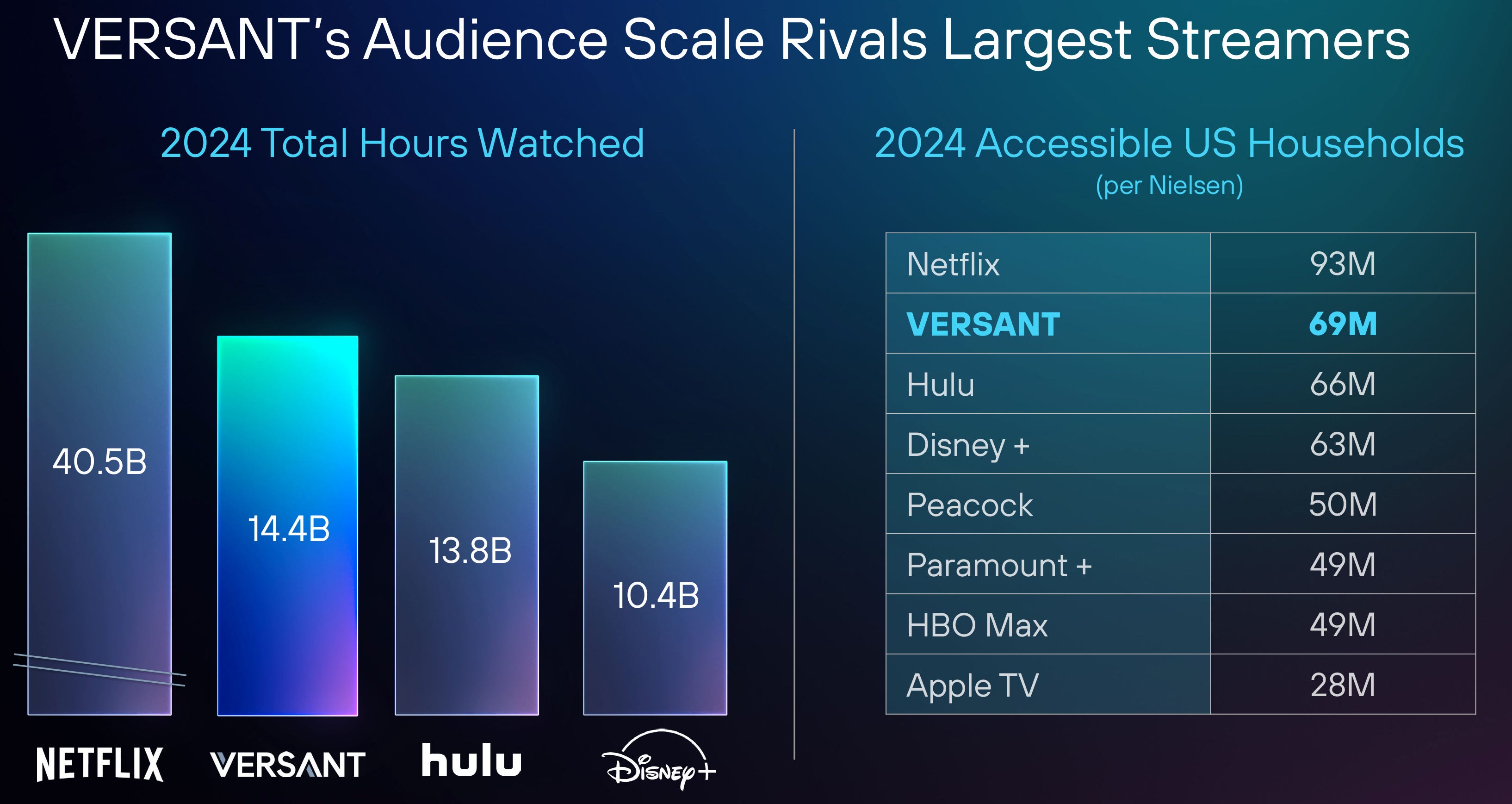
Versant has some well recognized brands that are popular across different viewer demographics. In 2024, more than 60 million viewers watched content on a Versant network each week. To put this in perspective, audiences consumed over 14 billion hours of programming on Versant networks during 2024. The majority of these viewing hours were driven by sports and news.
CNBC - CNBC is a global leader in business and personal finance news, offering real-time market coverage and in-depth analysis. Its flagship programs—Squawk Box, Squawk on the Street, Closing Bell, and Mad Money—have made the network an essential source of information for business leaders and investors. CNBC has had the top performing business website, based on total user consumption, for four consecutive years as of 2024.
USA Network - is a channel that features leading sports, entertainment and live event programming. Sports offerings on USA include WWE, NASCAR, the WNBA (starting with the 2026 season), golf, including the U.S. Open, The Open Championship and the Ryder Cup along with the Premier League, college basketball and the Olympics. USA Network has been in the top-five among cable entertainment networks each year for the past 30 years.
The Golf Channel is the one of the best channels for golfing fans and for live golf and related content, including news, instruction, documentaries and library programming. Its content is distributed on a variety of platforms to millions of viewers in more than 50 countries. Golf Channel celebrated its 30th anniversary in 2025, making it the longest-running single-sport television network. In 2024, Golf Channel aired more live golf than all the other U.S. television networks combined.
MSNOW reaches a highly loyal and engaged audience, delivering political news programming to more than 14 million weekly viewers in 2024, according to Nielsen. MS NOW (formerly MSNBC) had the second highest average weekly watch time per viewer, among cable networks in 2024. MSNOW was the #1 news brand on YouTube in 2024.
GolfNow is one of the world’s largest online tee-time marketplaces, connecting golfers with more than 9,000 courses globally. In addition to booking services, GolfNow provides golf course operators with a suite of technology and operational tools—including on-site payment solutions for tee times, food and beverage, and merchandise—to help streamline and modernize their business.
SportsEngine – is a software platform that helps youth sports managers schedule and process payments for youth sports teams and leagues. More than 8 million athletes and over 25,000 organizations use SportsEngine to help manage their leagues.
Fandango Media – Fandango offers movie and television information for users and helps users book tickets to movies at the movie theaters. Fandango had roughly 40 million unique visitors per month, per the company’s recent Form 10 filing. Fandango also owns Rotten Tomatoes, which is a great resource for online movie and TV reviews.
Other Versant brands include E!, SYFY, and Oxygen True Crime.
Versant also licenses TV shows and movies such as Law & Order: SVU on USA, Forensic Files on Oxygen, and Harry Potter and the Hunger Games on USA Network. It also features the Fast & the Furious on E!
The Versant spinoff offers an attractive combination of cash-flow durability and asymmetric upside as the stock normalizes to its true value.
Next, I’ll break down exactly what I think Versant is worth—and the specific price levels, trade setup, and one-year return potential I’m targeting when it starts trading in January.
