

Today, I will be reflecting on my last year of investment performance. Over the last year or so since I started writing on Substack, I have written investment research articles on 13 stocks. Some of them have worked out well while others haven’t.
First, a little background about me…
I am a concentrated value investor that likes to invest with a “margin of safety” as Ben Graham described in Chapter 20 of the Intelligent Investor. I never use margin or speculate with options. I write about nearly every stock that I own or have owned in the past.
I am a value investor through and through. The two books I have most recently read are Security Analysis and the Intelligent Investor. I have read them many times but go back to them periodically to refresh my memory on certain topics. I also bought a copy of all of Berkshire Hathaway’s annual reports and use them as a textbook to get better at investing. I’ve passed Level I of the CFA® exam, but I don’t believe that alone means much in terms of real-world investing skill. Much of the CFA curriculum provides a strong foundation in security analysis, but it doesn’t necessarily instill the temperament, discipline, or psychological edge that is needed to outperform the market.
I run a concentrated portfolio, typically holding only 5–7 stocks. For investors who have the time and skill to perform deep security analysis, it rarely makes sense to own dozens or hundreds of positions.
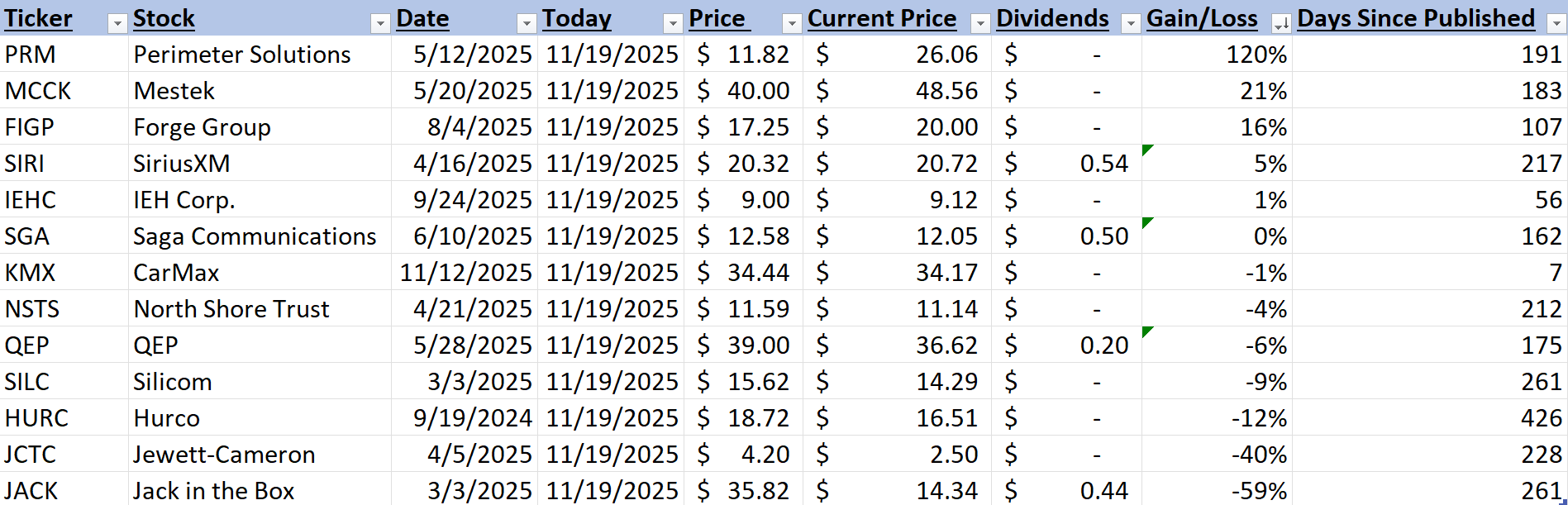
This my investment checklist that I use to analyze stocks. Not every stock will meet all of these criteria, but I try to find stocks that meet as many as possible. It’s rare that I find a stock that checks all 10 boxes but occasionally I find one. When I wrote up Perimeter Solutions (PRM) back in May, I believed it was one of those rare companies that scored a 10 out of 10 on my investment checklist. Since I wrote about Perimeter Solutions, it has more than doubled and is up about 120%.
My Year-to-Date Returns
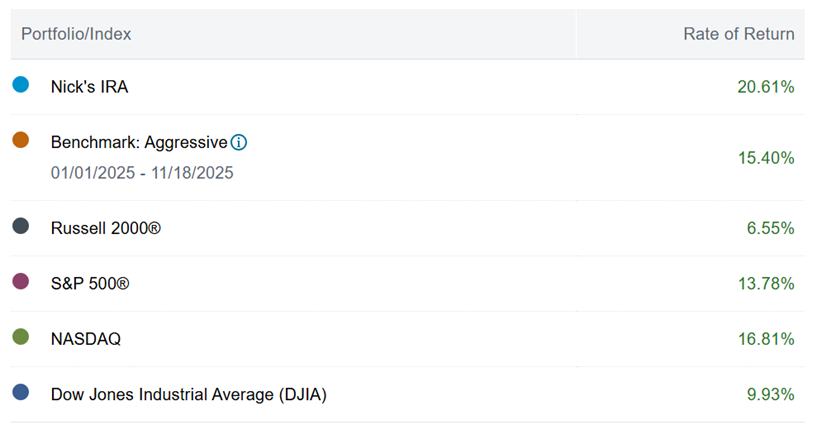
My goal is to generate 20% annual returns in the stock market. Since January 1st 2025, I have achieved this goal, with a year-to-date return of 20.6% as shown below (as of November 18th, 2025). However, I don’t put too much weight on this because it is very short-term.
My view is that 5 years is the minimum amount of time needed to judge someone’s investment performance. My plan is to post my investment returns at the end of each year so you can see how the investments I write about perform over time.
Portfolio Update: What I Currently Own and What I Have Sold
Here is my current portfolio:

I currently own 5 stocks which make up about 97.3% of my portfolio. The other stock I own is a speculative position in Joby Aviation and only makes up roughly 2.7% of my portfolio. I bought Joby Aviation a few years ago and believe in the long-term potential of eVTOL’s. I haven’t written about it because I think it’s a high-risk, speculative bet and not a value investment.
*I should emphasize that this portfolio doesn’t represent ALL my net worth and I don’t recommend putting ALL of your net worth in a highly concentrated portfolio. This portfolio represents roughly 20% of my entire net worth with the rest in cash, mutual funds, and real estate.
Here is the performance for each stock I have written about since the date it was published:
Current Stock Holdings
CarMax (KMX)
I believe CarMax offers a compelling bargain at the current price levels, which are near a 13-year low. CarMax has a competitive moat, strong balance sheet, and I believe is trading at one-third of its fair value. You can read my recent writeup on CarMax here: CarMax at 13-Year Lows: A Value Investor’s Perspective. CarMax is currently my largest holding.
Perimeter Solutions (PRM)
Here’s my original writeup: Perimeter Solutions: The Little-Known Monopoly Dominating a Critical Niche
At the time of my original writeup, Perimeter Solutions was my second largest holding. Since I bought shares back in March, the stock is up nearly 3x. I have since trimmed the position slightly, but it still is my second largest holding and currently makes up 25% of my portfolio. I really believe Perimeter is a “long-term compounder” and I plan on holding my shares for the long-term. I decided to sell some of my shares in Perimeter just because the stock has run up quite a bit over the last 6 months and I now think the stock is trading near its intrinsic value.
Perimeter recently reported a strong 3rd quarter. Here are some of the highlights:
Perimeter Solutions (NYSE: PRM) reported a strong third quarter for 2025, with net sales rising 9% year-over-year to $315.4 million, driven by solid growth in both Fire Safety (up 9% to $273.4 million) and Specialty Products (up 15% to $42 million). Despite this sales growth, the company recorded a net loss of $90.7 million, similar to the prior year’s $89.2 million loss. Adjusted earnings per share improved to $0.82 from $0.75, while adjusted EBITDA rose 9% to $186.3 million, reflecting strength in the Fire Safety segment, which saw a 13% increase in adjusted EBITDA to $177.2 million, partly offset by a 29% decline in Specialty Products EBITDA.
For the first nine months of 2025, Perimeter’s net sales climbed 16% to $550.1 million, led by a 15% gain in Fire Safety and a 20% increase in Specialty Products. The company’s net loss narrowed to $66.1 million from $150.1 million a year earlier, while adjusted earnings per share grew to $1.24 from $0.99. Adjusted EBITDA rose 20% year-to-date to $295.7 million, supported by a 24% increase in Fire Safety profitability, though Specialty Products EBITDA slipped 11% year-over-year.
Sirius XM (SIRI)
SiriusXM is currently my third largest holding, and I plan on holding this one until it trades closer to its fair market value. I think SiriusXM is probably worth $50 - $60 per share and it’s currently trading in the low-20’s (near 10-year lows). Here’s my writeup on SiriusXM: Deep Dive into Sirius XM’s Valuation.
Here’s a quick snapshot from the recent 3rd quarter earnings call:
SiriusXM reported third-quarter 2025 revenue of $2.16 billion, down 1% year-over-year, and net income of $297 million, a sharp turnaround from a $2.96 billion loss in the prior year, which had included a large noncash goodwill impairment tied to the Liberty Media transaction. Adjusted EBITDA slipped to $676 million from $693 million due to lower subscriber revenue and higher costs, though margins remained strong at 31%. CEO Jennifer Witz highlighted progress in enhancing the subscriber experience, expanding digital advertising, and strengthening podcasting operations, while CFO Tom Barry noted improved financial discipline, including a $120 million debt reduction and $111 million returned to shareholders. The company raised full-year guidance for revenue, adjusted EBITDA, and free cash flow by $25 million each.
Forge Group (FIGP)
I believe Forge Group is a hidden gem in the micro-cap space. They are a well-run P&C insurer, and the CEO owns a large percentage of the stock. Here’s my original writeup: A Nano-Cap Auto Insurer Trading for Less Than Its Real Estate. I still own the shares and plan on holding them for the long-term.
IEH Corp (IEHC)
I still own this stock, and it is a long-term hold. The stock is very cheap with a large downside margin of safety. Nearly half of the company’s balance sheet is in cash and the company has no debt. The stock trades just above its net current asset value and the CEO owns a large percentage of the stock. The company makes niche, hyperboloid connectors for the aerospace and defense industry and just reported a record high order backlog.
Here’s the original writeup: IEH Corporation: A Hidden Gem in the Micro-Cap Market
Stocks I Sold:
As part of my goal to maintain a concentrated portfolio of high-conviction ideas, I periodically exit positions when I either (a) find a more compelling opportunity, (b) reassess the competitive dynamics, or (c) no longer have sufficient conviction to justify portfolio space. Below is a summary of the positions I’ve exited and the reasoning behind each sale. These decisions are not necessarily reflections of poor businesses—many would still be attractive in a diversified portfolio—but concentration requires selectivity.
Mestek (MCCK)
Here’s my original writeup on Mestek: Mestek: A Profitable HVAC Company Selling at 3.5x EV/EBIT and Just Below Net Current Asset Value
I sold my position in Mestek because I think the stock is now fairly valued. They have a large holding of gold which has caused the price to run up, and I sold the position at about a 20% gain. I would consider buying it again if the price came down. I think it’s a solid company, I just believe that the runup in gold prices is not sustainable long-term.
Silicom Ltd. (SILC)
I still like Silicom as part of a diversified basket of net-net or deep value securities. However, I exited the position after a gain because (1) I found opportunities with higher expected returns, and (2) my conviction level in SILC was lower relative to my core holdings.
Jack in the Box (JACK)
My original thesis did not hold up and Jack in the Box has not performed well at all. The company carries significant leverage and lacks a durable competitive moat, making long-term compounding difficult. I exited the position at a loss and moved on. I think the stock is dirt cheap at current prices, but I think there’s too much risk with the high level of debt they have.
Saga Communications (SGA) & QEP Co. (QEPC)
Both Saga Communications and QEP remain fundamentally sound in my view and offer good value with a significant margin of safety and I would consider repurchasing shares at the right price. I sold these positions to reallocate capital into CarMax (KMX), which I believe currently trades at a deeper discount to intrinsic value and offers a higher projected annual return.
Hurco Companies (HURC)
Similar to Silicom, Hurco is a stock I would still include in a diversified deep-value or net-net portfolio. However, relative to my highest-conviction ideas, the expected upside wasn’t sufficient to justify maintaining a position.
Jewett-Cameron Trading Company (JCTC)
While Jewett-Cameron screens attractively on a net-net basis, I don’t see a clear path to unlocking value without activist involvement. Given management owns little amounts of stock and has done nothing to unlock shareholder value, I chose to exit and redeploy capital elsewhere.
NSTS Bancorp (NSTS)
This is a small bank in Illinois that had recently done a mutual to thrift conversion. I think it has a low-risk balance sheet and will likely get acquired at some point. The stock still trades at a large discount to book value. I don’t currently own the stock.
Final Thoughts
Selling does not always mean a company is flawed—often it simply reflects portfolio triage and opportunity cost. My strategy emphasizes concentration, and that requires continuously favoring the highest-conviction opportunities rather than owning every company that screens cheap.
I’ll continue to provide updates as my thinking evolves and as opportunities shift.
*Investing involves risk, including the potential loss of principal. The analysis shared here reflects my personal opinions and should not be relied upon as the sole basis for any investment decision.