

Today I wanted to give readers an update on my investment performance, some mistakes I’ve made and lessons learned.
For readers who may not know, I am a concentrated value investor that likes to invest with a “margin of safety” as Ben Graham outlined in Chapter 20 of the Intelligent Investor.
I look for understandable businesses with strong balance sheets, durable competitive advantages, shareholder-friendly management teams and a valuation that provides a margin of safety. My goal is to generate 20% annual returns in the stock market.
So far, the results have been good, but my process has room for improvements.

Investment Performance
I started documenting my investment performance in September 2023, so I have been at this a little over three years. In 2025, the portfolio was up 41%.
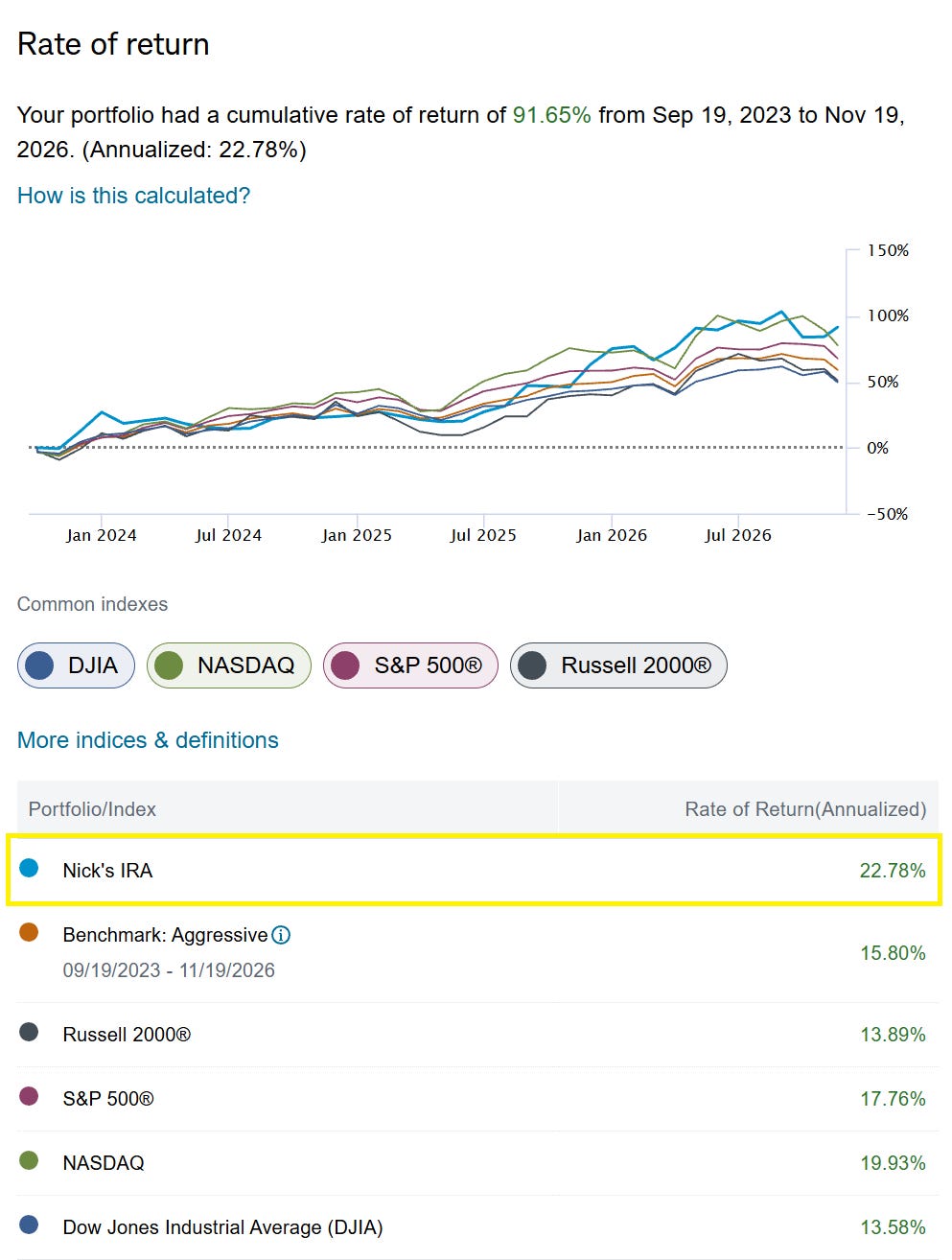
From September 19, 2023 – November 20, 2026, my portfolio has generated an annual return of 22.8% vs. 17.8% for the S&P 500, 13.6% for the Dow, and roughly 19.9% for the NASDAQ.
I am actually surprised by this outperformance since I would have expected a value investing strategy like mine to underperform during the last few years when AI stocks have been booming and value stocks in general have been out of favor.
My portfolio doesn’t have much exposure to AI/chip stocks, so it has held up relatively well despite the recent volatility in the markets.
2026 Year-to-Date Performance
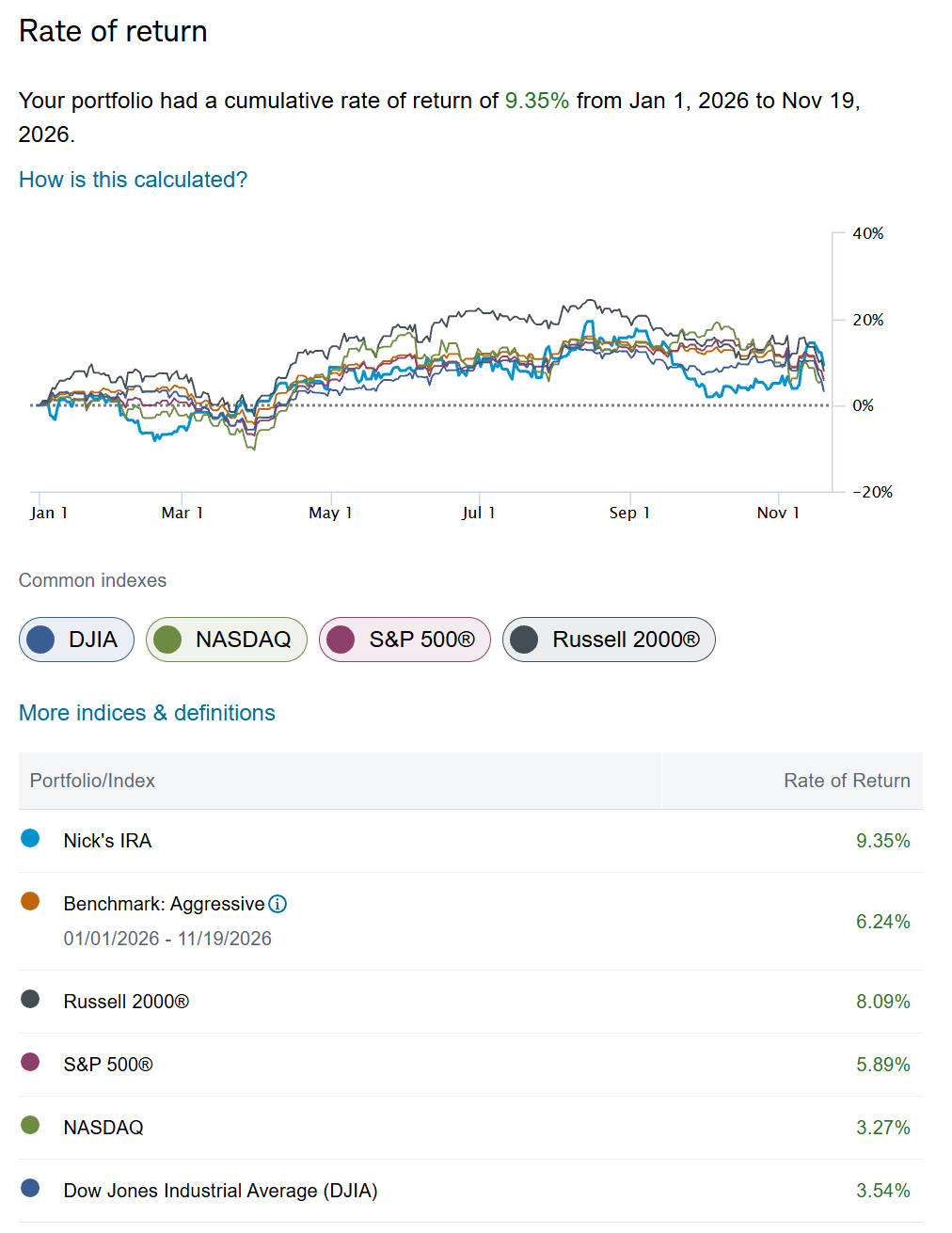
Year to date in 2026, my portfolio is up 9.35% as you can see below, which is ahead of the S&P 500, Dow, and NASDAQ.
While I think these results are satisfactory, three years is still too short of a timeframe in which to distinguish investing skill from luck. I don’t believe a few years of outperformance necessarily establish a durable investment edge. I believe at least five years is needed to evaluate a strategy like mine properly.
More importantly, the returns don’t tell the entire story. I’ve made several mistakes along the way, some of which have reinforced the importance of discipline, patience, and proper position sizing.
Performance of Previous Writeups
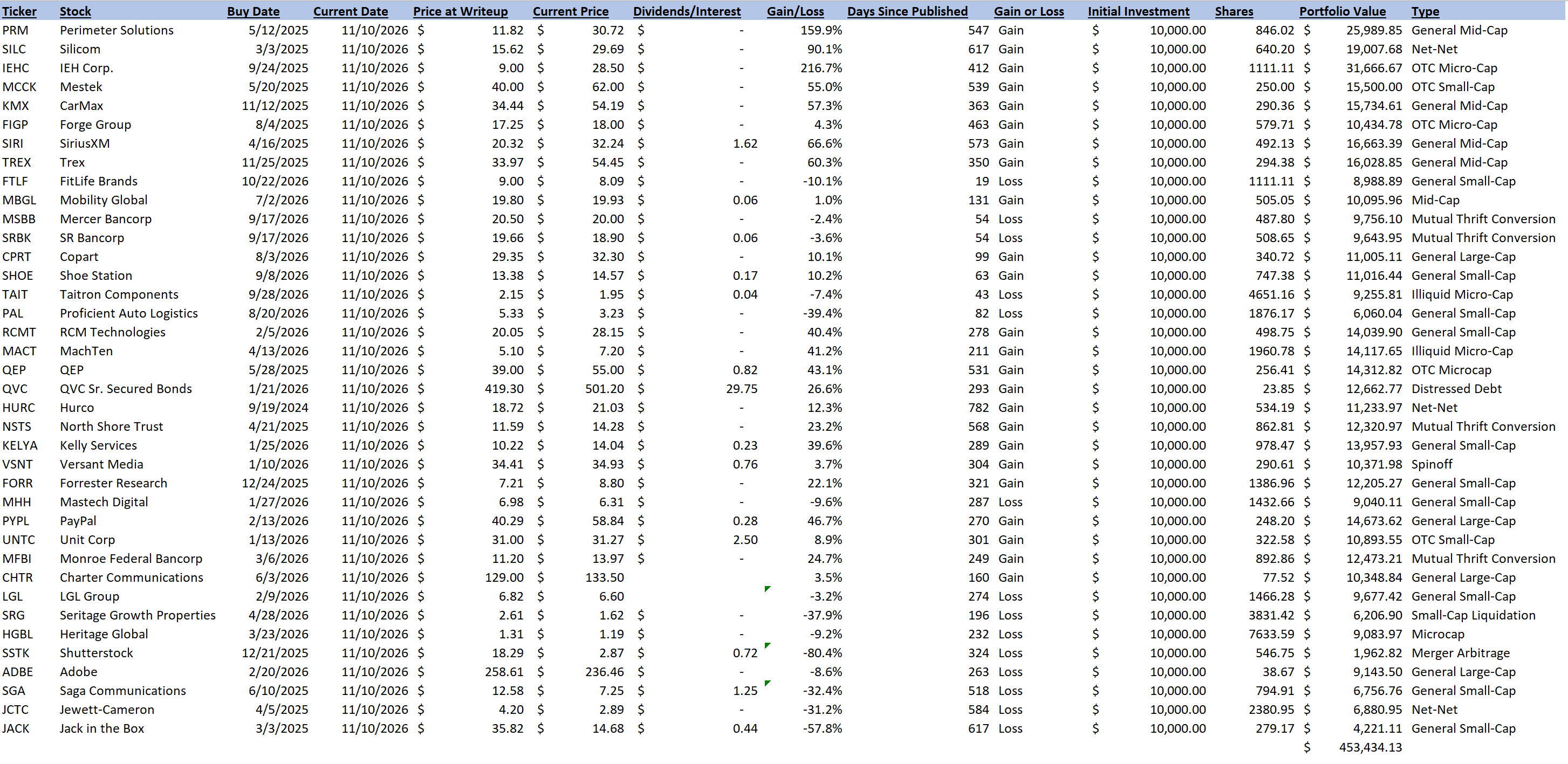
I ran an analysis of 38 stocks/bonds I previously wrote about on Substack. If an investor had put $10,000 in each stock on the day of the writeup, they would have realized about a 19.21% nominal return, or roughly 21.4% annualized taking into account the timing of each purchase. This was from the day of each writeup through November 10th, 2026.
Mistakes and Lessons Learned
Oversizing Positions Simply Because They’re Cheap
One mistake I’ve made a few times is allocating too much capital to businesses primarily because their valuations appeared exceptionally cheap.
Two examples that come to mind are Forrester Research and Versant Media.
Both appeared inexpensive relative to historical earnings power and estimated intrinsic value. However, I’ve increasingly come to appreciate that a low valuation alone doesn’t necessarily justify a large position.
While both stocks haven’t lost a lot of value (Forrester is up and Versant is roughly flat), both probably don’t justify a large position due the fact that I don’t have as much conviction in the long-term earning power of either business.
There is a meaningful difference between a great business trading at a reasonable discount and a mediocre or challenged business trading at an exceptionally low multiple.
The latter may offer substantial upside, but it also carries a greater risk of permanent capital impairment if the underlying business deteriorates.
I’ve developed a position-sizing framework that helps me balance conviction with risk. If a stock passes my initial checks, I typically begin with a 2–5% starter position. This gives me room to add as my understanding and conviction grow. If I’m wrong or the thesis breaks, the smaller initial position limits the damage to the overall portfolio.
Shutterstock is another big mistake I made. About a year ago, I wrote an article titled: Shutterstock: Heads You Win, Tails You Don’t Lose Much.
Boy, was I wrong on that one!
Shutterstock is down almost 90% since. Shutterstock’s stock has collapsed due to a combination of deteriorating fundamentals and mounting disruption risk. Generative AI has weakened demand for traditional stock imagery and made Shutterstock’s long-term competitive position increasingly uncertain. Those concerns became tangible in Q3 2026: revenue fell 33%, Content revenue declined 19%, and adjusted EBITDA dropped 47%. The failed Getty Images merger removed the expected benefits of greater scale and cost savings, triggering another sharp selloff. Shutterstock then suspended its dividend to prioritize debt reduction and financial flexibility—another signal that management expects continued pressure.
This is why I typically avoid merger arbitrage. I bought some shares in Shutterstock because I thought even if the merger broke that the stock looked undervalued and this turned out to be my biggest mistake over the last year. Luckily, I sold out of Shutterstock before the large drawdown and before the merger collapsed. One of the biggest risks for investors is investing in “value traps”, stocks that look absurdly cheap, but whose future earning power is significantly impaired. Shutterstock still appears extremely cheap, but the problem is that if earnings decline by 20% annually, then even paying 4x earnings likely won’t result in a great investment outcome.
Another stock I changed my mind on is Proficient Auto Logistics. The shares are down roughly 47% since my original write-up, and I underestimated how severely elevated diesel prices would pressure the business. The company also carries meaningful debt while working through the integration of a major acquisition, adding both financial and execution risk.
I still believe Proficient Auto could appeal to a deep-value investor with a high-risk tolerance, but I believe the uncertainty warrants a much smaller position than I initially believed.
Deep Value Stock with Declining Earnings vs. Quality Compounder at a Discount
Suppose you buy XYZ value stock for $4 per share—just four times its $1 of earnings. The company distributes all its earnings as dividends since it doesn’t have any attractive reinvestment opportunities, but earnings decline by 20% annually. Because the business continues to deteriorate, the market never awards it a higher multiple. After five years, the dividends and sale proceeds would merely return your original $4 investment, producing essentially no return.
Now consider ABC, a higher-quality company purchased at 11 times earnings. Assume it can grow earnings by 10% annually, has a long reinvestment runway and can maintain its competitive advantages. Since the company is growing, the market rewards it with a higher multiple. If the market values it at just 15 times earnings after five years, the investment will generate an annualized return of approximately 17%.
This illustrates why the lowest multiple does not always offer the best value. I would rather pay a reasonable price for a durable, growing business than own a shrinking company simply because it looks statistically cheap.
XYZ value stock
Purchase price: $4
Initial EPS: $1
Valuation: 4× earnings
Earnings decline: 20% annually
Payout ratio: 100%
Exit multiple: 4×
If the first $1 dividend is received after Year 1 and earnings begin declining afterward, the cash flows are:
$1.00, $0.80, $0.64, $0.512, and $0.410, plus a $1.638 sale price.
The annualized return is approximately 7.1%.
If earnings decline immediately and the first dividend is only $0.80, the annualized return is 0%.
ABC Quality Compounder at a Discount
At 11× initial earnings, with 10% annual earnings growth and a 15× exit multiple:
Without dividends: approximately 17.0% annualized
XYZ value stock is a deliberately harsh example.
Investors can still earn attractive returns from deep-value stocks, particularly when depressed earnings are cyclical or temporary rather than permanently impaired. The key is determining whether the low multiple reflects temporary pessimism or a business whose earnings power is structurally deteriorating.
A cheap stock can work extremely well if earnings stabilize—but a low multiple offers little protection when earnings continue to collapse.
Cutting Losses vs. Trying to Recover
Too many investors try to wait for a stock to recover in an effort to recoup their losses. I’ve found this to be an expensive mistake. If a stock is down due to deteriorating fundamentals or the thesis has broken, it’s better to cut your losses sooner and move on. Some of the biggest losses can occur when investors repeatedly average down into a deteriorating business. The market doesn’t care what your cost basis is, so I’ve found it best to cut losses quickly if the business performance has gotten materially worse.
Position sizing should reflect an investor’s conviction in the overall setup, including competitive position, management team, valuation, etc.
Business quality, balance sheet strength, competitive positioning, and confidence in normalized earnings all deserve consideration. Look down before you look up and think about downside risks more than how much you can make on a stock.
A stock trading at 3 – 4x earnings doesn’t necessarily deserve a larger allocation than a higher-quality business trading at 10 – 12x earnings. In fact, I would probably rather own a stock at 11x earnings that has a stronger balance sheet, generates higher returns on capital, and has a wide moat with a long reinvestment runway.
I’ve recently increased my cash position to about 11% in order to take advantage of future volatility in the markets. I may increase this cash allocation in the future. I believe there are many significant headwinds for equities in general over the next 12 - 18 months and my plan is to have dry powder available to take advantage of temporary drawdowns.
As always, thanks for reading and happy investing!
Congrats on your performance. I think you probably realize - based on your mistakes we all make - that you won't be doing a 20% cagr. But it's a wonderful target to shoot for and certainly will be 3-5 year periods you can do it.
Cutting losses as soon as possible is probably the most important skill to get there, because it allows you to redeploy cash into winners. Don't fall for 'thesis creep.' There's no bonus for trying to beat the market with a higher degree of difficulty.
Best of luck!